
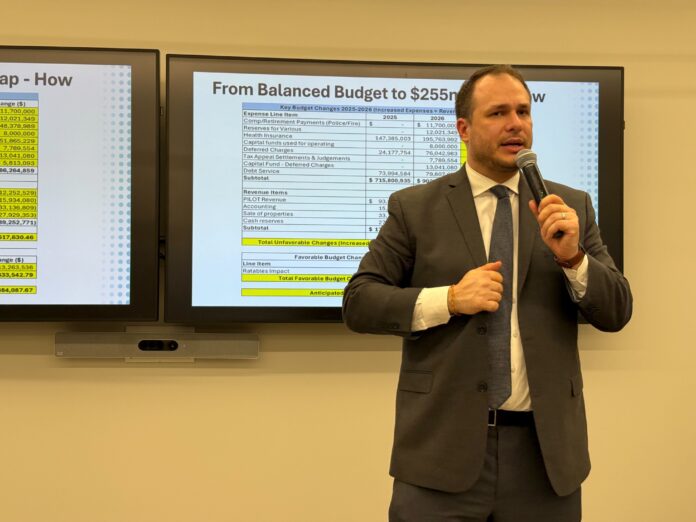

The state’s second-largest city will receive $120 million in state assistance under the FY27 budget package advanced by the Legislature on Sunday night, delivering to newly elected Mayor James Solomon the financial lifeline that his administration had been pursuing since January — when he walked into City Hall and discovered that the deficit he had inherited from his predecessor was not the $150 million his campaign had anticipated but something far more severe. The package, secured by State Senator Raj Mukherji and supported by Hudson County Executive Craig Guy and the entire Hudson County legislative delegation, consists of $105 million in long-term, low-interest borrowing authority and $15 million in transitional grants — a structure designed to spread the repayment of obligations accumulated under the previous administration over multiple years rather than requiring Jersey City to absorb them in a single budget cycle.
Governor Sherrill, Senate President Nick Scutari, and Assembly Speaker Craig Coughlin were the state-level partners whose support made the package possible, with Chief of Staff Alex Ball, State Treasurer Harold Aaron Binder, and Commissioner of Community Affairs Jacquelyn Suárez described by city officials as particularly engaged in the negotiations that produced the final framework. State officials expect the financial assistance to begin flowing within 30 days of the state budget’s enactment. Mayor Solomon, whose first formal municipal budget is scheduled for introduction to the City Council on July 15 with final adoption targeted for mid-August, called the package the result of historic leadership and an historic partnership — an investment in a city that was genuinely in danger of a fiscal collapse with regional and statewide consequences.
The Scope of the Problem Solomon Inherited
Before understanding what $120 million means to Jersey City, it is necessary to understand what $255 million means to a municipal government, because the scale of the deficit that Solomon discovered upon taking office in January 2026 has no close parallel in recent New Jersey municipal history. The figure represents approximately 28 percent of Jersey City’s entire annual budget — roughly a quarter of the city’s operating revenues, gone, in the form of a structural gap between what the city owes and what it takes in. For comparison, the municipal deficit that drove Detroit into the largest municipal bankruptcy in American history was proportionally smaller relative to that city’s operating budget. Jersey City’s crisis, while different in character and context, is of similar severity by the metrics that matter.
The deficit did not materialize overnight. Jersey City’s interim budget report, released by the Solomon administration in the first months of his tenure, is one of the most transparent acts of municipal financial disclosure in New Jersey in recent memory — a document that lays out, with specific dollar figures and documented sources, how the city arrived at a $255 million shortfall during what were ostensibly years of economic growth and development.
The core finding is that Jersey City under the Fulop administration came to rely on approximately $667 million in one-time, non-repeatable revenue sources to balance its budgets over the preceding six years. The tools were the standard instruments of fiscal evasion available to municipal governments: drawing down reserves, selling public land, borrowing to cover operating costs, and deferring known obligations into future years. The city entered 2026 owing approximately $52 million in unpaid healthcare claims that had accumulated and remained unpaid. The 2025 budget had been balanced in part using $33 million in one-time land sales that cannot be repeated. The financial picture that emerged from the Solomon administration’s review was of a government that had been borrowing from its own future to present an appearance of fiscal health that the underlying numbers did not support.
Former Mayor Steve Fulop — who departed City Hall to lead the Partnership for New York City and who has spent recent months publicly criticizing New York City Mayor Zohran Mamdani’s proposed tax increases — denied responsibility for the deficit and declined to comment on the financial disclosures his successor made. The absence of a substantive response from Fulop to a documented account of budget practices under his tenure has been noted by political observers in New Jersey, where accountability for municipal fiscal management has consequences that extend well beyond the boundaries of Hudson County.
What Solomon’s Team Did Before the State Got Involved
The $120 million in state assistance is the outcome of a months-long state negotiation, but it did not arrive before Solomon’s administration had already exhausted the measures available to an incoming mayor working within his own authority. The interim budget report documents $83.2 million in gross savings identified through administrative actions, reduced to approximately $55 million in net deficit reduction after accounting for $28.2 million in offsetting cost increases that the financial review surfaced. The gap at the time the state aid was being negotiated stood at approximately $200 million — down from $255 million, a meaningful reduction that gave the state a partner who had demonstrably done the available homework rather than simply presenting Trenton with a bill and asking someone else to pay it.
The specific measures Solomon implemented reflect the kind of across-the-board fiscal discipline that credible municipal crisis management requires. Department leaders were directed to reduce spending by 10 percent over time through efficiencies that would not harm public services. Public safety overtime was limited. Vacant positions were eliminated. The city’s health insurance program was switched from Horizon to Aetna, a change that produced meaningful savings on administrative costs. The Pompidou Museum project — a plan Fulop had advanced to bring a branch of the prestigious Paris institution to Jersey City, representing significant future financial commitments — was cancelled. Mayor Solomon reduced his own annual salary to $1. An audit of PILOT agreements — the payment-in-lieu-of-taxes arrangements that govern how developers contribute to municipal revenues in lieu of standard property tax assessments — was launched, with the goal of collecting what developers already owed and renegotiating terms that had failed to serve the city’s fiscal interests.
The PILOT audit is particularly significant because it addresses one of the structural elements of Jersey City’s fiscal imbalance that will persist beyond any one-time state assistance package. Jersey City has used tax abatements and PILOT agreements extensively as development incentives, a strategy that generated construction activity and economic growth while potentially underpricing the city’s contribution to that growth. The City Council’s role in reviewing and restructuring these agreements — some of which run for decades — will be a central element of the longer-term fiscal reform that Solomon has described as the harder part of the work ahead.
The Structure of the Aid Package and What It Actually Does
The $105 million in long-term, low-interest borrowing authority represents the bulk of the package and functions differently from a direct grant: the city is receiving the ability to borrow against a state-backed facility at rates that the private capital market would not offer to a municipality in fiscal crisis, spreading repayment obligations over a period that gives Jersey City’s budget the runway to implement structural reforms without being crushed by the near-term debt service load those reforms require.
The $15 million in transitional grants is the direct cash component of the package — money that does not need to be repaid and that addresses the most immediate, acute obligations the city faces before the borrowing facility can be accessed. Together, the two components represent a financing structure modeled on the precedents established for Atlantic City and Newark — two New Jersey cities that received state financial assistance during their own periods of fiscal distress and that have used varying combinations of state oversight, structural reform, and access to state-backed financing to stabilize their budgets over multi-year periods.
The comparison to Atlantic City is instructive but imperfect. Atlantic City’s fiscal crisis was driven primarily by the collapse of its gaming industry and the simultaneous flight of casino-related revenue that had been the city’s primary tax base. Jersey City’s crisis is different in character: the underlying city is economically vital, growing, and generating substantial tax revenue at every level of government. The problem is not that Jersey City’s economy is failing — it is that the previous administration’s management of the city’s finances failed to adequately capture and retain the revenue that the city’s economic vitality was generating, while simultaneously building obligations that the actual revenue base could not sustain.
Senator Mukherji and the Economic Argument That Won the Case
The advocacy that produced the state aid package was led primarily by State Senator Raj Mukherji, who represents Jersey City in the Senate and who spent months building the case that the financial assistance request was not a bailout of a poorly managed municipality but an investment in the largest single generator of state tax revenue in New Jersey. The economic argument Mukherji made to state officials is compelling on its face: Jersey City generates an estimated $1.3 billion annually in state income, sales, and business taxes — approximately 3.1 percent of New Jersey’s major tax collections from a city that represents roughly 3 percent of the state’s population. The city’s growth trajectory has provided the state with approximately $400 million more in annual revenue than it would otherwise have received. The proposition, as Mukherji framed it, is that allowing the state’s most productive economic engine to enter a fiscal death spiral — triggering a 31 percent property tax increase, deep cuts to municipal services, and the potential departure of residents and businesses for other jurisdictions — would impose costs on the state budget that would dwarf the $120 million investment in stabilizing it.
Mukherji’s position was not universally embraced in Trenton. Republican legislators pushed back on the assistance on both substantive and political grounds. Senator Mike Testa of South Jersey published an open letter criticizing the transitional aid program and suggesting that state assistance should be distributed on a per-capita basis rather than concentrated in the state’s largest cities. Assemblywoman Dawn Fantasia questioned how Solomon, who had served as a City Councilman for eight years before becoming mayor, could claim to have been blindsided by the deficit. The critique reflects a legitimate question about the information available to council members during the Fulop years and the degree to which the financial practices that produced the deficit were visible to elected officials who were not controlling the executive budget process. The Solomon administration’s answer is that the full picture was not available until the independent financial review it commissioned after taking office, and that the structures through which one-time revenue was being used to cover operating costs were not transparent to outside observers examining only the formal budget documents that had been presented to the council and the public.
Hudson County Executive Craig Guy brought significant political capital to the negotiations, spending months in meetings, phone calls, and conversations with Governor Sherrill’s administration that he described as requiring a considerable amount of effort and diplomacy to bring to resolution. Guy’s characterization of the final result — difficult, unforeseen, requiring real partnership — is consistent with how every participant in the negotiation has described the process, and his specific acknowledgment of Sherrill’s role is significant given that this was her first major municipal fiscal crisis as governor and one that involved significant political risk.
What the State Aid Does Not Solve
The explicit acknowledgment by Solomon and his team that the $120 million resolves the acute crisis without addressing the chronic one is the most important contextual element of the announcement, and it is credit to the administration’s transparency that they have made that distinction in every public statement about the package.
Jersey City faces a recurring structural deficit estimated at approximately $90 million annually — the gap between what the city spends on an ongoing basis and what it collects in revenue on an ongoing basis, independent of the one-time obligations accumulated under the previous administration. The state aid package addresses the one-time obligations. The structural deficit is a separate problem requiring a combination of spending reductions and revenue increases that will play out over multiple budget cycles.
Solomon put it directly: this $120 million enables the city to pay off the former mayor’s debts over years and allows the administration to focus on fixing the structural deficit. The hard part comes next — closing a $90 million annual gap between spending and revenue while striking a balance between reducing the financial burden on Jersey City families and avoiding cuts to the city workers who keep the city running. That framing is both honest and sobering: the state aid avoids the worst-case scenario of a 31 percent tax increase and devastating cuts to public services in a single year, but it does not eliminate the need for a significant property tax increase as part of the 2026 budget, and it does not resolve the fundamental mismatch between what Jersey City promises its residents and what it currently collects to deliver those promises.
The 2026 municipal budget to be introduced July 15 will require the City Council to confront those choices explicitly. Solomon had previously proposed a 20 percent municipal tax rate increase — a proposal he pulled when it became clear the council votes were not there — and will need to bring a revised proposal to the council that reflects both the state aid’s contribution and the remaining gap that other revenue and spending measures must address. For Jersey City residents — renters who face pass-through costs when landlords face higher property taxes, homeowners on fixed incomes, working families whose budgets have been stretched by years of inflation — the specifics of that budget will determine what the state aid actually means for their household finances.
Jersey City in New Jersey’s Economic Ecosystem
The state aid package secured through the FY27 budget is, in the framing of its primary advocates, an act of enlightened fiscal self-interest by the state of New Jersey as much as it is an act of generosity toward its second-largest city. Jersey City’s economic contribution to the state is not in dispute: the tax revenue it generates, the private-sector employment it supports, the economic activity it anchors in Hudson County and across the broader metropolitan region are all substantial and documented. A Jersey City in fiscal collapse — with reduced municipal services, a degraded quality of life, and a political crisis over who bears the cost of a generation’s worth of financial mismanagement — is not just a problem for Jersey City residents. It is a problem for New Jersey’s tax base, its economic trajectory, and its credibility as a stable environment for the investment and development that produce prosperity.
Whether the 2026 state budget’s investment in Jersey City’s stability will be validated by the city’s subsequent performance depends entirely on whether the Solomon administration’s structural reform agenda — the PILOT audit, the spending discipline, the developer accountability measures, the longer-term revenue restructuring — produces the results it projects. The $120 million provides the runway. The structural reforms provide the destination. The schedule Solomon has laid out — a full budget by July 15, council adoption by mid-August, state assistance flowing within 30 days of the budget’s enactment — is ambitious enough to indicate that his administration understands the urgency and is not treating the state aid as a substitute for the harder work that follows.
For New Jersey, the question the Jersey City situation ultimately poses is one that applies beyond Hudson County. How did the state’s system of municipal fiscal oversight fail to identify and intervene in the accumulation of $667 million in one-time revenue use over six years at a major city? What mechanisms exist — or should be created — to prevent a similar accumulation of deferred obligations from producing another crisis of this scale at another New Jersey municipality? The answer to those questions will determine whether the Jersey City package is a one-time intervention in an unusual situation or a preview of the kind of fiscal triage that New Jersey may need to perform with increasing frequency as more municipalities reach the limits of the financial management practices that have historically sustained them.
















