
Every June, the conversation about what a hockey organization actually is — what its values look like on the ice, what kind of players it wants to build, what philosophy guides the countless developmental decisions that eventually determine who appears on an opening-night NHL roster three or four years down the line — moves from the theoretical to the observable. The New Jersey Devils’ 2026 Development Camp, running from Sunday, June 28 through Wednesday, July 1 at the RWJBarnabas Health Hockey House at Prudential Center in Newark, is that moment for an organization in active transition. With first-year General Manager Sunny Mehta having just completed his inaugural draft, his class of seven new prospects joins select members of the 2025 draft class for four days of on-ice sessions that will provide the development staff, the coaching staff of the Lehigh Valley Phantoms, and anyone paying close attention with the first sustained look at these players in a New Jersey context.
Development camp is not the regular season. It is not even training camp, where roster decisions are made and competitive pressure governs every shift. It is something different — a structured educational environment whose purpose is to accelerate the introduction of prospects to professional standards, to expose developmental gaps that the coming months of individual and team training can address, and to begin the relationship-building between prospects and the organization’s player development apparatus that will carry these players through the years between their draft day and their NHL debut. The stakes, measured by the scoresheet, are minimal. Measured by what the organization learns and what the players learn, they are substantial.
The Headline Arrival: Alexander Command and What the Devils Are Building Toward
The most-watched player at this year’s camp is the most obvious choice: Alexander Command, the 6-foot-1 Swedish center selected 12th overall in last week’s draft, wearing number 17 and making his first appearance in a New Jersey context after what must have been one of the most emotionally compressed weeks of his life. Command was picked, flew to New Jersey, attended the post-draft media availability, and now skates at the same facility where Nico Hischier — the player to whom he has most frequently been compared by draft analysts — practiced throughout his career as the franchise’s captain.
That comparison, and Command’s ability to either live up to it or reframe it over the coming years, begins here in a small way. Development camp is not the venue where legacies are established. But it is where organizations get their first direct look at a prospect’s skating in person, at how he receives instruction, at how he competes in the informal scrimmage environment that camp’s on-ice sessions generate, and at how he carries himself in a professional setting for the first time. The intelligence and compete level that the Devils’ scouting staff identified in Command during the season — the qualities that produced 44 points in 30 games at Örebro HK’s U20 program and a gold medal at the World Under-18 Championship — are the same qualities that show up in practice environments. Development staff members watch for them intently.
Command’s path from camp through his development will almost certainly involve continued play in the Swedish Hockey League before a North American transition — a timeline that is standard for European prospects of his profile and that allows the physical and technical maturation to continue in a professional environment without the pressure of NHL readiness. But that path starts here, at the Hockey House in Newark, skating alongside other prospects in his first official week as a member of the New Jersey Devils’ organizational family.
The Full Roster: Two Draft Classes Together
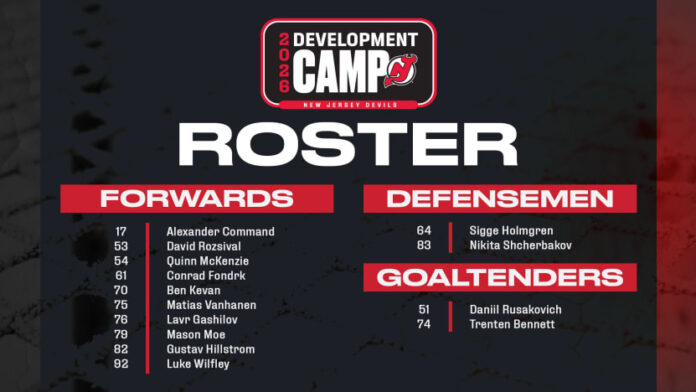
The 14-player development camp roster that the Devils assembled brings together the six members of the 2026 draft class alongside eight prospects from the 2025 class — a roster composition that creates an interesting dynamic on the ice. The 2025 players bring an additional year of professional development context to the sessions, while the 2026 players bring the energy and the uncertainty of having literally just learned which organization they belong to. The interaction between those two groups — the slightly older prospects who have already been through one development camp and have some sense of what the organization wants, and the newest arrivals who are forming their first impressions simultaneously — is part of what makes development camp a useful organizational exercise beyond its formal on-ice content.
Among the forwards in camp, the 2026 class is represented by Command at number 17, Finnish wing Matias Vanhanen at 75 (second round, 37th overall), Russian center Lavr Gashilov at 76 (fourth round, 119th), Luke Wilfley at 92 (sixth round, 172nd), and Quinn McKenzie at 54 (seventh round, 222nd). The 2025 prospects joining them include Conrad Fondrk at 61, Ben Kevan at 70, Mason Moe at 79, and Gustav Hillström at 82.
Vanhanen’s presence is particularly notable among the camp’s forward group. The Finnish wing who passed over in the 2025 draft before spending the 2025-26 season with the Everett Silvertips of the WHL — where he posted 87 points in 62 regular-season games and helped Everett win the WHL Championship — arrives as the camp’s most statistically decorated prospect. His rapid adaptation to North American hockey, his playmaking at an elite rate, and his performance through the Silvertips’ Memorial Cup run give him a developmental head start on much of the camp’s forward group, and watching how he plays alongside Command will be one of the more interesting individual storylines of the four days.
On the defensive side, the 2026 class contributes Nikita Shcherbakov at number 83 — the 6-foot-5 Russian defenseman taken 44th overall who brings the most imposing physical profile in the entire camp alongside skating qualities that scouts identified as exceptional for his size. Joining him on the blue line from the 2025 class are David Rozsíval at 53 and Sigge Holmgren at 64. Between the pipes, 2026 fifth-round pick Daniil Rusakovich wears number 51, joined by 2025 prospect Trenten Bennett at 74.
The RWJBarnabas Health Hockey House: What This Facility Represents
Development camp’s location — the RWJBarnabas Health Hockey House at Prudential Center in Newark — is not incidental. The facility serves as the New Jersey Devils’ primary practice and development venue, situated within the complex that houses the arena where the franchise plays its home games. For prospects arriving at their first development camp, practicing at the Hockey House carries a specific psychological weight: this is where Nico Hischier, Jack Hughes, and the franchise’s current NHL players work each day. This is the ice surface where the gap between where a prospect is now and where the organization hopes he will be is most physically apparent.
The facility has been home to the Devils’ year-round development programming, the Cross-Ice Development League that introduces young local players to the game, and the annual tradition of development camp sessions that go back through multiple generations of Devils prospects. Its integration with Prudential Center means that prospects at development camp can see the arena from the practice facility, can hear the ambient sounds of a building that hosts one of the NHL’s oldest franchises, and can begin forming the visceral sense of what it means to play for this organization in this city. That sense — often described by players who eventually make the NHL as something they carry from their first development camp through their careers — is one of the intangible things organizations build at events like this one.
The camp sessions will include both formal on-ice instruction and the informal competitive elements — scrimmages, drills, small-area games — that give development staff members the observational data they will carry back into their evaluations for the coming year. Past Devils development camps have also included community engagement components, with prospects visiting hospital partners of RWJBarnabas Health and participating in community-oriented activities that introduce them to the Newark community the franchise calls home. Those components, when they are part of the program, serve a developmental purpose that extends beyond hockey skill: they establish early that the New Jersey Devils’ organizational identity includes genuine engagement with the community that hosts it.
The NHLCA Coaching Participants: Two Programs Worth Understanding
Among the most distinctive elements of this year’s development camp are two coaching additions drawn from the National Hockey League Coaches Association’s formalized diversity programs — individuals who bring perspectives and expertise that standard development camp staffing does not typically include and that reflect the league’s ongoing effort to broaden the pipeline of coaching talent available to NHL organizations.
Kelly Nash, the head coach of Long Island University’s women’s hockey program, joins the camp’s bench staff through the NHLCA’s Female Coaches Development Program — an initiative designed to create meaningful professional development opportunities for female coaches in an environment historically dominated by men at every level of the coaching hierarchy. Nash’s presence in a Devils development camp context is both an opportunity for her to develop professional relationships and gain exposure within the NHL organizational structure and a signal from the Devils that they take the NHLCA’s inclusion commitments seriously enough to make them tangible rather than simply stating them.
Dennis Ruppe, the Manager of Hockey Operations for Hockey in New Jersey — the state’s primary amateur hockey development organization — joins through the NHLCA’s BIPOC Coaches Program, which creates similar pathways for coaches from Black, Indigenous, and other communities of color. Ruppe’s connection to Hockey in New Jersey gives his participation a specific local dimension: he is embedded in the amateur hockey development ecosystem that the Devils exist within and benefit from, and his experience building hockey programming for young players in New Jersey carries direct relevance to how the organization thinks about the pipeline between youth hockey in this state and the NHL.
Both coaching participants represent the NHL’s recognition that the game’s long-term health depends on broadening the pathways into leadership positions across every dimension of the sport — not as a token acknowledgment of diversity but as a genuine developmental investment in the coaches whose presence in elite hockey environments generates the professional networks, the mentorship relationships, and the practical experience that allow them to advance within the sport. Including them at the same table where a 12th overall draft pick is being evaluated for the first time says something specific about the organization’s values, and that specificity is worth noting.
What Development Camp Is and Is Not
The four days that run from June 28 through July 1 will produce no definitive verdicts. Alexander Command will not establish himself as a certainty for the NHL roster by skating well on Tuesday. Matias Vanhanen will not secure a spot in the opening-day lineup by dominating a scrimmage. Nikita Shcherbakov will not transform from an international junior player into a professional defenseman between Sunday and Wednesday. Development camp is too short, too low-stakes, and too removed from the competitive context of professional hockey to produce reliable outcomes data at that level.
What it does produce is something more modest and more valuable for an organization’s development staff: a baseline. The first look at how Command’s skating translates from European junior ice to a North American professional facility. The first assessment of how Vanhanen carries himself in a new environment after relocating once already for the WHL. The first observation of how Shcherbakov’s 6-foot-5 frame navigates professional-pace skating drills against other high-level prospects. The first extended interaction between these players and the Devils’ development staff, which must now begin the four-or-five-year relationship that will determine how each player’s potential is either realized or unrealized.
Mark Dennehy, the Devils’ Chief Amateur Scout who led the scouting effort that produced this class, described the organization’s draft philosophy in terms that apply equally to development camp: the goal is to find the highest-ceiling player, using every available data source — scouting observations, analytics, psychological assessment, physical testing — to understand a prospect fully enough to project where he is going rather than simply where he has been. Development camp is the first opportunity to apply that same comprehensive evaluation within the organizational environment, with the development staff running their own set of assessments that go beyond what external scouting can observe.
The Hockey House sessions that run through July 1 will close the book on the Devils’ most eventful offseason in recent memory — a summer that included Sunny Mehta’s appointment as general manager, the trade that sent Simon Nemec and Maxim Tsyplakov to Calgary for Etienne Morin and significant draft capital, and now a seven-player draft class built around a Swedish two-way center who has been drawing Nico Hischier comparisons since the moment his name was called in Buffalo. For New Jersey Devils fans, development camp is the first tangible installment on all of those investments — not a promise of what is coming, but the beginning of the process by which what is coming gets built.
The public is invited to watch the on-ice sessions at the RWJBarnabas Health Hockey House during the camp’s run. The facility is adjacent to Prudential Center in downtown Newark, accessible by NJ Transit rail to Newark Penn Station. For anyone who wants to see Alexander Command on the ice for the first time as a member of the New Jersey Devils’ organizational family, the window is open through Wednesday, July 1.