
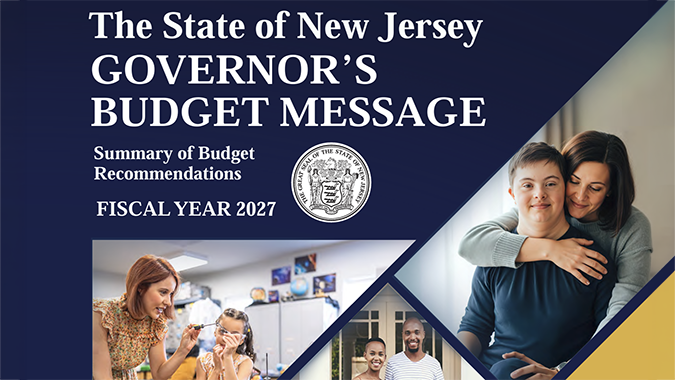

The ink was barely dry on Sunday night’s late-night committee votes advancing New Jersey’s $60.7 billion Fiscal Year 2027 budget when the state’s largest and most influential business advocacy organization issued a formal response that pulled no punches. The New Jersey Business and Industry Association, which represents more than 20,000 businesses and employers across the state, delivered a statement from President and CEO Michele Siekerka that acknowledged modest progress while making unmistakably clear that, from the perspective of the private sector job creators who employ millions of New Jersey workers, the final budget arriving at Governor Sherrill’s desk for signature tomorrow carries the same fundamental problem as every budget it preceded. In Siekerka’s own words: “The bottom line for the business community is we are still under attack.”
The NJBIA statement, released Monday morning following the Senate and Assembly budget committees’ party-line approvals, represents the most substantive formal critique of the FY27 budget from a constituency that does not vote on it but that absorbs its consequences through changed tax obligations, altered hiring incentives, and the cumulative signaling effect that each year’s budget decisions send to the companies considering whether New Jersey is a place to expand, stay, or leave. It also represents a characterization of the final budget that is, in several important respects, more honest about its compromises and costs than the Democratic leadership’s own framing in their joint statement celebrating the deal.
What NJBIA Is Acknowledging: The Credit It Is Willing to Give
The business community’s critique of the FY27 budget is not across-the-board condemnation, and the NJBIA statement is careful to distinguish between what it sees as genuine progress and what it views as persistent problems. Understanding the distinction matters, because it illuminates which elements of the budget the state’s employer community views as defensible and which it views as policy failures that will compound in future years.
Siekerka credited the budget for demonstrating a genuine effort to find efficiencies and to keep overall spending relatively flat compared to the previous fiscal year — a restraint that the organization specifically contrasted with what it described as massive spending increases from the previous eight years of unsustainable budgets under Governor Murphy. That framing is the NJBIA’s consistent fiscal argument: that New Jersey’s structural deficit crisis was created over multiple budget cycles by spending commitments that outpaced the revenue base, and that addressing that crisis requires genuine spending discipline rather than the perpetual reliance on new revenue sources that has defined the state’s recent fiscal history.
The statement also noted that the number of current-year budget additions — the legislative earmarks and locally targeted spending items advanced through the supplemental spending bill — was lower than in typical years, though still too many in NJBIA’s assessment. The organization specifically praised the inclusion of funding for Governor Sherrill’s Saving Time and Money agenda — the regulatory reform and permitting streamlining initiative that the business community has supported as one of the most practical and consequential pro-growth moves a New Jersey administration can make — and welcomed the inclusion of New Jersey Manufacturing Extension Partnership funding as a specific investment in the state’s manufacturing sector.
The acknowledgment of these positives reflects the evolution in NJBIA’s relationship with the Sherrill administration compared to its posture toward the Murphy years. When Sherrill delivered her March budget address, Siekerka described it as an attentive budget developed through a transparent process — language that was conspicuously absent from any characterization of recent prior years’ budgets. The March statement emphasized that the budgetary challenges were not being thrust exclusively onto the business community for the first time in recent memory, and that a better balance between spending cuts and tax changes was being struck. Sunday night’s statement is harsher in tone but consistent in its underlying analytical framework: this governor is trying to do the right things, and some of the right things are actually happening, but the budget that emerged from the legislative process still raises taxes on business in ways the organization cannot support.
The Three Tax Provisions That Define the Business Community’s Grievance
The NJBIA’s substantive objections to the FY27 budget are concentrated around three specific revenue-raising measures that survive in the final agreement, in some cases in modified form, but that the organization argues collectively constitute another round of tax increases on New Jersey’s already overburdened business community.
The Net Operating Loss limitation, which caps all NOL deductions under the Corporation Business Tax at $1 million annually for tax years 2026 through 2028, is projected to generate approximately $485 million in state revenue over the three-year period. Net operating loss carryforward provisions are a foundational element of tax policy for capital-intensive businesses and for enterprises in early growth phases, because they allow companies that sustain losses in a given year to apply those losses against future profits, reducing tax liability in ways that make long-term investment planning more predictable and rational. The temporary cap does not eliminate the NOL deduction — it limits it — but the NJBIA’s chief government affairs officer, Christopher Emigholz, has made the argument throughout the budget process that even a temporary cap sends the wrong signal to the corporate decision-makers who are evaluating New Jersey as a location for investment and operations. The message it sends, in Emigholz’s framing, is that New Jersey is not a safe and predictable business environment — that the rules governing the relationship between the state government and its corporate taxpayers can change without warning and to the corporation’s disadvantage. That predictability concern, repeated consistently by business advocates, is not simply rhetorical. Site selection and capital investment decisions are made against multi-year financial models, and a state that has demonstrated willingness to alter fundamental tax provisions retroactively — even temporarily — introduces a risk premium into those models.
The elimination of the Alternative Business Calculation deduction, commonly known as the ABC deduction, for pass-through businesses with gross income of $1 million or more is the provision that most directly affects small and mid-size New Jersey businesses rather than large corporations. Pass-through businesses — sole proprietorships, partnerships, S corporations, and limited liability companies that pass their income through to the owners’ personal income tax returns rather than paying corporate income tax — rely on the ABC deduction to achieve parity with corporate taxpayers who face different effective rates on business income. The provision was created through bipartisan legislation specifically to address that disparity. Its elimination for businesses grossing above $1 million effectively raises the tax burden on a very large number of what would conventionally be called small businesses, because $1 million in gross revenue, as NJBIA pointed out in committee testimony, is a threshold that a gas station with a couple of employees reaches quickly. The gross revenue threshold is not a net profit threshold — it measures top-line revenue, not what the owner takes home — and its application at $1 million captures a significant portion of the retail and service businesses that form the backbone of New Jersey’s local economies.
The Employer Healthcare Assistance Contributions — the per-employee fee on businesses with 50 or more workers enrolled in NJ FamilyCare rather than an employer-sponsored health plan — is the provision that generated the most sustained advocacy throughout the budget process and that survived the final negotiation in a modified form. The original proposal assessed fees ranging from $325 to $725 per enrolled employee annually. The modifications in the final agreement adjusted the structure, but the fundamental mechanism survived: large employers whose workforce includes employees who rely on Medicaid rather than employer-provided health insurance will face a new financial obligation beginning in the coming fiscal year.
Siekerka’s statement on this provision is notable for its specificity and its acknowledgment of where the negotiation landed. She said that compromises were made on the per-employee fee, but that many job creators will still be penalized for something they have little to no control over — and that, yes, workers on Medicaid will still be impacted. The last clause is the most pointed element of the statement, and the most important: NJBIA is arguing that the fee creates incentives for employers to avoid hiring workers whose economic circumstances would place them in Medicaid eligibility ranges, and that those incentives will ultimately harm the workers the fee was ostensibly designed to help. The argument is not that the problem of employers shifting health costs onto public programs is imaginary — the data on Medicaid enrollment by employer is real and the cost to taxpayers is real. The argument is that the mechanism chosen to address it will produce unintended consequences that reverse the intended benefit.
The Climate Superfund and the Fair Price Protection Act: Two Additional Flashpoints
Beyond the three core tax provisions in the budget itself, the NJBIA statement reserves some of its most forceful language for two pieces of legislation advancing simultaneously with the budget process that the organization views as compounding the business climate damage the budget itself creates.
The Polluters Pay Act — which would establish a $50 billion climate adaptation fund through assessments on fossil fuel companies responsible for more than one billion metric tons of covered greenhouse gas emissions between 1995 and 2024 — received what amounts to the most emphatic language in the entire NJBIA statement. Siekerka described it as one of the worst business policies in New Jersey history, which is no small task in our state — a phrase that acknowledges the competition for that designation in a state with one of the nation’s most restrictive regulatory and tax environments. The NJBIA’s specific objections extend from the constitutional (the organization views retroactive liability as a fundamental legal infirmity), to the economic (projected job losses and damage to refinery operations and connected industries), to the consumer impact (energy cost increases that would affect every New Jersey household and business over the assessment period). Deputy Chief Government Affairs Officer Ray Cantor, in a separate statement released during the budget process, described the bill as an unconstitutional attempt to retroactively penalize businesses that legally provided an essential product used by everyone.
The Fair Price Protection Act, which was advanced as a consumer protection measure, drew NJBIA criticism from a different direction. The organization argued that instead of using the legislative vehicle to explicitly protect consumers from the cost increases that business tax changes might generate — a provision NJBIA had advocated for — the Legislature advanced a version of the bill that the organization says compromises the very cost-saving programs that consumers rely on. The critique reflects the organization’s underlying argument about what responsible regulation looks like: if the state is going to impose new costs on businesses, it should simultaneously act to ensure those costs are not simply passed through to consumers. The version of the Fair Price Protection Act that advanced, in NJBIA’s assessment, does not accomplish that goal.
The Structural Argument: Gimmicks and the Next Deficit
Underlying the NJBIA’s specific objections is a structural fiscal argument that Siekerka has been making consistently for years and that the FY27 budget process has not resolved. The concern, stated directly in Monday’s release, is that the budget uses fiscal gimmicks to fund new spending commitments, which inherently creates a larger structural deficit entering next year’s budget cycle. The gimmick framing is pointed: it describes the use of one-time revenue sources, shifted accounting categories, and timing manipulations that make the current year’s numbers add up while deferring underlying imbalances to future budgets.
The structural deficit that Sherrill inherited — estimated between $3 billion and $4 billion at the start of the year — has been cut roughly in half in the FY27 agreement. That is real progress and the NJBIA acknowledges it. But a structural deficit that has been cut in half rather than eliminated is still a structural deficit, and the specific mechanism by which the remaining gap is papered over — to the extent that gimmicks rather than genuine structural reforms account for part of the balancing — will determine whether the FY28 budget process begins from a better or worse fiscal position than the one that produced Sunday night’s marathon committee sessions. If the gimmick characterization is accurate, the answer is worse.
The NJBIA’s closing argument is the one it has been making, in various forms, across successive administrations: rather than continuing to add costs and burdens to job creators both small and large, policymakers should embrace real reforms. The reforms the organization consistently identifies include pension and benefits system structural changes, pro-growth spending prioritization, and a regulatory environment that provides the predictability and consistency that businesses require to make the long-term investment decisions that generate employment and tax revenue. The budget that will arrive on Sherrill’s desk tomorrow does not, in the NJBIA’s assessment, move meaningfully toward any of those reforms. It cuts the structural deficit, maintains key investments in education and pensions, and protects the surplus. But it funds those objectives in part by making New Jersey more expensive to do business in, and that outcome, after what NJBIA describes as eight years of the same pattern, is the foundation of the organization’s declaration that the business community remains under attack.
What the Business Community Will Be Watching Next
The NJBIA’s statement is Monday morning’s assessment. But the budget cycle does not end when the governor signs the bill — it continues through the implementation of the new provisions, the litigation that the Climate Superfund Act would generate if enacted, the employer responses to the Medicaid assessment’s new financial obligations, and the layoff announcements and relocation decisions that the business community’s economic models predict as consequences of the combined tax burden.
New Jersey started 2026 with more than 4,700 notable layoffs announced in the first three months, and by late June, that number had climbed above 8,100. The business community’s advocates will be watching whether those numbers change direction in the coming months, and whether any acceleration in layoff activity or any high-profile corporate relocation decision becomes directly attributable to the tax provisions that became law with the governor’s signature. That tracking — of actual economic outcomes against predicted consequences — is how the FY27 budget’s business tax provisions will ultimately be evaluated, not by the budget committees that voted on them Sunday night, but by the companies and workers whose economic futures they shape.
For Governor Sherrill, the calculus is different but related. Her administration has consistently argued that the budget’s investments in education, pensions, and healthcare coverage — sustained at full funding levels despite a structural deficit that made sustaining them genuinely difficult — are what make New Jersey’s economy resilient and its workforce attractive to employers. The argument is that a state with excellent schools, funded public pensions, and a reliable healthcare safety net is a better place for businesses to locate and retain workers than one that has cut those investments to provide tax relief. The NJBIA’s argument is that the same businesses those investments are supposed to attract are being taxed to fund them in ways that make the attraction calculation negative rather than positive. That disagreement, fundamental and unresolved, is the organizing tension of New Jersey’s economic policy debate heading into the FY28 budget cycle, which begins, effectively, the moment Sherrill signs this one.
















