

The National Weather Service has issued an Extreme Heat Watch covering all 21 New Jersey counties, and the language in the official forecast from the NWS Philadelphia and Mount Holly office leaves no room for misinterpretation. Confidence is increasing, the service stated this weekend, that multiple days of near-record-breaking heat and humidity will impact the region beginning Wednesday through the Fourth of July holiday weekend. High temperatures will be well in the mid-90s to as high as 105 degrees. Maximum heat index values — the combined measure of temperature and humidity that reflects what the human body actually experiences — will reach between 100 and 110 degrees for multiple consecutive days. Multiple temperature records for July 2nd and 3rd could be challenged or broken. Overnight temperatures will provide little relief, with lows in the 80s in urban areas on Thursday and Friday nights.
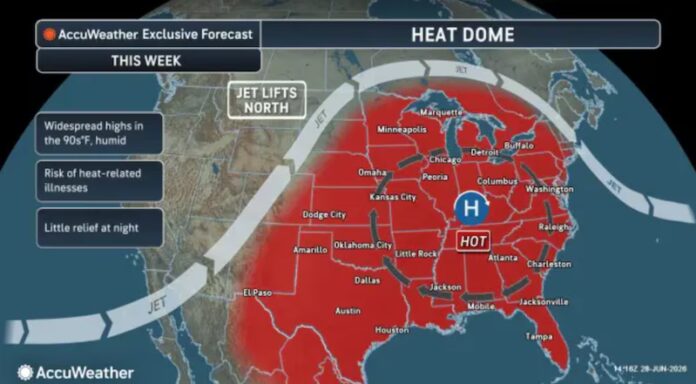
This is not a standard summer hot stretch, and it is not a situation in which the ordinary advice to stay hydrated and avoid the midday sun is a sufficient public health response. It is a multi-day atmospheric event that will place every vulnerable person in New Jersey — the elderly, the very young, outdoor workers, people without air conditioning, people with cardiovascular and respiratory conditions — at genuine risk of heat stroke, heat exhaustion, and death. The heat dome building over the northeastern United States this week is being described by meteorologists as the most significant heat event of 2026, and the Extreme Heat Watch is the most serious level of alert the National Weather Service issues before the event arrives.
What an Extreme Heat Watch Means and Why It Matters
Federal weather alert terminology follows a hierarchy that reflects the increasing certainty and severity of an incoming hazard. An Extreme Heat Watch — as opposed to a Heat Advisory or an Extreme Heat Warning — is issued when conditions necessary for an extreme heat event are expected but have not yet occurred. The Watch is a planning tool: it tells emergency managers, public health officials, hospital systems, transit operators, utility companies, and ordinary residents that a serious event is coming, that the forecast confidence is high enough to trigger formal preparedness actions, and that the window to prepare — to open cooling centers, to check on neighbors, to stock water, to adjust outdoor work schedules — is open and should be used.
When the NWS issues a Watch covering all 21 New Jersey counties simultaneously, it is communicating that there is no part of the state that will escape what is coming. The distinction that sometimes applies in heat events — coastal communities tempered by sea breezes, elevated inland areas cooled by altitude — is not operating in a meaningful way this week. The atmospheric pattern producing this event is a heat dome: a high-pressure ridge that has locked into position over the eastern United States, trapping hot air beneath it and preventing the frontal systems that would otherwise bring cooler, drier air from penetrating the region. Under a heat dome, daytime temperatures accumulate over successive days rather than recovering overnight, which is why the most dangerous aspect of this event is not Thursday’s peak temperature but the sustained character of the heat from Wednesday through Saturday.
The New Jersey state record for high temperature is 110 degrees Fahrenheit, set at Runyon on July 10, 1936 — a record that was set during the most catastrophic heat wave in American history, a summer that killed thousands across the nation. The heat index values projected for Thursday and Friday of this week, between 105 and 110 degrees, will approach or match that record-level intensity on the perceived temperature scale even if actual thermometer readings do not reach it. The body does not distinguish between ambient temperature and heat index. It responds to what it feels, not to what the thermometer says.
The Day-by-Day Forecast Through the Holiday Weekend
Monday, June 29th, provides the last comfortable window before the event begins in earnest — partly sunny skies and highs holding in the mid-to-upper 80s, warm but not dangerous, a day that in a different week would feel like a typical New Jersey July afternoon. The moderate conditions today are the preparation window: the time to identify your household’s cooling plan, to check in with elderly neighbors or relatives who live alone, to make sure you know where your nearest cooling center is located, to stock up on water, and to evaluate whether your home’s air conditioning is functioning before you genuinely need it to function in an emergency.
Tuesday, June 29th, marks the transition. Temperatures will approach 90 degrees as a warm front lifts northeast across the region, and the humidity will begin its sustained climb. Isolated afternoon and evening thunderstorms are possible across northern counties, with a threat of damaging winds in any storms that develop. The storms, if they materialize, will not provide meaningful cooling — they are a function of the warm front’s dynamics rather than a frontal passage that would actually lower temperatures — and may be accompanied by power outages that would compromise air conditioning access at the most critical moment. Anyone with elderly or medically vulnerable family members whose residence depends on powered cooling should be in communication with them on Tuesday and should have a contingency plan if power is interrupted.
Wednesday, July 1st, is the day the NWS identifies as the official onset of the dangerous heat event. High temperatures will surge into the mid-90s, and the humidity’s contribution to the heat index will push the real-feel temperature to between 100 and 105 degrees. Cooling centers across the state will be opening on Wednesday, and anyone without reliable home air conditioning should not wait for Thursday’s peak to use them. The physiological damage from heat accumulates across days, not hours. A person who spends Wednesday in conditions at or above 100 degrees heat index and then spends Wednesday night unable to cool below 80 degrees is already physiologically stressed before Thursday’s worst temperatures arrive. Cooling center use beginning Wednesday, not Thursday, is the medically sound decision.
Thursday, July 3rd, is the anticipated peak of the event. Actual thermometer temperatures will hit triple digits — between 100 and 105 degrees in most New Jersey locations, with the potential for some inland urban areas to reach the upper end of that range or beyond. The heat index on Thursday afternoon will reach between 105 and 110 degrees or higher, depending on the humidity’s precise trajectory. Multiple daily temperature records for July 3rd could be challenged or broken on this day, and the duration of the extreme heat — sustained for more than two hours at or above 110 heat index — is the characteristic that makes Thursday the most medically dangerous afternoon of the event. The urban heat island effect will push temperatures in Newark, Jersey City, Trenton, Camden, and Elizabeth above the regional average, potentially into ranges that the NWS classifies as life-threatening for unprotected individuals.
Friday, July 4th, Independence Day, begins as hot as Thursday in most parts of the state — actual temperatures in the mid-90s to near 100 degrees, heat index values likely remaining above 100 degrees into the early afternoon. The holiday complicates the heat picture in specific ways. Fourth of July traditions — outdoor gatherings, parades, barbecues, fireworks viewing — will take place in conditions that are dangerous for prolonged outdoor exposure. Parade routes in direct sun, with minimal shade and limited access to hydration, are among the higher-risk settings for heat illness during this event. Fireworks viewing that requires standing or sitting outdoors for extended periods beginning well before sunset — when the heat index will still be elevated — creates cumulative exposure risk that family organizers need to account for explicitly.
The first indication of change comes Friday evening, when a slow-moving cold front is expected to trigger a round of potentially severe thunderstorms beginning Friday night and continuing through the holiday weekend. The storms will provide some cooling relief, but the NWS is already signaling the possibility of severe weather — damaging winds, large hail, heavy rain, and the possibility of isolated tornadoes — embedded within the frontal system. The convergence of extreme heat, vulnerable outdoor gatherings, and a severe weather threat across the same holiday weekend creates a public safety environment that requires active awareness and flexible planning rather than fixed outdoor commitments.
Saturday and Sunday retain heat in the mid-90s, still above 90 degrees and potentially near 100 in some areas, while the thunderstorm risk continues. The heat will begin easing Sunday as the frontal passage completes, but Sunday will likely still reach the upper 80s to mid-90s across much of the state.
The Overnight Temperature Problem: Why This Heat Wave Is Especially Dangerous
The most underappreciated element of the physiological danger in this event is the overnight temperature profile. On typical hot summer days, even uncomfortable ones, nighttime brings temperatures into the mid-60s or lower — conditions under which the human body can reduce its core temperature, allow the cardiovascular system to reduce its workload, and prepare physiologically for the next day’s heat. That recovery window is what allows people to tolerate extended heat events that would otherwise be debilitating or fatal.
This week, that window will not exist in most of New Jersey. Overnight lows from Wednesday through Friday are forecast to remain in the upper 70s across much of the state, falling to no lower than the low-to-mid 80s in the urban corridors of the I-95 corridor and the Hudson River waterfront. In Newark, Jersey City, Hoboken, Trenton, and Camden — cities defined by dense built environments that absorb heat during the day and radiate it at night, with limited green space and tree canopy to moderate the urban heat island effect — nighttime temperatures during peak event days will make sleeping difficult and heat illness substantially more likely.
For elderly individuals living alone in upper-floor apartments in older buildings without central air conditioning, this overnight temperature profile is the most dangerous dimension of the entire event. The physiological vulnerability to heat increases significantly with age: the body’s ability to regulate temperature through sweating diminishes, the sense of thirst becomes less reliable, and existing cardiovascular and kidney conditions become more acute under the stress of sustained heat load. A person who is 75, living alone, without working air conditioning, who spent Wednesday and Wednesday night without meaningful cooling, who faces Thursday’s 110-degree heat index on an already-compromised physiological baseline — that is the specific scenario that heat waves kill people in.
Community members are the most effective heat safety infrastructure for this population. Checking on elderly neighbors, on elderly relatives, on anyone known to be living alone without reliable cooling, on Wednesday and each day through Saturday — not asking by text whether they are okay, but physically checking or calling and speaking with them directly — is the most valuable public health action that ordinary New Jersey residents can take this week.
Who Is Most At Risk and What the Medical Community Wants You to Know
The New Jersey Department of Health and the National Weather Service identify the same population categories as facing the highest risk during extreme heat events. Elderly adults, as described above, face elevated risk due to the physiological changes of aging. Infants and young children have less efficient thermoregulatory systems than adults and depend entirely on adults to move them to cooler environments when heat stress builds. People with chronic conditions — cardiovascular disease, diabetes, respiratory conditions, kidney disease — are at elevated risk because heat stress amplifies the load on organ systems already under physiological pressure. Outdoor workers — construction workers, landscapers, agricultural workers, delivery personnel, traffic control officers — face the highest occupational exposure risk and should be covered by employer heat safety plans that include mandatory rest breaks, shaded rest areas, water access, and the option to reduce or suspend outdoor work during peak heat hours.
Heat stroke is the most severe and life-threatening form of heat illness. It occurs when the body’s temperature regulation fails and core temperature rises to 103 degrees or above. Symptoms include hot, red, dry or damp skin; rapid and strong pulse; confusion, slurred speech, or loss of consciousness; and the cessation of sweating in some cases. Heat stroke is a medical emergency requiring immediate 911 contact and rapid cooling of the person’s body with whatever means are available — cool water, ice packs, wet towels — while waiting for emergency services. Heat exhaustion, the less severe but still serious condition that precedes heat stroke, presents with heavy sweating, cold or pale skin, fast and weak pulse, nausea, and fatigue. A person experiencing heat exhaustion should be moved immediately to a cool location, given cool water, and monitored closely. If symptoms do not improve within an hour, or if the person loses consciousness, call 911.
Athletes, coaches, and recreation leagues should treat outdoor activity during peak heat hours on Wednesday through Friday as medically contraindicated for all but the most heat-acclimatized individuals with immediate medical supervision available. Youth sports practices and games scheduled for Wednesday through Friday afternoons should be rescheduled, postponed, or moved to indoor facilities where air conditioning is available. Heat illness in young athletes can escalate from discomfort to emergency within thirty minutes of onset, and the combination of intense physical exertion and sustained high heat index values creates a risk profile that responsible sports organizations will not accept.
Finding a Cooling Center and What to Expect There
Cooling centers are the primary public health infrastructure response to heat emergencies in New Jersey. They are spaces — libraries, community centers, senior centers, municipal buildings, churches, malls — designated by county and municipal offices of emergency management to be open and accessible to residents who need relief from the heat. They are air-conditioned, they are free to enter, they do not require identification or documentation, and they are staffed during their operating hours by personnel who understand their role in the heat emergency response.
The most reliable way to find a cooling center near you during this week’s event is through NJ 2-1-1 — the statewide information and referral service accessible by dialing 2-1-1 from any phone, available 24 hours a day, seven days a week. The 2-1-1 system maintains an updated directory of cooling center locations by municipality and county, and operators can help callers identify the nearest open cooling center, its hours, and whether transportation assistance is available. The NJ 2-1-1 website at nj211.org provides the same information in a searchable online format for those with internet access.
County emergency management offices, municipal governments, and local health departments will also be publicizing cooling center locations through their websites, social media, and community notification systems starting Tuesday and continuing through the event. New Jersey residents who know of elderly or isolated neighbors without reliable cooling should not wait for those neighbors to find cooling centers themselves. Identifying the closest option and offering transportation — or coordinating with neighbors or local social service agencies to provide it — is the specific action that can prevent a neighbor from becoming a heat fatality in a preventable circumstance.
Independence Day Plans: What Families Need to Know Right Now
The convergence of a historic heat event with the Fourth of July holiday weekend requires families to make decisions in the next 24 to 48 hours rather than waiting to see how the forecast develops. The core decisions are: what outdoor plans can be maintained with risk management modifications, what outdoor plans should be moved indoors or cancelled, and what is the contingency plan if a severe thunderstorm interrupts outdoor activities on Friday or Saturday.
For outdoor events planned for Thursday, July 3rd — picnics, barbecues, pool parties — the heat index reaching 105 to 110 degrees means that the window for safe outdoor activities on Thursday will be limited to the morning hours before 10 a.m. and, to a somewhat lesser extent, the evening hours after sunset. Midday and early afternoon events on Thursday should be moved indoors, condensed, or cancelled for participants at elevated risk: elderly family members, infants, anyone with a medical condition that increases heat sensitivity.
Fireworks viewing on Thursday night will occur after sunset, when temperatures will have moderated from the daytime peak — but moderated does not mean cool. Urban heat island areas will remain above 90 degrees well after sundown on Thursday. Viewing locations with no shade, no seating, and no water access are more dangerous this Thursday than in any recent year, and the elderly or medically vulnerable individuals in your family who cannot comfortably tolerate those conditions should not be pressured to attend.
For events planned for Friday, July 4th, the severe thunderstorm threat beginning Friday evening means that outdoor events with fireworks planned for after dark should have an explicit cancellation or relocation plan in place by Wednesday. Lightning, damaging winds, and heavy rain are possible during the Friday night and Saturday overnight periods, and fireworks displays that cannot be relocated indoors should have a clear go/no-go decision point established in advance rather than attempting to monitor conditions in real time as crowds are already assembled.
The Heat and the Atmosphere: What Is Producing This Event
The meteorological mechanism behind this week’s event is the same mechanism that produces New Jersey’s most extreme summer heat events across its history: an upper-level high pressure ridge building over the eastern United States that traps warm, humid air at the surface and prevents the frontal systems from the north and west from penetrating the region. The physics of this pattern — sometimes called a heat dome — are well understood. What varies is the intensity of the pressure gradient, the moisture content of the trapped air mass, and the duration of the pattern before the next frontal system arrives to displace it.
This week’s heat dome is distinguished by its projected intensity — temperatures reaching 105 degrees and heat index values potentially at 110 degrees are not routine summer events, even in a state that expects heat each July — and by the duration of the most extreme conditions, which spans Wednesday through Friday with residual heat persisting into Saturday. The warm front that crosses the region Tuesday is a precursor to the heat rather than a relief from it, and the cold front expected Friday night is the mechanism that will eventually break the pattern, though at the cost of a severe weather event that carries its own public safety implications.
Climate research consistently documents that extreme heat events in the northeastern United States are becoming more frequent, more intense, and longer in duration than they were in the mid-twentieth century, and that urban heat islands — the phenomenon by which densely developed areas absorb and retain heat at rates above the surrounding landscape — are amplifying those changes in the communities most likely to contain vulnerable populations. New Jersey’s major cities are among the most heat-island-affected environments in the state, and their residents bear a disproportionate share of extreme heat’s public health burden. The cooling center network, the 2-1-1 system, and the community check-in practices described in this article are the tools available to narrow that disparity this week, before the temperatures arrive.
The National Weather Service forecast office in Mount Holly will continue updating the Extreme Heat Watch and will transition to an Extreme Heat Warning when the event’s onset is imminent — likely on Wednesday. Monitor the NWS Philadelphia/Mount Holly website and local emergency management communications through Tuesday night for the most current alert status and forecast details.
















