


The Philadelphia Flyers conducted their 2026 NHL Draft operations from Atlantic City, New Jersey — a geographic detail that is not incidental. The franchise that wears orange and black, whose history is woven into the fabric of the Delaware Valley, chose to make its most significant annual talent acquisition decisions from a location squarely within its home state’s borders, while the prospects’ names were called from KeyBank Center in Buffalo. The six players selected over the two days of that draft now report to South Jersey this week, joining 35 additional prospects at the Flyers Training Center in Voorhees for the club’s 2026 Development Camp — a five-day program running from June 29 through July 3 that represents the first formal introduction of these players to the organization’s development philosophy, its coaching staff, and each other.
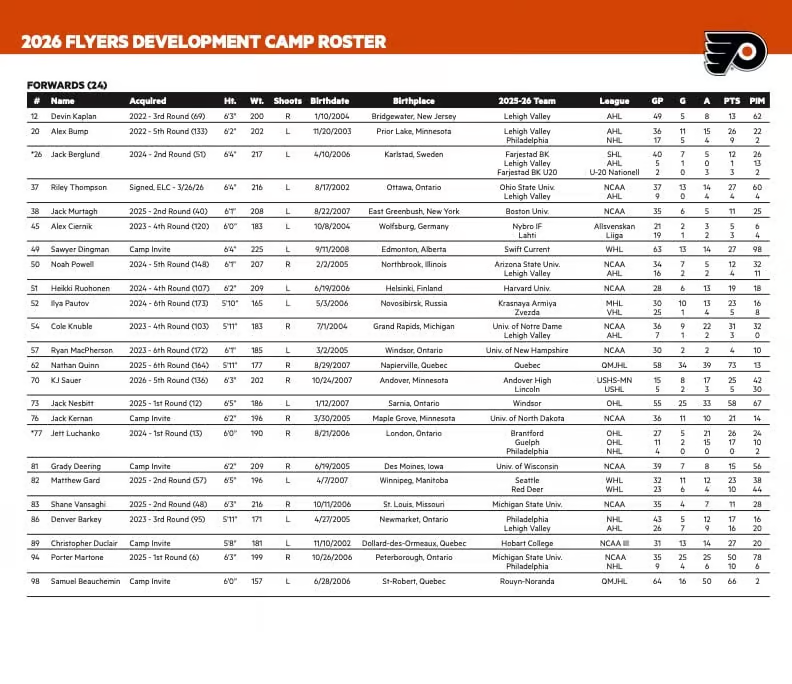
General Manager Daniel Briere announced the development camp roster and schedule on June 28th, confirming that all six members of the 2026 draft class would attend. Director of Player Development Riley Armstrong will oversee the on-ice program, working alongside his player development staff and the coaching staff of the Lehigh Valley Phantoms — the Flyers’ American Hockey League affiliate whose coaches bring the professional development context that connects development camp directly to where these players will eventually play their first games as professionals. The 41-player group will be divided into three skill and skating units and two game teams designated Team Briere and Team Jones. The week’s on-ice sessions are free and open to the public, with a scrimmage on Thursday, July 2 at 6:00 p.m. and a three-on-three tournament closing the camp on Friday, July 3 at 10:00 a.m.
The Trade Architecture That Shaped the Class
Before examining who the Flyers selected, the mechanics of how they acquired their picks are worth understanding, because the deal that Briere made on draft day restructured the organization’s first-round positioning in ways that gave him more picks at higher value than the single selection with which he entered the day.
On Day 1 of the draft, the Flyers traded the 21st overall pick to the San Jose Sharks in exchange for the 27th, 62nd, and 120th overall selections — a trade-back of six slots in the first round that returned two additional selections: a second-round pick and a fourth-round pick. The conventional analysis of such trades involves weighing the expected value difference between a mid-first-round pick and a collection of picks at lower positions. Briere’s execution of this trade suggests he had identified specific players available at the later positions whose value, in his evaluation framework, exceeded the probability-weighted value of whoever might have been available at 21. The draft confirmed that judgment in at least two of the three acquired picks: Sokolovskii at 27 and Psohlavec at 62 both represented players the organization had clearly pre-identified rather than falling into at unfamiliar positions.
A separate transaction completed on June 25, two days before the draft, sent forward Garnet Hathaway to the Florida Panthers alongside a sixth-round pick, returning a fifth-round pick in 2026 and a fourth-round pick in 2027. Hathaway, a veteran energy forward, was acquired by Florida at the stage of his career where he is a depth contributor on a Stanley Cup contending roster rather than a building piece for an organization in Philadelphia’s current developmental phase. The return of additional future picks for a player of Hathaway’s profile reflects the front office’s disciplined orientation toward accumulating the assets that a franchise in transition needs.
Pick 27: Maksim Sokolovskii, the Physical Foundation of the Blue Line Pipeline
The first selection of the Flyers’ draft, taken at 27th overall after the Sharks trade, is Maksim Sokolovskii — a 17-year-old, 6-foot-7, 238-pound left-shot defenseman from Kazakhstan who spent the 2025-26 season with the London Knights of the Ontario Hockey League. In 44 regular-season games with London, Sokolovskii recorded two goals, six assists, and eight points alongside a plus-10 rating — modest offensive production numbers for a first-round selection, but entirely expected from a player whose value resides almost entirely in physical projection, skating quality, and the defensive presence that his extraordinary dimensions create on the ice surface.
Briere’s public characterization of the selection focused on the progression element — the idea that Sokolovskii was an early-season prospect whose standing improved month by month as the staff watched him adapt to the OHL’s pace and structure. That trajectory, of a player getting better rather than simply maintaining a static profile, is the kind of developmental signal that draft evaluators weigh heavily because it suggests a player who is still growing into his game rather than one who has found his ceiling. At 17 years old, not yet turning 18 until July 12th, Sokolovskii’s physical frame is almost certainly not finished developing, and the combination of his eventual fully matured size with the skating ability that has already distinguished him at the junior level represents a profile that is genuinely rare.
The OHL pedigree is significant independently of Sokolovskii’s individual production. The London Knights are one of the most decorated programs in junior hockey history, a franchise whose development record for NHL-level talent is among the best in the CHL. Players who go through the London system are evaluated, pushed, and expected to compete every night against the OHL’s highest-caliber competition. The Knights reached the postseason and Sokolovskii appeared in five playoff games — exposure to high-stakes hockey in a proven development environment. The Flyers have shown consistent respect for the London program as a development partner over the years, and Sokolovskii’s selection continues that pattern.
Sokolovskii will head to the University of Maine for the 2026-27 season — a path that gives him NCAA-level competition and coaching while allowing him to develop at a measured pace before the professional game’s demands are placed on a frame still growing into its full capabilities. For a franchise that has had Rasmus Ristolainen providing the physical, edge-oriented blue-line presence that opponents remember long after a game, the addition of a larger, younger player with similar physical tools represents a genuine long-term strategic investment.
Pick 53: Brek Liske, the Memorial Cup Champion Who Finished the Year in Overdrive
The Flyers’ second selection, taken at 53rd overall in the second round, addresses the defensive prospect pipeline from a very different angle than Sokolovskii. Brek Liske, an 18-year-old from Beausejour, Manitoba, is a 6-foot-1, 190-pound defenseman whose 2025-26 season with the Everett Silvertips of the WHL produced a Memorial Cup championship — the most significant achievement available to a player in the Canadian Hockey League.
Liske’s regular-season production — seven goals, 17 assists, 24 points in the regular season — represented career highs in every offensive category. More significant was his postseason performance: 17 points in 18 playoff games, a production rate that placed him among the WHL’s highest-performing defensemen during the stretch run. Scout Mark Greig’s description of the selection specifically highlighted the second-half progression that enabled Everett’s championship run — Liske stepped into additional responsibility when the team suffered a defensive injury and responded by elevating his game in ways that continued uninterrupted through the Memorial Cup.
The description of Liske as a two-way defenseman reflects a genuine evaluation rather than a positional label applied by default. His plus/minus and defensive zone tracking throughout the season indicated a player capable of managing his own end while contributing offensively, which is the foundational profile for the kind of defenseman who can progress from prospect to NHL contributor without requiring reconstruction of his game at the professional level. The Flyers’ defensive prospect pipeline has been built predominantly around right-handed shots — Spencer Gill, Oliver Bonk, Carter Amico — making Liske’s left-handed shot a meaningful complement to the existing inventory.
Pick 62: Martin Psohlavec, the Czech Netminder With the Save Percentage That Commands Attention
The selection of goaltender Martin Psohlavec at 62nd overall is the pick in this class most likely to surprise observers who had not tracked the Czech U20 league closely during the 2025-26 season. Psohlavec, an 18-year-old from Ostrov, Czechia, standing 6-foot-5, posted a .928 save percentage and a 1.92 goals-against average in 42 regular-season appearances with HC Energie Karlovy Vary’s U20 program — numbers that represent elite-level performance by any standard of evaluation at this age level.
The postseason results were equally impressive: five wins against three losses, a .925 save percentage, and a 1.78 goals-against average in eight games. These are not the statistics of a prospect who is good for his level. They are the statistics of a goaltender who dominated his competition at a level where European scouting departments have become increasingly attentive given how consistently Czech and Slovak goaltenders have developed into NHL contributors over the past decade.
Goaltender Scout Ryan Cyr specifically highlighted Psohlavec’s athleticism relative to his size — the challenge of finding a large goaltender who has not traded foot speed and reflexes for physical dimensions. At 6-foot-5, the expectation is often that a goaltender will be positionally sound but limited in his ability to make the reactive, scrambling saves that small, quicker netminders execute more naturally. Cyr’s characterization of Psohlavec as genuinely athletic for his size suggests a goaltender who may not face that trade-off — whose physical development has accompanied rather than undermined his technical capabilities. The ceiling reference is the qualifier that appropriately hedges this projection: Psohlavec at 18 in Czech junior hockey is not Psohlavec at 22 in the AHL. The development path between those two points is long and non-linear. But the foundation is clearly there.
Pick 120: Marek Sklenicka, the Seattle Thunderbird and Bronze Medal Goaltender
Philadelphia took its second goaltender with the 120th overall selection, adding Marek Sklenicka — a 17-year-old from Litvinov, Czechia, who split his 2025-26 season between the Seattle Thunderbirds of the WHL and the Czech national team at the IIHF World Under-18 Championship. The North American season produced a 20-12-6 record, a .902 save percentage, a 3.21 goals-against average, and three shutouts in 42 games, followed by an international run in which he went 2-1 and helped the Czech Republic claim a bronze medal.
At 6-foot-3 and 170 pounds, Sklenicka has the size the modern NHL goaltending market demands and the developmental trajectory that the Flyers’ scouting team clearly found compelling. Cyr’s description of the selection emphasized consistent improvement across the course of the WHL season — the kind of in-season growth curve that scouting departments value because it suggests a player who responds to coaching and competition rather than simply executing a static skill set. The 170-pound frame also leaves significant room for physical development, which the Flyers are treating as an asset rather than a concern.
The organizational decision to take two goaltenders within the top 62 picks of a single draft reflects both the scarcity of the position in the NHL talent pipeline and the Flyers’ current organizational calculus about their goaltending depth beyond the immediate NHL level. With Samuel Ersson establishing himself as the organization’s primary prospect at the position, adding a pair of young European netminders who could develop over three to five years before demanding NHL consideration gives the franchise flexibility rather than urgency.
Pick 136: KJ Sauer, the Andover, Minnesota Center Heading to Edmonton
The lone forward in this draft class, taken 136th overall, is KJ Sauer — a 6-foot-3, 202-pound center from Andover, Minnesota, whose 2025-26 season was defined more by what the beginning of it was not than by the production of its final months. Sauer missed the majority of the year to injury, returning late to play 15 games at Andover High, during which he produced 25 points in 15 games, before appearing in five USHL games with the Lincoln Stars and recording two goals and three assists in those five contests.
The scouting assessment from Shane Fukushima specifically acknowledged the injury context while emphasizing what the abbreviated return demonstrated: a large center who can skate, who impacts games immediately upon returning from a significant absence, and who has the physical toolkit — size, skating, with developing offensive instincts — to project as a useful NHL-level player if his development arc follows its apparent direction. The commitment to the Edmonton Oil Kings of the WHL for 2026-27 gives Sauer the high-level junior competition he needs to accumulate the game experience that his Minnesota high school career, curtailed by injury, was not able to provide at sufficient volume. Fukushima identified rounding out the offensive game as the primary developmental task ahead of Sauer — which is, for a 6-foot-3 center who can skate, one of the more solvable developmental challenges in the prospect universe.
Pick 213: Max Laatikainen, the Finnish Offensive Defenseman
The final selection of the Flyers’ 2026 draft is Max Laatikainen, a 17-year-old Finnish defenseman taken at 213th overall who played the 2025-26 season with Kiekko-Espoo’s U20 program and made six appearances in Finland’s Liiga — the top professional league in the country — as a teenager. The 5-foot-11, 173-pound blueliner recorded 11 points in 22 U20 games and added two points at the Liiga level, then represented Finland at the World Under-18 Championship, contributing two points in five games.
Brent Flahr’s characterization of the selection emphasized Laatikainen’s offensive orientation and energy — a player who wants the puck, moves it well, and was effective with the Finnish national team. The acknowledged uncertainty about whether he will add an inch to his current height is the kind of honest assessment that informed draft evaluations provide: Laatikainen’s profile is predicated on offensive creation and skating quality, and if the physical frame does not grow significantly, his NHL ceiling will depend on whether those skills translate through the developmental pipeline at a level that compensates for his dimensions. European scout Sami Sandell’s advocacy for the selection is the kind of internal organizational validation that gives a seventh-round pick credibility — these late picks succeed when the scouts who watch the relevant market closely believe in a player enough to campaign for him, and Flahr’s public acknowledgment of Sandell’s persistence reflects the internal process that produced the selection.
Development Camp in Voorhees: What This Week Means
The decision to hold the Flyers’ development camp at the Flyers Training Center in Voorhees, New Jersey, is a return to the organization’s South Jersey roots in the context of prospect evaluation. The Training Center, which serves as the franchise’s primary practice facility, provides the organizational infrastructure — ice, staff, analytics capacity — for a five-day program designed to accelerate the introduction of new prospects to professional standards of conditioning, skating, and systems while also evaluating how the prospects interact with established organizational players and with each other.
The 41-player roster that will gather in Voorhees this week spans all six members of the 2026 draft class alongside unsigned free agents and previously drafted prospects for whom this camp represents an additional evaluation opportunity. Riley Armstrong and his development staff will oversee the on-ice programming, working alongside the Lehigh Valley Phantoms coaches who represent the professional developmental context the prospects are working toward. The three-group structure for power skating and skill sessions reflects the roster’s diversity of experience and current developmental stage — prospects at different points in their journeys require different on-ice environments to be challenged appropriately.
The public nature of the camp is worth noting explicitly: all on-ice sessions are free and open to Flyers fans, creating an opportunity for the Delaware Valley hockey community to watch the next generation of the franchise in their first formal workouts as members of the organization. The scrimmage on Thursday July 2 at 6:00 p.m. and the three-on-three tournament on Friday July 3 at 10:00 a.m. are the most game-like settings of the week and will give observers their clearest look at how these players compete at pace.
The Franklin Institute Autograph Session: A Philadelphia Moment
On Wednesday, July 1, all Flyers fans are invited to the Franklin Institute in Philadelphia for a fan engagement event built around the development camp roster. Players will appear from 3:30 to 5:30 p.m. to meet fans and sign autographs, with the event opening at 2:00 p.m. to allow early arrival for Flyers-themed activations including an appearance by Gritty, the Flyers Ice Team, and additional programming. Museum admission tickets are required for the event and are available through the Flyers’ official website.
The Franklin Institute setting is characteristically Philadelphia — a science museum that has been a landmark of the city since 1934 and that occupies a special place in the educational and cultural life of the region. Bringing development camp players to the Franklin Institute connects the franchise’s youngest prospects to the community they are being developed to represent, and the access to players this early in their organizational relationships is the kind of opportunity that turns a first-generation Flyers fan into a lifelong one.
For New Jersey residents making the trip, the Franklin Institute is accessible by PATCO from South Jersey to City Hall in Philadelphia, a short walk from the museum on Ben Franklin Parkway. The Voorhees Training Center sessions, running Monday through Friday, are accessible from throughout South Jersey for fans who want to watch skating sessions in a more intimate on-ice setting.
The Philadelphia Flyers’ 2026 draft class is assembled. The development camp is underway. The first chapter of what these six players might become for this franchise is being written this week, in South Jersey, at a training facility that has produced the first developmental experiences of every Flyers prospect for the past two decades. The hockey world will not be watching closely. That is the nature of development camp. The Flyers’ coaching and development staff will be watching closely, which is the only audience that matters right now.
















