
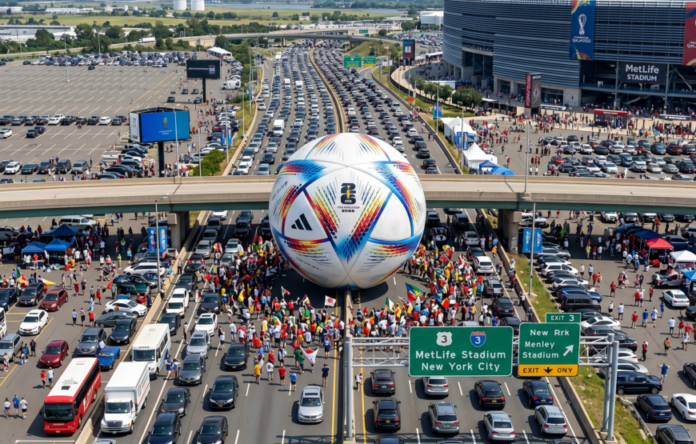

On July 19, 2026, MetLife Stadium in East Rutherford, New Jersey, will host the FIFA World Cup Final — the most watched 90 minutes of sport in the world, contested by the two best remaining teams from a 48-nation field that has played across three countries and four and a half weeks of tournament competition. When the trophy is lifted in the Meadowlands, it will happen in New Jersey. Not in Manhattan. Not at a venue whose naming rights acknowledge the state as a secondary consideration. In the stadium that sits eight miles west of Midtown in a state that has long served as the backdrop for events the world comes to see. The World Cup Final is New Jersey’s, and the summer leading up to it has already demonstrated that East Rutherford is capable of hosting the most significant sporting event on the planet at the level the event demands.
MetLife Stadium, operating under the name New York New Jersey Stadium for the duration of the tournament, is hosting eight total World Cup matches — five in the group stage, one in the Round of 32, one in the Round of 16, and the Final itself. The total volume of World Cup competition at this venue exceeds that of any other single stadium in the tournament, and the path to July 19 has already included some of the most dramatic and technically accomplished play the group stage has produced.
The Full Match Record at New York New Jersey Stadium
The group stage at MetLife Stadium opened on June 13 with a rematch of the 2022 World Cup group stage meeting between Brazil and Morocco — a game that ended 1-1 in Qatar four years ago and played out the same way in New Jersey, Brazil and Morocco drawing 1-1 in a match that demonstrated Morocco’s continued growth as a genuine World Cup contender while raising the first questions about whether Brazil’s talented squad would cohere under tournament pressure. The draw was a result that pleased neither set of supporters but reflected the genuine parity between two teams that had both arrived in East Rutherford believing they could win the match.
Three days later on June 16, France faced Senegal in a Group I clash that carried particular resonance given the history between the French national program and the African continent — many of France’s most important players trace their roots to Senegal and surrounding nations, while Senegal itself has developed into one of the most technically accomplished African squads in the tournament’s history. France won 3-1, with a performance that confirmed the depth and balance of Les Bleus’ squad under Didier Deschamps, who is approaching his fourth World Cup as France’s manager with a team arguably better equipped than any of his previous editions.
On June 22, the stadium hosted Norway against Senegal in the groups’ second-round fixture — a match that served as an elimination-pressure game for Senegal after their opening loss to France and that produced a 3-2 Norway victory, the Scandinavians riding an extraordinary performance from their attacking players to eliminate Senegal from tournament contention and secure their own path to the knockout rounds. The atmosphere at East Rutherford that night reflected the stakes: Senegal’s considerable supporter base in the region had arrived knowing the result was a must-win requirement, and the evening’s tension produced the kind of match that justifies an 82,500-seat stadium.
June 25 brought what may have been the group stage’s defining upset at the New Jersey venue. Ecuador defeated Germany 2-1 — a result that reverberated across Group E’s standings and demonstrated both Ecuador’s development as a consistent tournament competitor and the vulnerabilities in a German squad that had entered the tournament as one of the competition’s most technically regarded European sides. The Ecuador win, achieved against a team that had beaten them in preparation and whose European technical qualities were assumed to provide a significant advantage, was the result that neutrals at the stadium will remember longest from the group phase.
The group stage concluded at the stadium on June 27, tonight, as Panama faced England in a Group L fixture that ended 2-0 in England’s favor. The result confirmed England’s advancement while Panama’s tournament ended in New Jersey, their first appearance on this particular stage producing an experience that the Panamanian federation and its supporters will carry home as both a benchmark and a motivation.
Into the Knockouts: France vs. Sweden and the Road to July 19
With the group stage complete at the New York New Jersey Stadium, the attention turns to what comes next. On Tuesday, June 30 at 5:00 p.m., the stadium hosts its first knockout match — France against Sweden in the Round of 32, a fixture whose stakes need no elaboration. France are among the two or three strongest contenders to lift the trophy on July 19, while Sweden — whose group stage was marked by a decisive 5-1 victory over Tunisia and a 1-1 draw with Japan — have demonstrated the technical qualities and organizational discipline that can carry a compact, well-managed squad deep into a tournament.
The Round of 32 format, introduced for the first time in this expanded 48-team World Cup, creates the possibility of significant upsets as group winners and runners-up meet the best third-placed finishers from across all 12 groups. France entered their Round of 32 as clear favorites in the conventional seeding sense, but World Cup history provides no shortage of evidence that clear favorites at this stage do not always advance. The June 30 match at East Rutherford begins a sequence that will determine whether the tournament’s Final on July 19 produces the kind of blockbuster narrative that the world’s most-watched sporting event generates when its two highest-profile participants survive long enough to meet in the closing match.
The Round of 16 match at the stadium follows on July 5 at 4:00 p.m. — the specific teams determined by the Round of 32 results — before the Final on July 19 at 3:00 p.m. closes the tournament with what will almost certainly be the most attended and most globally watched event in the stadium’s history.
The Stadium Itself: What 82,500 World Cup Fans Are Experiencing
MetLife Stadium opened in 2010 at a construction cost of approximately $1.6 billion and is privately owned by the NFL’s New York Giants and New York Jets — an unusual ownership structure that has translated into a facility maintained to the standard that two major NFL franchises require and that has proven flexible enough to accommodate the full range of major live entertainment that the New York metropolitan market demands. The stadium’s exterior lighting system, which shifts between blue for the Giants and green for the Jets during NFL season, has been adapted for the World Cup to reflect the national colors of the teams competing on any given match day — a visual transformation that has converted a recognizable New Jersey landmark into something that reads differently depending on which flags are flying.
The stadium holds approximately 82,500 spectators and has been configured for World Cup matches according to FIFA’s specific requirements, which include a field orientation and sightline standard that differs from NFL configuration. The surface — natural grass installed for the tournament — has performed well through the first five matches, a result that required careful preparation given the Meadowlands complex’s climate challenges and the tournament’s compressed scheduling.
What the venue has delivered, by the account of fans, journalists, and FIFA officials who have attended all five group stage matches, is a World Cup atmosphere that rivals or exceeds what international supporters anticipated from an American venue. The New York-New Jersey metropolitan area’s extraordinary diversity — the region is home to significant communities from nearly every nation competing in the tournament — has produced supporter cultures that travel to East Rutherford and create the kind of atmosphere that the World Cup’s commercial and sporting reputation is built on. The Brazil-Morocco crowd reflected both nations’ diasporas. The France-Senegal atmosphere was defined by the cultural complexity of who, exactly, was rooting for whom. The Ecuador-Germany crowd produced some of the evening’s most emotionally charged moments as the upset developed in real time. The diversity of New Jersey’s own population has been one of the tournament’s unexpected assets at this venue.
Getting to the Stadium: What Every Fan Needs to Know
The transportation infrastructure for World Cup matches at MetLife Stadium is structured differently from any previous major event at the venue, and fans attending any of the remaining three matches — June 30, July 5, and July 19 — need to plan their travel well in advance.
There is no general parking at the stadium on match days. This is not a conventional NFL-style restriction that creates inconvenience for some fans — it is an absolute prohibition, with vehicle access on match days limited to FIFA-permitted vehicles only. The stadium and its surrounding road network operate as a transit-only zone from four hours before kickoff through the post-match dispersal period. Fans who arrive by car without pre-purchased parking at the American Dream mall — approximately a five-minute walk from the stadium via existing pedestrian connections — will have no access option.
NJ Transit provides the primary recommended transportation solution for match days. From New York Penn Station, fans board a standard NJ Transit rail service to Secaucus Junction — a trip of approximately ten minutes — and then transfer to the dedicated Meadowlands Rail Line shuttle that runs directly to the stadium. The transfer is straightforward, the Meadowlands Rail Line is matchday-only service running exclusively for ticketed fans, and the total journey from Penn Station to the stadium is approximately 30 minutes under normal conditions. Round-trip rail tickets, which were initially announced at $150 and subsequently reduced to approximately $98-$105 following public and political pressure including direct complaints from Governor Sherrill and United States Senate Minority Leader Chuck Schumer, must be purchased in advance through the NJ Transit mobile app. They are limited to 40,000 per match day and will not be available at station ticket offices or vending machines on the day of the match. Fans from New Jersey connecting from other NJ Transit rail lines should plan to connect to the Meadowlands Rail Line through Secaucus Junction.
Official shuttle service operates from three transit hubs in New York City — the Port Authority Bus Terminal, a Midtown North location, and a Midtown East location — and one park-and-ride facility in New Jersey at the Hackensack Meridian School of Medicine in Clifton. Shuttle tickets are priced at approximately $20 per person round trip, making them the most affordable transportation option available, and must be purchased in advance. The shuttle is a one-seat-ride option for fans who want to avoid the Secaucus Junction transfer and is particularly well suited to visitors unfamiliar with the NJ Transit rail system.
Rideshare services are available for fans choosing to arrive by Uber or similar platforms, with drop-off and pick-up designated in the Meadowlands Racing and Entertainment area adjacent to the stadium property, connected to the gates by a direct walking path. Surge pricing before and after matches is expected to be significant, and arrival certainty by rideshare during peak demand periods is considerably lower than by rail or shuttle.
The transportation pricing controversy deserves direct acknowledgment. FIFA, which stands to generate approximately $11 billion from the 2026 tournament, contributed nothing to NJ Transit’s match-day operations costs, forcing the transit authority to absorb approximately $48 million in additional operating expenses. The discrepancy between FIFA’s tournament revenues and its financial contribution to the host city infrastructure that makes the tournament possible provoked public criticism from both elected officials and ordinary commuters whose Northeast Corridor service is affected by World Cup matchday rail operations. The reduced round-trip fare — from $150 to approximately $98-$105 — represents a partial accommodation of that criticism but does not resolve the underlying question of whether international governing bodies should bear a greater share of the public costs their events impose.
New Jersey’s Broader World Cup Footprint: Beyond East Rutherford
The FIFA World Cup’s presence in New Jersey extends well beyond the stadium in East Rutherford. Governor Sherrill’s $5 million NJ World Cup Community Initiative, administered through the New Jersey Economic Development Authority, funded community events across the state — including SoccerFest26 at Wiggins Waterfront Park in Camden, which ran June 25-27 as a free three-day festival featuring 12 match screenings on large outdoor displays, youth soccer clinics, food vendors, and a craft marketplace. The Camden event reflected the NJEDA’s specific objective of ensuring that World Cup economic benefits reached communities across the state rather than concentrating in the immediate Meadowlands vicinity.
Team Brazil, one of the tournament’s most commercially significant squads, has been headquartered at the RWJBarnabas Health Red Bulls Performance Center in Harrison, Morris County — a facility that has positioned New Jersey as the host state for a national team whose fanbase represents one of the largest single-nation diaspora communities in the metropolitan area. The Flag Cities 2026 series, operated by GOYA Foods across seven New Jersey locations through July 3, brought match screenings to communities across the state, and the Newark Fan Village provided an additional free watch-party destination for fans in Essex County.
The Newark Fan Village represents one of the more consequential community investments of the tournament period — a publicly accessible gathering space in a city whose relationship to professional sports venues has historically been complicated by the fact that the region’s major stadiums are located in municipalities that are not Newark, despite Newark’s central position in the metropolitan area. The Fan Village acknowledged that reality and provided a World Cup destination for Newark’s diverse population that did not require a $1,000 ticket and a trip to East Rutherford.
Watching the Remaining Matches: Television and Streaming
For New Jersey residents who are not attending the June 30, July 5, or July 19 matches in person but want to follow them on screen, all 104 World Cup matches air on Fox and FS1 in English and on Telemundo and Universo in Spanish. Every match streams through the Fox One and Fox Sports apps, with the opening game and specific high-profile matches available on Tubi without a subscription. The complete tournament schedule is available through FIFA’s official website, and both the Fox Sports and NBC Sports platforms maintain updated standings and results from across all 16 stadium sites.
The three remaining matches at New York New Jersey Stadium — France vs. Sweden on June 30, the Round of 16 fixture on July 5, and the World Cup Final on July 19 — represent the arc of the tournament’s culminating phase. Whatever the results of the knockout rounds between now and July 19, the Final will take place eight miles west of Manhattan, in a state that has been one of the 2026 World Cup’s most active and most demographically representative host environments. New Jersey has earned this.
















