
New Jersey has a stronger claim to the center of the American Revolution than almost any other state, and the summer of 2026 is the moment that claim is being made explicit. The Semiquincentennial — America’s 250th birthday — arrives in a state where Washington crossed a freezing river on Christmas night, where the Battle of Monmouth was fought in searing June heat, where the Continental Army wintered and regrouped and eventually prevailed, and where the geography of the revolutionary period is still legible in the landscape if you know where to look. The events New Jersey has assembled for this summer and fall are not generic patriotic observances. They are the specific, place-rooted celebrations of a state that was not a peripheral participant in the founding of the republic but one of its primary theaters — a state where independence was genuinely won, at real cost, by real people whose names are carved into the stone of the towns and parks and memorials that New Jersey residents pass every day.
The lineup of events runs from a massive international maritime spectacle off the Highlands coast to a 13-bell ceremony at a 19th-century cotton mill in Millville, from a historically accurate pub crawl through Lambertville to immersive living history exhibitions in Hunterdon County, from a 24-piece jazz orchestra in Wildwood to a living history weekend at Cold Spring Village on the Cape May peninsula. Taken together, they represent the most comprehensive public engagement with New Jersey’s revolutionary history since the Bicentennial in 1976 — and in several cases, they reach places and stories that the Bicentennial itself did not.
The Premier Event: Sail 4th 250 in Highlands and Ships to Shore at Twin Lights
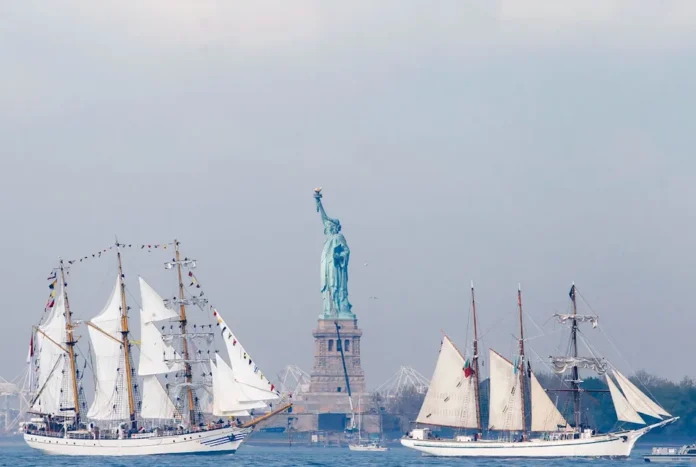
The centerpiece of New Jersey’s America 250 summer is taking shape along the Sandy Hook Bay waterfront on July 3rd, when the Port of New York and New Jersey hosts more than 50 international tall ships and naval vessels as part of the Sail 4th 250 maritime spectacle. The Highlands waterfront offers some of the finest views in the region for this event, positioned directly on Sandy Hook Bay with clear sightlines to the anchored fleet and the open waters of Lower New York Bay beyond. A historic welcoming ceremony for the international sailors — including the crew of the Amerigo Vespucci, the celebrated Italian naval training vessel that is one of the most recognized tall ships in the world — will mark the occasion with the kind of formal pomp that seafaring nations have used to mark significant moments for centuries.
The Amerigo Vespucci’s presence at this gathering carries particular symbolic resonance. The ship is named for the Florentine explorer whose accounts of the Americas prompted the cartographer Martin Waldseemüller to suggest that the new continents bear his name — making the Vespucci a vessel that, in a very direct sense, sails under the flag of a country named for its namesake. Its participation in New Jersey’s Semiquincentennial celebrations connects the event to the longer arc of transatlantic history that preceded and made possible the revolution of 1776. Seeing it anchored in Sandy Hook Bay on the day before America’s 250th birthday, alongside warships and tall ships from dozens of other nations, is an encounter with history that no museum exhibit can fully replicate.
Ships to Shore at Twin Lights, running concurrently on July 3rd at the Twin Lights Historic Site above the Highlands waterfront, transforms the Semiquincentennial maritime celebration into an educational festival with genuine depth. Visitors can climb the twin lighthouse towers — the brownstone structures built in 1862 that were, when constructed, the most powerful lighthouse beacons in the country — for elevated views of the anchored fleet below. On the grounds, costumed demonstrators will present 18th-century rope-making techniques, maritime knot-tying demonstrations, and the other manual skills that kept wooden ships functioning across ocean voyages in the age of sail. Live music will provide a continuous backdrop. The combination of the elevated vantage point, the active demonstrations, and the historical context of Twin Lights itself — the site where Marconi transmitted some of the first wireless messages in American history, and where the Lighthouse Board once conducted the tests that shaped American lighthouse design — gives the Ships to Shore festival a layered significance beyond its position as a viewing platform for the tall ships.
For New Jersey residents planning their July 3rd, the Highlands waterfront and Twin Lights represent the optimal position for one of the most visually spectacular events of the entire summer. The Sandy Hook Peninsula, accessible from the south via Gateway National Recreation Area, provides additional viewing options along the bay for visitors who arrive early and find the Highlands waterfront at capacity.
The Fourth of July Across New Jersey: Four Distinct Celebrations Worth Knowing
The July 4th calendar in New Jersey this year encompasses everything from intimate historical ceremonies to large-scale community festivals, and the diversity of format reflects the diversity of the communities celebrating it.
In Aberdeen Township, the July 1st Independence Day celebration at Veterans Memorial Park provides an early entry point into the holiday week — a community festival with live entertainment, local food vendors, family programming, and a fireworks display specifically themed to the 250th anniversary. Aberdeen is a community that takes its Veterans Memorial Park seriously as a civic space, and the decision to frame the holiday celebration explicitly around the America 250 moment reflects the municipality’s awareness of the historical weight this particular Fourth of July carries.
Denville’s celebration on July 4th at Gardner Field takes a different approach, building the community festival around a set of experiential elements that make the day genuinely memorable: tethered hot air balloon rides that give participants an aerial perspective on the township and the surrounding Morris County landscape, an arts and crafts market featuring local makers, a beer garden, and live music from the Norton Smull Band. The hot air balloon rides in particular are the kind of programming decision that distinguishes a thoughtfully planned community celebration from a perfunctory one — the image of ascending above New Jersey farmland on a clear July morning, looking out over a landscape that has been cultivated and settled for three and a half centuries, carries a historical resonance that amplifies the holiday’s significance.
Wildwood’s celebration of the Fourth takes a form that has no equivalent elsewhere in the state this year. Fox Park will host The Songbook of America, a performance by a 24-piece jazz orchestra that interweaves live dramatic storytelling about the American Revolution with the iconic musical compositions that have defined the American cultural canon. The combination of orchestral jazz, narrative history, and the outdoor setting of Fox Park on the Fourth of July represents an event that serves adults and serious music listeners in a way that most municipal Fourth celebrations do not attempt. The ambition is considerable — condensing 250 years of American music and history into a single evening’s performance is a genuine artistic challenge — and the outcome should be one of the more memorable events of the summer on the Jersey Shore.
Freehold’s America 250 Celebration arrives on July 5th, the day after the Fourth, at the Freehold Raceway Mall — a venue that can accommodate the kind of county-wide commemoration that Monmouth County’s oldest significant municipality deserves to host. Freehold was the site of the Battle of Monmouth, fought on June 28, 1778, in temperatures that climbed above 100 degrees and that created casualties from heat prostration alongside those from combat. The battle was one of the largest of the Revolution, involved more than 25,000 combatants across both forces, and ended in a tactical standoff that is debated by historians to this day. A county-wide commemoration at Freehold, with historical tribute performances, live orchestral music, and evening fireworks, grounds the July 5th event in a specific place and a specific history that the date and the location together make legible.
Living History: The Events That Put You Inside the Revolution
The most powerful America 250 programming in New Jersey this summer is the category that does not simply observe the founding period but inhabits it — events that use costumed interpreters, material culture demonstrations, and historic sites to create the experience of proximity to the revolutionary moment rather than simple commemoration of it.
Washington Crossing Historic Park in Titusville holds its dedicated Living History Day on July 4th, presenting 18th-century military camp life for visitors who want to understand what the Continental Army’s daily existence actually looked like between the battles. This event is not an isolated observance — it anchors a year-long programming series organized around the 250th anniversary that culminates in December with the 74th Annual Christmas Day Crossing Reenactment, the annual recreation of Washington’s ice-choked Delaware River crossing on December 25, 1776, that preceded the Battle of Trenton and turned the Revolution’s most desperate moment into one of its defining strategic victories. The Christmas crossing event draws thousands of participants and spectators each year and has been performed continuously since 1953. This December’s performance, as the 74th iteration in a year when the country is marking its 250th birthday, will have a particular resonance.
Millville’s “Let Freedom Ring” ceremony on July 4th at the David C. Wood Mansion is one of the year’s most distinctive living history events precisely because of its specificity. At 11:30 a.m., the Millville Historical Society will ring the 1851 Cotton Mill Bell — a bell that has hung in its current location for 175 years — exactly 13 times, once for each of the original colonies. The ceremonial bell ringing will be followed by a public reading of the Declaration of Independence, a tradition that dates to the document’s first publication in 1776, when copies were read aloud in public squares across the new nation to citizens who had no other means of encountering the text. The combination of the 175-year-old bell and the 250-year-old declaration, in a setting defined by South Jersey’s manufacturing and agricultural history, is the kind of layered historical moment that New Jersey’s revolution-dense landscape makes possible.
The East Amwell Historical Society in Ringoes opens its immersive “Hidden History of the Revolution” exhibition on July 4th at the historical society’s museum at 1053 Old York Road, alongside colonial dramatic readings by costumed performers. The “Step Inside 1776” format is designed to move visitors through the less-familiar dimensions of the revolutionary period in Hunterdon County — the loyalist-patriot divisions that split communities, the experience of civilians in a territory that changed military hands repeatedly, the stories of enslaved and free Black residents whose relationship to the revolution’s stated ideals was more complicated than the commemorative tradition usually acknowledges. Hunterdon County was actively contested territory during the Revolution, and the East Amwell Historical Society’s exhibition engages with that complexity rather than simplifying it.
Cold Spring Village in Cape May County brings the Semiquincentennial to its open-air living history museum on July 5th with a full day of interactive programming in the period village setting. The costumed interpreters at Cold Spring Village do not stand behind barriers and answer questions — they demonstrate the actual manual processes of early American domestic and commercial life: blacksmithing, weaving, foodways, and the dozens of trades that sustained 18th-century communities. A community brass band concert in the village setting provides a period-appropriate musical conclusion to a day that situates the 250th anniversary in the material reality of what life in the founding era actually required.
The Hidden Gems: Specialty Events That Deserve Their Own Audience
The America 250 Pub Crawl on July 4th in Lambertville is the year’s most enjoyably incongruous event — a historically accurate bar crawl led by costumed Continental Army soldiers that departs from Lambertville Station and crosses the Delaware River pedestrian bridge into New Hope, Pennsylvania. The event features revolutionary-era storytelling at each stop, custom wooden beer mugs for participants, and the particular kind of immersive historical education that works best when the participants are also having a very good time. Lambertville’s position directly on the Delaware River, at the same crossing point that was strategically critical during the Revolution’s New Jersey campaigns, gives the historical narrative a geographic authenticity that a pub crawl in a less historically sited location could not achieve. The Continental Army did cross the Delaware. The river is right there.
Preservation New Jersey’s Middlesex County 250th Bus Tours on July 18th offer a very different kind of engagement with the revolutionary landscape — the kind that requires an expert guide and a willingness to visit the places that formal commemorative culture has historically overlooked. Departing from East Jersey Old Town Village, the guided bus route travels to critical, off-the-beaten-path 18th-century battlegrounds and encampments across Middlesex County that most New Jersey residents have never heard of despite living within driving distance of them for their entire lives. The tour is organized by Preservation New Jersey, the state’s premier historic preservation advocacy organization, whose expertise in the documentary and material record of New Jersey’s built environment gives these tours an analytical depth that conventional historical tourism does not provide. Participants will encounter places where battles were fought, armies camped, and the outcome of the Revolution was genuinely uncertain — not because the markers on the roadside tell them so, but because the guide makes the evidence visible.
The March to Yorktown Day in Westfield on August 16th — hosted at the Washington-Rochambeau Trail Park — commemorates one of the Revolution’s most consequential and least-known strategic movements: the coordinated march in 1781 of Washington’s Continental Army and Rochambeau’s French expeditionary force from their encampments in the Northeast to Yorktown, Virginia, where their combined forces would surround and compel the surrender of Lord Cornwallis’s British army and effectively end the war. The Washington-Rochambeau Revolutionary Route, which passes through New Jersey on its way south, is a National Historic Trail whose full significance is only beginning to receive the public attention it deserves. Historical reenactors portraying Washington and Rochambeau, performances by the New Jersey Fifes and Drums, and the specific setting of the Trail Park in Westfield make this August event one of the calendar’s most substantive and most underattended opportunities to encounter the Revolution’s defining campaign in a place where it actually happened.
Why New Jersey’s America 250 Matters Beyond the Fireworks
The events described in this article represent only a portion of the full America 250 programming across New Jersey this summer and fall. They are unified, however, by something more than shared timing or patriotic occasion — they represent a state’s attempt to be honest about what the Revolution actually was and what actually happened here, rather than simply staging a pleasant backdrop for the celebratory impulse that a 250th birthday naturally generates.
New Jersey lost more battles than it won. Its civilian population was subjected to years of military occupation, foraging, and the particular violence that armies in transit inflict on the communities they move through. Its geographical position as the corridor between the British stronghold in New York and the Continental Army’s positions in Pennsylvania made it the most contested terrain in the North for the war’s middle years. The famous battles — Trenton, Princeton, Monmouth — were real, and they were fought by people whose situations were desperate enough that the outcome was genuinely uncertain at the moment they were fighting them.
The best events on this summer’s calendar take that uncertainty seriously. The bell ringing in Millville takes the original 13 colonies seriously as specific, distinct political entities whose decision to unite was not inevitable. The Ringoes exhibition’s “hidden history” framing acknowledges that the revolutionary story has dimensions the commemorative tradition usually smooths over. The bus tours in Middlesex County take visitors to places where the Revolution happened as a material event rather than a symbolic one. The tall ships in the Port of New York and New Jersey connect the founding of the republic to the international context in which it took place — a context that included French military and financial support without which the Revolution would almost certainly have failed.
New Jersey’s role in all of that is not peripheral. It is central. And this summer’s events are the state’s most comprehensive public statement of that fact in half a century.
Planning Your America 250 Summer in New Jersey
The events span the full arc of the summer and into the fall, with the heaviest concentration in the July 3rd through 5th window. Visitors planning to attend the Sail 4th 250 maritime events in Highlands should account for the significant crowd volume that 50 international tall ships will generate along the Sandy Hook Bay waterfront and arrive early to secure waterfront positions or claim space at Twin Lights before the tower viewing reaches capacity. Wildwood, Aberdeen, Denville, Freehold, Washington Crossing, Millville, Ringoes, Cold Spring Village, Lambertville, Middlesex County, and Westfield each offer events that can be incorporated into day trips from most points in the state, and several are accessible by NJ Transit rail service.
For the most current information on event times, locations, ticketing, and any weather-related updates, the New Jersey America 250 programming network, Preservation New Jersey, the Washington Crossing Historic Park, and the individual event organizers’ social media and website pages are the most reliable sources. The summer of 1776 was the most consequential in New Jersey’s history. Two hundred and fifty years later, the state is doing what it can to make sure that the people who live here understand why.