
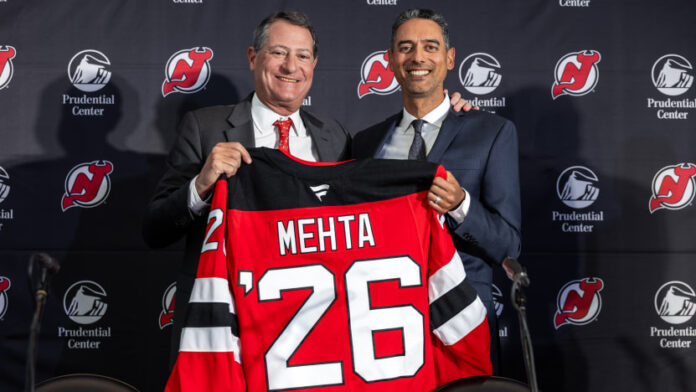

The New Jersey Devils have made a defining statement about their future—and about their identity—by naming Sunny Mehta as the franchise’s sixth general manager, a move that signals not only a shift in leadership but a recalibration of how this organization intends to compete, build, and ultimately win in today’s NHL. For those who follow the team closely through New Jersey Devils coverage, this is more than a front office hire. It is a structural pivot toward a modern, analytically driven, aggressively intelligent approach to roster construction and organizational philosophy.
Mehta’s appointment on April 16, 2026, and his formal introduction at Prudential Center on April 21, marks a rare convergence of personal narrative and professional pedigree. A Wyckoff native and lifelong Devils fan, Mehta returns not as a rising executive, but as a fully formed architect of championship-caliber hockey operations. His recent tenure as assistant general manager of the Florida Panthers—where he played a critical role in back-to-back Stanley Cup championships in 2024 and 2025—positions him as one of the most sought-after and forward-thinking executives in the league. The Devils did not simply hire a general manager. They secured a strategic operator with a proven track record of building winners under pressure.
From the outset, Mehta’s role has been defined with unusual clarity and authority. He is not just the general manager in title; he is the central decision-maker across all hockey operations, effectively absorbing responsibilities typically assigned to a president of hockey operations. This consolidation of power is not accidental. It reflects ownership’s confidence in Mehta’s vision and signals a streamlined chain of command designed to eliminate ambiguity, accelerate decision-making, and establish a unified organizational voice.
What distinguishes Mehta from traditional hockey executives is not just his résumé, but the unconventional path that shaped it. Before entering NHL front offices, he operated in environments that demand probabilistic thinking, emotional discipline, and strategic adaptability: professional poker, derivatives trading at Peak6 Capital Management, and even professional jazz performance. Each of these disciplines reinforces a core competency that now defines his management style—processing incomplete information, identifying inefficiencies, and capitalizing on them before competitors can react. In a league increasingly defined by margins, this is not an abstract advantage. It is a competitive weapon.
That mindset was already evident during Mehta’s first stint with the Devils from 2014 to 2018, when he pioneered the NHL’s first full-time analytics department. At a time when many organizations were still skeptical of data-driven decision-making, Mehta helped institutionalize a model that blended traditional scouting with advanced statistical analysis. The results were not theoretical. They were tangible. His internal models famously identified Jesper Bratt as an elite talent in the 2016 NHL Draft—far earlier than consensus rankings—leading to one of the most successful late-round selections in franchise history. That singular decision now stands as a case study in how information asymmetry can be leveraged into long-term organizational value.
Now, nearly a decade later, Mehta returns to a league where analytics are no longer optional—but where true innovation still separates contenders from champions. The expectation is not that he will replicate his earlier work, but that he will evolve it. The tools are more advanced. The data sets are richer. The competitive landscape is more sophisticated. And Mehta, by all indications, has continued refining his methodologies throughout his tenure in Florida, where the Panthers became known not only for headline-grabbing acquisitions, but for consistently identifying undervalued talent and integrating it into a cohesive, high-performance system.
Yet even with that pedigree, Mehta’s early messaging has been notably disciplined. He has described his current phase as an “assessment period,” a term that carries significant weight. It suggests a deliberate, methodical approach rather than immediate, reactionary change. For a Devils team that features a dynamic young core—including Jack Hughes and Nico Hischier—this is a critical distinction. The objective is not to dismantle, but to diagnose. Not to overhaul for the sake of optics, but to optimize for sustained success.
Among the most pressing issues on Mehta’s desk is the future of the coaching staff, led by head coach Sheldon Keefe. While no definitive decisions have been announced, the lack of immediate endorsement or dismissal reflects a broader pattern: Mehta is gathering information before committing to structural moves. This approach extends across the organization, from player development systems to scouting infrastructure and front office composition. It is a comprehensive audit, not a superficial review.
Roster construction, however, will inevitably accelerate as the offseason calendar advances. The Devils enter this period with approximately $12.18 million in projected salary cap space and a number of consequential decisions looming. Nico Hischier’s contract extension eligibility on July 1 represents a cornerstone negotiation, one that will shape both the team’s salary structure and its leadership core for years to come. At the same time, younger players such as Arseny Gritsyuk and Simon Nemec require immediate contractual clarity, adding layers of complexity to an already intricate cap environment.
This is where Mehta’s experience in Florida becomes particularly relevant. The Panthers’ success was not built on a single philosophy, but on a hybrid model that combined opportunistic blockbuster moves—most notably the acquisition of Matthew Tkachuk—with a relentless focus on uncovering undervalued contributors like Gustav Forsling. The question now is how Mehta will adapt that dual approach to the realities of New Jersey, a market without the tax advantages that Florida enjoys. If anything, this constraint may further amplify his reliance on data, development, and strategic precision.
Equally important will be how Mehta constructs his internal team. With Tom Fitzgerald no longer leading the front office, the opportunity—and expectation—is that Mehta will reshape the organizational hierarchy to reflect his own operational philosophy. This includes not just personnel decisions, but structural ones: how departments communicate, how information flows, and how decisions are ultimately executed. In modern hockey operations, these internal dynamics often determine whether a team can consistently translate talent into results.
Beyond the ice, the broader organizational context adds another layer of significance to this transition. With ongoing discussions surrounding substantial investment into Prudential Center renovations, there is a parallel emphasis on enhancing the overall experience for fans and players alike. While these developments sit outside Mehta’s direct control, they intersect with his mandate to position the Devils as a premier destination within the league—an organization defined not just by its roster, but by its infrastructure, culture, and long-term vision.
For the fanbase, the early response to Mehta’s hiring has been overwhelmingly positive, driven by both his credentials and his authenticity. This is not an external executive parachuting into an unfamiliar market. This is someone who understands the history, the expectations, and the emotional stakes of Devils hockey. That connection, however, comes with its own pressure. Familiarity does not guarantee success. It raises the standard.
What ultimately matters is execution. Press conferences, messaging, and early impressions carry weight, but they do not win games. The real evaluation of Sunny Mehta’s tenure will unfold over months and years—through draft selections, trades, contract negotiations, and the incremental decisions that collectively define a franchise’s trajectory. Early indicators suggest a leader who is composed, calculated, and acutely aware of both the opportunities and the risks ahead.
In a league where parity is relentless and margins are razor-thin, the Devils have made a calculated bet that intelligence, discipline, and innovation can tilt the balance. Sunny Mehta represents that bet in its purest form. For New Jersey, this is not just a new chapter. It is a redefinition of how the story will be written.
















