
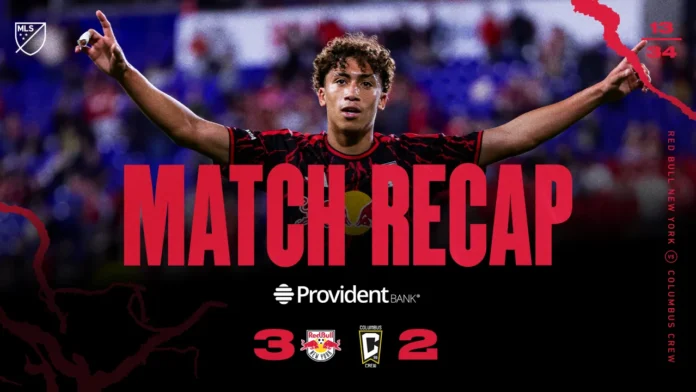

The New York Red Bulls have spent years building an organizational identity around youth development, relentless pressure, athleticism, and the belief that elite young talent can emerge quickly when placed into meaningful first-team situations. On Wednesday night at Sports Illustrated Stadium, that philosophy produced one of the most important performances by a young player anywhere in Major League Soccer this season.
In a dramatic 3-2 victory over the Columbus Crew, 18-year-old forward Julian Hall delivered a historic hat trick that instantly elevated both his national profile and the growing momentum surrounding Red Bull New York’s 2026 campaign. At 18 years and 50 days old, Hall became the youngest player in MLS history to score a hat trick, accomplishing the feat against one of the league’s most structurally disciplined and consistently competitive clubs.
The performance was not simply a milestone moment for a promising teenager.
It was the kind of breakthrough game that changes the trajectory of how a player is viewed throughout the league.
Hall’s three-goal performance arrives at a critical point in the season for the Red Bulls, who now turn immediately toward one of the defining fixtures on the MLS calendar: the Hudson River Derby against New York City FC. The timing could not be more significant. A rivalry match already carrying major emotional and playoff implications now becomes the stage for one of the most rapidly emerging young stars in American soccer.
That development matters not only for Red Bull New York, but for MLS itself.
For years, the league has pushed aggressively to establish itself as both a developmental pipeline and a destination for elite young talent capable of eventually competing on the global stage. Hall represents exactly the type of player MLS organizations increasingly prioritize — technically advanced, tactically adaptable, fearless in transition, comfortable under pressure, and capable of producing against high-level competition before turning 20.
Wednesday’s performance against Columbus showcased all of those qualities.
The Red Bulls opened aggressively, setting the tempo early through direct attacking movement and vertical pressure. Hall’s first goal arrived in the seventh minute after Emil Forsberg delivered a perfectly weighted ball into space for Cade Cowell, whose driven service into the box found Hall in dangerous positioning. The finish itself was composed and instinctive, but what stood out most was Hall’s timing and movement off the ball.
He looked entirely comfortable operating inside high-pressure moments.
That confidence continued throughout the match.
After Columbus equalized, the Red Bulls regained control in the 40th minute through another transition sequence involving Cowell and Hall. Jahkeele Marshall-Rutty initiated the move down the right side before Cowell delivered another dangerous cross into the area. Hall again finished clinically, restoring the lead and further reinforcing the growing chemistry developing inside New York’s attacking structure.
By the second half, the atmosphere inside Sports Illustrated Stadium had shifted noticeably.
The crowd understood it was witnessing something significant.
Hall completed the hat trick in the 79th minute following a set-piece sequence that reflected both anticipation and composure beyond his age. Gustav Berggren’s redirected header created a loose-ball opportunity near the goalmouth, and Hall reacted first, stretching to place the deciding finish into the bottom corner.
The reaction afterward felt less like a routine regular-season victory and more like the formal arrival of a major young talent.
That perception is not driven solely by age-based novelty. Hall’s statistical production is already becoming difficult to ignore. His three goals against Columbus brought his season total to nine, placing him among the league’s leading scorers and reinforcing how rapidly he has evolved from developmental prospect into legitimate attacking centerpiece.
More importantly, his production is translating directly into results.
The Red Bulls continue showing increased attacking fluidity when Hall operates aggressively in transition and inside the final third. His pace changes defensive shape. His positioning creates spacing opportunities for wingers like Cade Cowell. His movement between lines forces defenders into difficult decisions. Even when he is not scoring, his activity alters the geometry of opposing backlines.
That broader impact helps explain why the organization appears increasingly comfortable placing larger responsibility on him despite his age.
Head coach Michael Bradley’s postgame comments reflected that confidence clearly. Rather than framing Hall as merely an exciting prospect, Bradley emphasized professionalism, preparation, and coachability — indicators typically associated with players already becoming foundational pieces within a club structure.
Those details matter because MLS history is filled with young players who flashed potential briefly before struggling with consistency, tactical growth, or the psychological demands that arrive once expectations change. The challenge for Hall now becomes sustaining this level of performance as opponents begin game-planning specifically around him.
That adjustment phase often separates exciting prospects from long-term stars.
The encouraging sign for New York is that Hall’s game already appears rooted in repeatable fundamentals rather than isolated moments of improvisation. His off-ball intelligence, positioning, and composure inside the box tend to translate more sustainably than purely highlight-driven skill sets.
The support structure around him also appears increasingly stable.
Cade Cowell delivered two assists against Columbus and continues developing into one of the league’s more dangerous transition wingers. Emil Forsberg’s experience and technical quality provide balance and control in midfield areas. Berggren’s physicality and distribution continue stabilizing the center of the pitch. Defensively, the Red Bulls remain aggressive in pressing sequences while still showing improved organization compared to earlier stretches of the season.
All of that creates a more manageable environment for a young striker continuing to evolve rapidly.
Now attention turns fully toward NYCFC.
The Hudson River Derby has become one of the league’s defining rivalries because it compresses geography, identity, history, and organizational contrast into a single fixture. Red Bull New York and New York City FC represent fundamentally different soccer models competing inside the same market. Every meeting carries emotional intensity far beyond ordinary regular-season matches.
This weekend’s matchup arrives with added significance because both clubs are fighting to establish momentum inside a highly competitive Eastern Conference landscape.
For the Red Bulls, the opportunity is substantial.
A victory over NYCFC would extend the momentum created by the Columbus result while further cementing Hall’s breakout emergence as one of the league’s central storylines entering the summer portion of the season. It would also reinforce the idea that New York’s long-term investment in youth development is beginning to produce elite first-team results again at precisely the right moment.
That developmental identity has always been central to the Red Bulls organization.
From Tyler Adams to Matt Miazga to countless academy contributors throughout the years, the club has consistently emphasized internal player progression as part of its competitive model. Hall now appears positioned to become the latest and potentially most explosive addition to that lineage.
The broader league is paying attention as well.
MLS increasingly understands that young domestic stars are essential both competitively and commercially. Players like Hall generate local excitement while simultaneously strengthening the league’s long-term international credibility. The emergence of elite young Americans performing in meaningful MLS matches remains one of the most important indicators of the league’s overall growth.
And few performances this season have resonated more loudly than what happened Wednesday night in Harrison.
For Explore New Jersey readers following the evolving landscape of professional soccer across the region, Julian Hall’s historic performance against Columbus may ultimately be remembered as more than a record-setting night. It may represent the moment a promising teenager officially became one of the faces of the next generation of Major League Soccer.
Now comes the next challenge.
A rivalry match. A national spotlight. A stadium expecting another statement performance.
And for the first time, Julian Hall enters that stage not simply as a prospect, but as one of the league’s most dangerous young forwards already changing the trajectory of the Red Bulls’ season.
















