
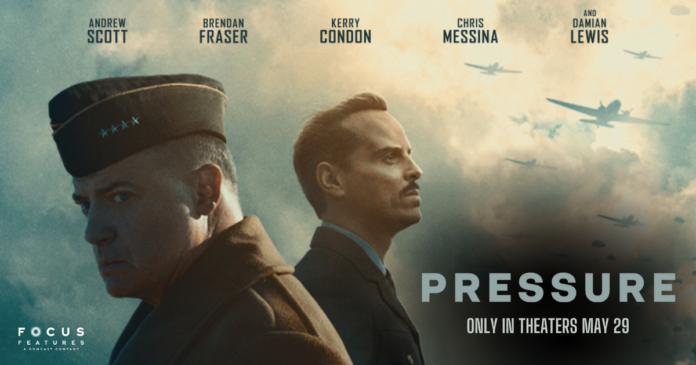

World War II stories have been told countless times across film and television, yet the most compelling projects continue finding new ways to revisit the conflict not through spectacle alone, but through the impossible human decisions that shaped history itself. “PRESSURE,” an intense new historical drama centered on the final seventy-two hours before D-Day, arrives with exactly that kind of focus, placing audiences inside one of the most consequential command decisions ever made during wartime.
Now, New Jersey audiences have an opportunity to experience the film early through a special premiere screening scheduled for May 28, with free tickets being offered to the first one hundred attendees who claim access through the promotional release. Claim your tickets now!
The film itself centers on General Dwight D. Eisenhower and Captain James Stagg during the critical lead-up to the Allied invasion of Normandy, when deteriorating weather conditions threatened to derail the largest amphibious military operation in history. At the core of the story is the extraordinary tension surrounding a decision that would ultimately affect not only the invasion itself, but the future direction of the war and the fate of Europe.
That premise immediately separates “PRESSURE” from more conventional war films.
Rather than focusing primarily on battlefield combat, the film appears structured around command pressure, uncertainty, strategy, and psychological strain. The central conflict is not simply military action, but the unbearable responsibility carried by leaders forced to make decisions with incomplete information while millions of lives hang in the balance.
It is a story about timing, judgment, and consequence.
Those elements have increasingly become some of the most compelling aspects of modern historical filmmaking because audiences today tend to respond strongly to character-driven tension rather than purely large-scale action sequences. Films centered on leadership under impossible circumstances often resonate more deeply because they emphasize the emotional and moral complexity behind historical events that are frequently simplified in public memory.
The D-Day invasion remains one of the clearest examples of that complexity.
Popular history often presents June 6, 1944 as an inevitable turning point, but the reality facing Allied leadership in the days beforehand was anything but certain. Weather forecasts were unstable. Sea conditions threatened landing operations. Visibility concerns complicated airborne deployments. Delaying the invasion carried enormous strategic risk, but launching under catastrophic conditions could have resulted in one of the greatest military disasters in modern history.
That uncertainty is where “PRESSURE” appears to locate its dramatic center.
Captain James Stagg, the meteorological officer responsible for providing weather analysis to Eisenhower, becomes a particularly fascinating figure within that context because his forecasts directly influenced the timing of the invasion itself. Unlike battlefield commanders making tactical decisions in combat, Stagg’s role revolved around prediction, probability, and scientific interpretation under extraordinary political and military pressure.
The emotional weight attached to that responsibility creates enormous cinematic potential.
One recommendation. One interpretation of incoming weather systems. One wrong call. The consequences would have been global.
That level of contained tension often produces some of the strongest historical dramas because audiences understand the stakes immediately without requiring excessive exposition. The clock is already ticking before the film even begins.
For viewers interested in military history, leadership studies, political decision-making, or historical thrillers, “PRESSURE” arrives at a moment when there is renewed public appetite for serious large-scale historical storytelling. Recent years have seen audiences gravitate strongly toward projects that combine historical realism with tightly focused human narratives rather than broad revisionist spectacle.
That trend has helped elevate films and series that emphasize atmosphere, procedural realism, political tension, and emotional authenticity.
“PRESSURE” appears positioned directly within that tradition.
The setting alone carries enormous cinematic gravity. The final days before D-Day remain among the most scrutinized and mythologized periods of twentieth-century military history. Yet despite the scale of the operation itself, the emotional reality of those seventy-two hours was deeply intimate — a handful of exhausted leaders, maps, forecasts, intelligence reports, military logistics, and the knowledge that failure would reverberate across the world.
That combination of claustrophobic decision-making and massive historical consequence often produces the strongest wartime storytelling.
It also aligns particularly well with audiences seeking films that feel grounded rather than overly sensationalized.
The special premiere screening component adds another layer of excitement for film audiences throughout New Jersey. Advance screenings consistently generate strong interest because they allow viewers to experience highly anticipated releases within a more event-driven atmosphere. The limited-ticket structure also creates urgency, especially for films tied to major historical subject matter or prestige dramatic positioning.
For moviegoers, premiere events offer something streaming platforms fundamentally cannot replicate: communal anticipation.
Watching a film alongside an audience encountering the story for the first time creates a very different emotional experience, particularly with tension-driven historical dramas where silence, suspense, reaction, and atmosphere become part of the event itself.
That theatrical energy has become increasingly important as the film industry continues navigating the long-term effects of streaming-era viewing habits. Large-scale event screenings, limited premieres, retrospective programming, and exclusive theatrical experiences have emerged as key strategies for reconnecting audiences with the communal side of cinema.
Historical dramas especially benefit from that environment.
The scale of the subject matter, the emotional pacing, the tension of unfolding decisions, and the immersive atmosphere all tend to resonate more strongly inside a theater setting than through fragmented at-home viewing.
The timing of the premiere also arrives as World War II storytelling continues evolving for new generations. Modern filmmakers increasingly approach the era not simply through patriotic framing or battlefield heroics, but through institutional pressure, psychological burden, intelligence work, logistics, political conflict, and the deeply human uncertainty that existed underneath monumental historical events.
That shift has produced richer and more layered storytelling overall.
“PRESSURE” appears ready to continue that direction by focusing less on the invasion itself and more on the impossible decision-making process that made the invasion possible in the first place.
For Explore New Jersey readers following major film releases, historical dramas, and special screening events, the May 28 premiere of “PRESSURE” represents one of the more compelling film opportunities currently circulating within the region’s entertainment landscape. The combination of historical significance, psychological tension, wartime leadership drama, and limited free-ticket access positions the event as more than just another movie screening.
It becomes an opportunity to experience one of history’s most pivotal moments through a different lens — not from the beaches of Normandy, but from the war room where the decision to launch was finally made.
And in those final seventy-two hours before D-Day, the pressure facing Allied leadership may have been as dangerous as the invasion itself.
















