
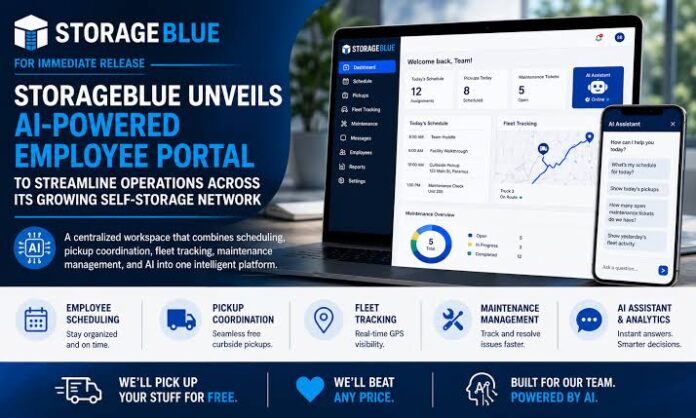

Alan Mruvka built two of the most recognizable cable television brands in American media history, E! Entertainment Television, which he co-founded in 1987, and FX, which launched in 1994, before pivoting to real estate in a way that most people from the entertainment industry do not. He did not simply invest in properties as a financial asset class. He founded StorageBlue, a vertically integrated self-storage company headquartered in New Jersey that now operates multi-story Class A facilities in Newark, Paterson, and Clifton, serves the dense commuter markets of Jersey City and Hoboken, and has positioned itself as the first company in its industry to fully embrace artificial intelligence as an operational infrastructure rather than a peripheral feature. The latest expression of that AI-first posture is the company’s newly unveiled internal employee portal, a unified digital workspace that consolidates employee scheduling, pickup coordination, fleet tracking, maintenance management, and AI-assisted decision support into a single platform — marking a meaningful step in StorageBlue’s stated mission to operate the most technologically sophisticated self-storage network in the New York metropolitan region.
The self-storage industry is not one that most people associate with the kind of operational innovation that requires a purpose-built AI platform to manage. That association is precisely what StorageBlue’s strategy is designed to disrupt. The industry’s historical operational model — a facility manager working from a front-desk software system, handling reservations and payments while coordinating with maintenance staff and truck vendors through disconnected channels — produces the kind of information fragmentation that technology infrastructure is specifically designed to eliminate. A district manager overseeing multiple locations in a dense urban environment like Newark, Paterson, and Clifton, where the facilities serve different demographics, different unit mix requirements, and different logistics challenges, has historically needed to synthesize operational data from multiple sources that do not naturally communicate with each other. The new employee portal Mruvka’s team has built addresses that fragmentation directly: every function that StorageBlue’s field-facing employees and managers perform — from shift scheduling and team communication through customer pickup coordination, fleet vehicle tracking, and the maintenance ticketing system that keeps multi-story urban storage facilities in the operational condition their clients expect — is now accessible within a single AI-informed interface that allows real-time visibility and decision support across the full operational footprint.
The pickup coordination component is particularly relevant to StorageBlue’s specific service model. The company has built a differentiating amenity into its new customer onboarding: free curbside pickup for move-ins, a service that requires precisely the kind of logistics coordination that a unified platform with fleet tracking and real-time scheduling management can provide more reliably than a phone-based system. In the dense urban environments StorageBlue serves — Newark’s downtown, Paterson’s commercial corridors, Clifton’s mixed residential and industrial zones, the Jersey City and Hoboken commuter belt where storage demand from apartment dwellers is consistently high — the ability to schedule, track, and complete a curbside pickup without the information delays and miscommunications that multi-system coordination typically produces is a service quality differentiator that the employee portal’s integrated architecture is designed to make consistent across every location.
StorageBlue’s AI investments predate the employee portal and provide the context in which its significance can be understood. The company publicly branded itself as the first AI-powered self-storage company in the United States after implementing a suite of AI tools that included an automated customer portal for reservations, account management, and support interactions. The progression from customer-facing AI to employee-facing AI reflects a coherent organizational theory: the operational intelligence that makes a customer experience genuinely better — real-time availability, accurate pricing, responsive account management — is only sustainable if the back-end employee experience is also designed around the same information architecture. A customer portal that promises real-time unit availability is only as reliable as the inventory management system feeding it; a pickup scheduling feature is only as dependable as the fleet tracking system informing its time windows. The new employee portal closes the loop between the customer-facing AI interface that StorageBlue has been developing and the operational reality that its employees manage on the ground.
The company’s broader growth ambitions provide additional scale context for why a unified operational platform matters now rather than at some later stage of development. The StorageBlue Growth Fund — a $350 million vehicle launched by Mruvka’s StorageBlue Capital affiliate to finance acquisition and development of self-storage facilities in underserved markets across New Jersey and New York — signals that the organization is preparing for a period of meaningful geographic expansion beyond its current Newark, Paterson, and Clifton locations. Managing a three-location urban self-storage network through disconnected operational systems is inefficient but survivable; managing an expanded network that could double or triple that footprint through the same disconnected model would be operationally untenable. The employee portal is, in that context, as much a scalability infrastructure investment as it is a current-operations improvement — the platform architecture that allows StorageBlue to add locations without linearly scaling the operational overhead that each additional facility would otherwise require.
Mruvka’s specific background in media and entertainment, while it might seem distant from the operational demands of self-storage, is less irrelevant than it initially appears. Building and programming television networks at the specific moment when cable television was being invented from scratch — E! in 1987, when cable was still establishing its audience base, and FX in 1994, when the model for ad-supported basic cable programming was still being worked out — required the kind of operational organization and technology infrastructure thinking that the entertainment industry of that era was developing alongside its creative content. The companies he helped build needed scheduling systems, distribution coordination, subscriber management, and the early versions of the audience analytics tools that have become standard across media businesses. The instinct to solve operational problems through technology infrastructure rather than through additional headcount is one that the media industry developed as a competitive necessity long before most other industries took it seriously. StorageBlue’s AI-first positioning reflects that same instinct applied to a different industry context.
For New Jersey residents and businesses in the Newark, Paterson, Clifton, Jersey City, and Hoboken service area, StorageBlue’s operational technology evolution matters primarily as it affects service quality: the reliability of pickup scheduling, the accuracy of unit availability information, the responsiveness of maintenance when something in a multi-story urban facility requires attention. The employee portal’s specific contribution to those service quality dimensions is the elimination of the information gaps between what a customer sees on the consumer-facing platform and what the employee managing that customer’s account can see and act on internally. Unit availability and pricing information available through storageblue.com is available for current unit and pricing information across all active locations.
















