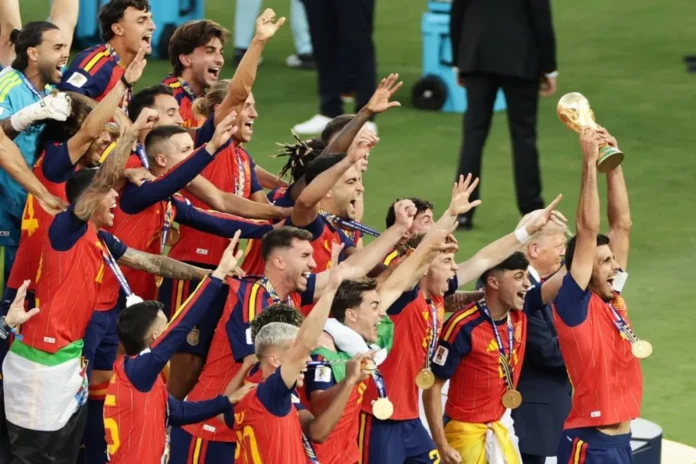

Spain has been crowned champion of the 2026 FIFA World Cup, defeating Argentina 1-0 in extra time at New York New Jersey Stadium in East Rutherford on Sunday, July 19, capping the largest sports spectacle on earth with a genuinely dramatic finish. The global spotlight reached its peak during halftime, when BTS took over the pitch for a full scale performance of “Dynamite,” giving the record breaking television audience a moment that felt as much like a global concert event as a football match. What followed the final whistle, though, quickly overshadowed even that historic halftime production, as tensions between the two teams boiled over into chaotic, unsportsmanlike scenes that unfolded in front of the watching world.
The trouble began almost immediately after the match ended. Frustrated by the loss, Argentina midfielder Leandro Paredes physically struck Spain’s Eric García and grabbed him near the throat in the moments right after the final whistle. Paredes then turned his attention to Spanish midfielder Gavi, wrestling with him and shoving him to the ground as the Spanish bench rushed onto the field to begin celebrating their victory. In a separate but overlapping altercation, Argentina’s Thiago Almada was caught on camera delivering a physical strike against Gavi during the same chaotic stretch. The referee issued Paredes a straight red card after the match specifically for his conduct in the incident, a decision that followed an earlier red card shown to Enzo Fernández in the 93rd minute of regulation play, meaning Argentina finished the match and its immediate aftermath with two separate players sent off for serious misconduct.
The tension did not end once order was restored on the field. During the trophy ceremony itself, the entire Argentina squad collectively turned their backs toward the stage as Spanish captain Rodri prepared to lift the FIFA World Cup trophy, a gesture that drew immediate and widespread criticism from international broadcasters and commentators, several of whom characterized the display as classless given the moment’s significance for Spain’s players and fans. Global sports outlets and fans across social media were quick to brand Argentina’s team as sore losers in the hours following the match, arguing that the squad had failed to extend even a baseline level of sportsmanship to the newly crowned world champions standing just feet away from them.
Sunday’s final had already carried genuinely historic stakes before any of that postgame drama unfolded. Spain’s extra time victory secured the country’s title as world champion in a match many observers had expected to hinge on Argentina’s ability to manufacture a late breakthrough against the tournament’s most disciplined defense, and the 1-0 scoreline suggests exactly that kind of tightly contested, tension filled contest played out for the full 120 minutes before Spain finally broke through. Instead of a clean, celebratory conclusion befitting the scale of the tournament and its record setting global audience, the match will now be remembered at least in part for the physical altercation that erupted in its immediate aftermath and the pointed, widely criticized gesture that followed during what should have been a purely celebratory trophy presentation.
With Spain now officially the 2026 World Cup champion, attention is likely to shift quickly toward how FIFA and the sport’s broader governing bodies respond to Sunday’s postgame conduct, both the physical altercation involving Paredes, García, Gavi, and Almada, and the trophy ceremony protest carried out by the entire Argentina squad. For a tournament that had otherwise delivered on its promise as the largest and most watched World Cup in history, the closing moments in East Rutherford leave the sport’s governing bodies, its broadcasters, and its global audience grappling with exactly how a championship of this magnitude should be remembered when the final whistle marks not the end of the drama, but a genuinely ugly new chapter of it.