
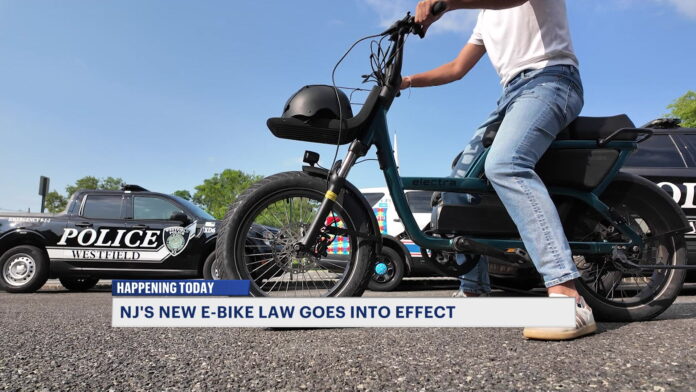

New Jersey commuters faced a genuinely significant shift in the rules of the road this week, as the state’s strict new e-bike law officially took effect on July 19, 2026, marking the end of a six month grace period that gave riders time to adjust before enforcement began in earnest. Enacted specifically to address a spike in serious e-bike related accidents across the state, the new framework eliminates the traditional three class e-bike system entirely and reclassifies nearly all e-bikes under regulatory rules previously reserved for mopeds and other motorized vehicles.
The law introduces genuinely specific age and licensing requirements that every rider now needs to understand before getting on the road. No one under the age of 15 is legally permitted to operate an e-bike on public roadways under any circumstance. Riders age 17 and older who already hold a valid, standard New Jersey driver’s license do not need any additional special licensing to operate an e-bike. For teens ages 15 and 16, along with any adult who does not hold a standard driver’s license, the law requires passing a vision test, a knowledge exam, and a practical road test through the New Jersey Motor Vehicle Commission specifically to earn a specialized motorized bicycle license before legally operating an e-bike on state roads.
Beyond licensing, every single e-bike operated within New Jersey must now be formally registered with the MVC and carry an actual license plate, treating e-bikes considerably more like traditional motorized vehicles than the informal bicycle accessory many riders previously considered them. To complete that registration, owners need to book an appointment directly at an MVC Licensing Center and provide six points of identity along with proof of ownership, such as an original purchase receipt or a notarized bill of sale. To help ease the transition for riders navigating this entirely new process, the state has waived both registration and licensing fees for the law’s first year, removing at least the financial barrier to compliance during this initial rollout period.
Insurance requirements under the new law vary depending on exactly what kind of e-bike a rider owns. Motorized bicycles, defined under the law as e-bikes that use a throttle to move without active pedaling, or any e-bike capable of reaching speeds up to 28 miles per hour, must now carry independent liability insurance, making New Jersey the first state in the country to mandate this kind of coverage specifically for e-bikes. That requirement catches many riders off guard, since traditional homeowners, renters, and standard auto insurance policies typically do not extend coverage to e-bike liability at all, meaning affected riders need to secure a dedicated micromobility or motorized vehicle policy specifically to remain compliant. Riders operating pure pedal assist models capped at 20 miles per hour, formerly classified as Class 1 e-bikes, remain exempt from that insurance mandate, though they still need to comply with the law’s standard licensing and registration requirements.
The new rules extend well beyond licensing and insurance into genuine roadway safety requirements as well. Wearing a helmet is now mandatory for every e-bike operator regardless of age, closing a gap that previously left adult riders without any helmet requirement at all. E-bikes are now formally classified as road vehicles, meaning they’re banned from sidewalks and natural surface trails unless a specific local town ordinance explicitly states otherwise, a change that will require many riders to adjust routes they may have used for years. Every e-bike must also be equipped with an audible horn or bell capable of being heard from 100 feet away, along with a white front headlight and a red rear taillight for night riding, standard safety equipment requirements similar to what’s long applied to mopeds and motorcycles. The law also places a one year ban on online sales of e-bikes shipped directly to New Jersey residents, and it strictly outlaws conversion kits specifically designed to modify a standard bicycle into a higher speed e-bike, closing off a workaround some riders had previously used to sidestep the state’s classification system entirely.
Enforcement carries real financial consequences for anyone who fails to comply. Riders caught operating an unregistered e-bike, or riding without active proof of the required license, face fines starting at $50, and local law enforcement is authorized to immediately impound noncompliant e-bikes on the spot rather than simply issuing a citation and allowing the rider to continue on.
The law has drawn genuine pushback from local transit advocacy groups, including the New Jersey Bike and Walk Coalition, which has argued that the new rules disproportionately punish commuters, low income workers, and food delivery couriers who depend on low cost micromobility options to get to work each day. The coalition has specifically raised concerns that many of these riders may lack the kind of documentation required to satisfy the MVC’s six point identity verification system, potentially locking out exactly the population that relies most heavily on affordable e-bike transportation in the first place. That tension between the state’s stated safety goals and advocates’ concerns about equitable access is likely to remain a genuine point of debate as enforcement of the new law continues rolling out across New Jersey’s cities and towns in the weeks ahead.
















