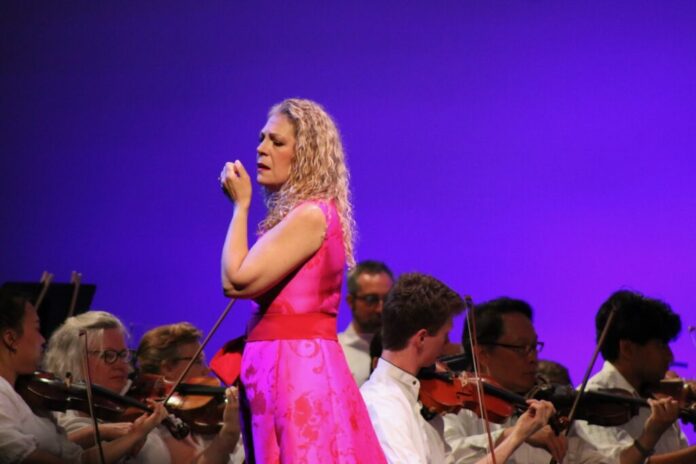

Sondra Radvanovsky is, by any reasonable measure of contemporary operatic achievement, one of the finest dramatic sopranos performing today — a singer whose career has included acclaimed appearances at the Metropolitan Opera, La Scala, and the Royal Opera House, and whose interpretations of the Verdi heroine repertoire are regarded among the most accomplished of her generation. Her June 6 appearance with conductor Rossen Milanov and the Princeton Symphony Orchestra at the Performance Pavilion at Morven Museum and Garden should have been one of the marquee events of this summer’s Princeton Festival season. According to the published critical review of the performance, it instead became a case study in how a constellation of preventable production and logistical failures can undermine even an artist of genuine stature — not because of any deficiency in her singing, but because of choices made entirely apart from it.
The distinction matters, and it is worth establishing clearly before examining what reportedly went wrong. Nothing in the available critical account suggests any failure of musicianship on Radvanovsky’s part. What the review describes instead is an evening in which the conditions surrounding her performance — rehearsal time, conductor positioning, sound engineering, and weather-driven scheduling disruption — combined to prevent the kind of evening her artistry should have produced.
The Rehearsal Problem: What “One-Off” Festival Programming Costs
The most structurally significant issue identified in the critical coverage concerns the fundamental nature of festival programming itself. Unlike a resident opera company that rehearses a production over weeks before opening night, a one-off festival concert — a single performance assembled around a guest soloist appearing with a regional orchestra for one evening — operates on a dramatically compressed preparation timeline. The review’s account of the evening’s technical shortcomings points directly to this structural reality: delicate musical nuance, the kind that depends on a soloist and an orchestra developing shared instinct for tempo, breath, and dynamic shading through repeated rehearsal, reportedly disappeared in several passages, with the Verdi duets singled out as containing clunky, under-prepared transitions.
This is a genuine and common challenge in the festival concert format generally, not a problem unique to Princeton. Verdi’s vocal writing, and particularly the duet passages that define much of his most celebrated repertoire, depends on an almost conversational level of coordination between singer and orchestra — moments where the vocal line and the orchestral accompaniment must breathe together in ways that are rehearsed into instinct rather than simply read from a score. A single rehearsal period, however professionally conducted, places real limits on how fully that coordination can be achieved, particularly when the material involves the kind of rubato and flexible tempo that Verdi’s dramatic duets require. The review’s account suggests that limit was reached and exceeded on this occasion.
A Conductor Who Could Not Be Seen
The most specific and, in terms of basic production planning, most avoidable failure described in the review concerns the physical positioning of conductor Rossen Milanov relative to the singers. According to the account, Milanov was placed behind the vocalists during the performance — a staging configuration that meant the singers could not see him and therefore could not follow his cues in the way that operatic performance fundamentally requires.
This is worth dwelling on because it represents a basic production planning failure rather than an artistic or interpretive shortcoming. Conducting opera is, at its core, an act of continuous visual communication between the podium and the stage: tempo adjustments, dynamic shifts, entrance cues, and the thousands of micro-coordinations that make a live operatic performance function as a unified artistic event all depend on the singers being able to see the conductor clearly and consistently throughout the performance. When that sightline is obstructed or eliminated by the physical staging of the event, even an experienced and highly capable conductor — and Milanov, who has built a substantial career as a respected orchestral leader, is unquestionably that — is reduced to a far more limited function. The review describes exactly this outcome: a conductor essentially reduced to keeping time and reactively trying to correct ensemble problems as they arose, rather than actively shaping the performance’s musical flow and dramatic momentum in real time.
The consequence, as described, was the elimination of the natural give-and-take between conductor and soloist that defines a great operatic performance — the sense of an evening unfolding with shared spontaneity rather than mechanical execution. This is a staging and production design failure, and one that should have been identified and corrected during the planning process for an event of this caliber, well before a world-class soprano took the stage.
The Sound Engineering Problem
A third issue identified in the review concerns the audio reinforcement system used in the Performance Pavilion’s tent structure — a venue that, by its outdoor and temporary nature, requires substantial electronic sound amplification to project orchestral and vocal sound effectively to the full audience. The review specifically describes an uneven electronic enhancement that produced a sharp, unnatural quality in the amplified sound whenever Radvanovsky sang at higher volumes — a metallic glare, in the review’s characterization, that compromised the natural beauty of her voice precisely at the moments when that voice was working hardest and should have been most rewarding to hear.
This is a sound engineering and calibration issue rather than an inherent limitation of amplified outdoor performance generally. Properly calibrated sound reinforcement can manage the dynamic range of a powerful operatic voice without introducing the kind of harsh artifacts the review describes; the fact that this particular performance reportedly produced that result suggests either inadequate calibration for this specific singer’s vocal characteristics, equipment limitations, or insufficient sound-check time built into an evening that was already operating on a compressed production schedule. For a soprano of Radvanovsky’s caliber, whose vocal control and dynamic shading are central to her artistic reputation, an amplification system that distorts those qualities at climactic moments represents a significant failure to showcase the artist the audience came to hear.
Weather, Delay, and the Compounding Effect on Pacing
The evening’s challenges were compounded by circumstances genuinely outside anyone’s control: severe thunderstorms and lightning activity in the region forced a delay of nearly an hour before the performance could begin, with the audience evacuated to an adjacent education building on the Morven grounds to wait out the weather before being permitted to return to the pavilion. By the time the concert finally started, the accumulated heat and humidity inside the tent — a structure that, as with any outdoor venue, lacks the climate control of a purpose-built concert hall — had created physically uncomfortable conditions for both performers and audience.
The review’s account suggests that this weather-driven delay did not simply inconvenience the evening’s schedule; it compounded the other production issues already in play. A performance already compromised by insufficient rehearsal time and a conductor positioned where singers could not see him became, in the accumulated heat and after an hour’s delay, an evening whose already-rigid pacing felt even more pronounced and difficult to sustain. The audience’s patience and physical comfort, already tested by the weather delay, had less reserve left to extend toward whatever technical rough edges the performance subsequently presented.
Separating the Artist From the Evening
What emerges from this account is not a critique of Sondra Radvanovsky’s artistry, which by every indication remains exactly what her international reputation suggests: among the finest dramatic soprano voices working in opera today. It is, instead, a documentation of how festival production logistics — rehearsal scheduling, conductor staging, sound engineering calibration, and weather contingency planning — can together undermine the conditions an artist of this caliber needs to deliver the performance her talent is capable of producing.
Each of the specific issues identified is, in principle, addressable through better advance planning. Conductor sightlines are a solvable staging problem. Sound calibration for a specific soloist’s voice is a solvable engineering problem, provided adequate sound-check time is built into the production schedule. Even the rehearsal time constraint inherent to one-off festival concert programming, while a structural feature of the format rather than a simple oversight, can be partially mitigated through more generous advance rehearsal scheduling for marquee events featuring soloists of this stature.
For audiences who attended the June 6 performance hoping to experience Radvanovsky’s celebrated interpretive power in Verdi repertoire, the evening’s reported shortcomings represent a missed opportunity rather than a referendum on what she is capable of delivering under better circumstances. For the Princeton Festival’s organizers, the specific and documented nature of each production failure — rehearsal time, conductor positioning, sound calibration, weather contingency — offers a clear roadmap for what needs to change before the next marquee soloist takes the Performance Pavilion stage. An artist of Radvanovsky’s stature, performing repertoire this demanding, deserves production conditions equal to her talent. On this particular evening, by the critical account available, that equation did not balance.