
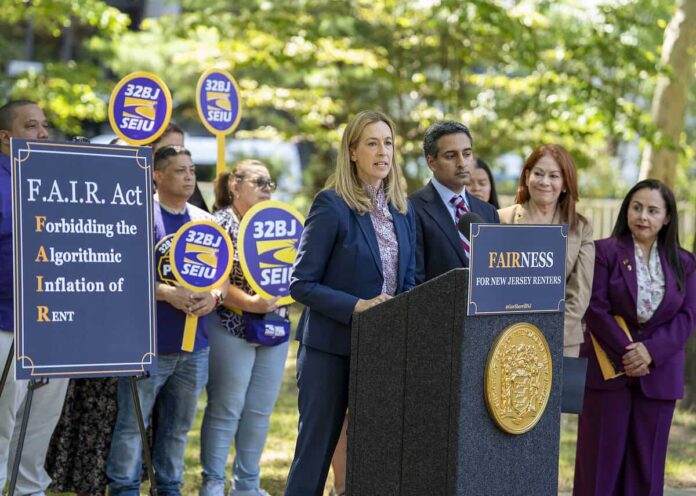

New Jersey has taken another significant step in its ongoing effort to address housing affordability with the enactment of the Forbidding the Algorithmic Inflation of Rent (FAIR) Act, legislation that establishes new restrictions on the use of algorithmic rent-setting systems in the residential housing market. Signed into law by Governor Mikie Sherrill, the measure is designed to prevent the use of software that can contribute to artificially inflated rental prices and reduced market competition, strengthening consumer protections for renters throughout the Garden State.
The new law arrives at a time when housing affordability remains one of the most pressing issues facing New Jersey residents. Rising rental costs have placed increasing pressure on households across urban, suburban, and rural communities, prompting lawmakers to examine how emerging technologies are influencing the rental marketplace. The FAIR Act directly addresses concerns surrounding algorithm-driven pricing systems that can recommend rental rates based on shared market data and occupancy trends, practices critics argue may reduce healthy competition among property owners.
By establishing clear rules governing the use of these technologies, New Jersey is seeking to ensure that rental pricing reflects legitimate market competition rather than automated systems capable of producing coordinated pricing recommendations across multiple housing providers. The legislation represents one of the state’s latest initiatives aimed at improving housing affordability while promoting greater transparency within the rental housing industry.
At the center of the FAIR Act is the regulation of algorithmic rent-setting software. These systems analyze large amounts of market information, including rental prices, vacancy rates, occupancy levels, and other housing data, to generate pricing recommendations for landlords and property management companies. While technology has become an increasingly common part of the real estate industry, lawmakers expressed concern that certain automated pricing models may discourage genuine market competition by encouraging similar pricing strategies across competing properties.
Under the FAIR Act, the use of algorithmic systems that facilitate coordinated rent-setting or occupancy decisions is explicitly regulated to help prevent practices that could artificially increase rental prices. The legislation seeks to reinforce the principle that landlords should compete independently by offering attractive pricing and housing options rather than relying on software that may contribute to market-wide price increases.
Supporters of the legislation argue that advances in technology should not come at the expense of housing affordability. As algorithmic pricing platforms become more widely adopted throughout the real estate industry, policymakers have increasingly examined their potential effects on consumers, particularly in markets where housing demand already exceeds available supply. By addressing these concerns through state law, New Jersey joins a broader national conversation about the role of artificial intelligence, data analytics, and automated decision-making in highly competitive industries.
Governor Mikie Sherrill signed New Jersey’s Forbidding the Algorithmic Inflation of Rent Act, known as the FAIR Act, into law on July 20, 2026, officially prohibiting landlords from using AI powered software to artificially inflate rental prices. The law directly targets property management software platforms like RealPage, which pool nonpublic pricing and vacancy data from competing landlords in order to coordinate rent pricing across an entire market rather than allowing each property to set prices independently. State officials have described the practice bluntly as collusion by algorithm, arguing that it effectively eliminates genuine market competition and drives rental costs upward for tenants who have no way of knowing that the price they’re being quoted was shaped by data shared among their landlord’s competitors.
The FAIR Act’s core provisions target that practice from several distinct angles at once. The law prohibits landlords from using software that analyzes competitor pricing, housing supply levels, lease termination dates, or occupancy rates specifically to set parallel rent prices across otherwise competing properties, closing off the exact mechanism that allowed landlords to effectively coordinate pricing without ever directly communicating with one another. It also restricts the underlying data sharing that makes this kind of software function in the first place, outlawing the practice of feeding private, sensitive rental data into these shared algorithmic pools, effectively shutting down the data pipeline that fuels corporate rent setting software at its source.
To give the law genuine enforcement weight, violations are classified directly under the New Jersey Antitrust Act, giving state officials considerably stronger legal leverage against corporate landlords who might otherwise attempt to work around the new restrictions through more subtle means. The law also mandates that the state Attorney General establish a public complaint portal on the Department of Law and Public Safety’s website, giving individual renters a direct, accessible way to report suspected violations rather than relying entirely on state investigators to uncover algorithmic pricing schemes on their own.
The FAIR Act will not take effect immediately. Under its enactment timeline, the law becomes operational on the first day of the twelfth month following its signing, meaning full enforcement will begin by summer 2027. That delayed timeline gives landlords and software providers a genuine window to adjust their existing pricing systems and data sharing arrangements before the law’s antitrust penalties and complaint portal become fully active.
New Jersey’s move places it as the fourth state in the country to pass explicit regulations specifically targeting algorithmic rent setting software, joining a small but growing group of states responding to mounting concern over how these platforms have reshaped rental markets in recent years. The law builds directly on top of earlier, narrower local bans already passed by cities including Jersey City and Hoboken, effectively taking what had been a patchwork of individual municipal restrictions and consolidating enforcement power at the state level instead. That shift matters considerably in practice, since state investigators generally hold stronger legal tools and broader jurisdiction to pursue large, multimillion dollar corporate landlords than individual city governments typically have access to on their own.
Assemblywoman Lopez, Chair of the Assembly Housing Committee, emphasized the importance of protecting New Jersey residents from housing practices that may place additional financial burdens on renters. She noted that algorithm-driven pricing has the potential to contribute to an already challenging housing environment by enabling rental increases that are driven by technology rather than traditional competitive market forces. The FAIR Act, she said, provides an important safeguard against practices that could make housing less accessible for families across the state.
Governor Mikie Sherrill likewise identified housing affordability as one of New Jersey’s defining public policy challenges, describing the legislation as part of a broader effort to improve affordability through coordinated action across state government. According to the Governor’s Office, the FAIR Act complements other housing initiatives by reinforcing competitive market principles while ensuring that technological innovation does not undermine consumer protections.
Housing affordability continues to influence communities throughout New Jersey. Rising rental costs affect not only individuals seeking apartments but also families, young professionals, seniors on fixed incomes, essential workers, and recent graduates entering the workforce. As rental expenses consume a growing share of household budgets, policymakers have increasingly focused on reforms designed to encourage fair competition while expanding access to affordable housing opportunities.
The passage of the FAIR Act reflects the state’s evolving approach to housing policy in an increasingly digital economy. Artificial intelligence, predictive analytics, and algorithmic software now influence numerous industries, from finance and healthcare to transportation and retail. The housing market is no exception, and lawmakers have recognized the importance of ensuring that technological tools operate within clear legal boundaries that protect consumers while preserving competitive markets.
Industry observers will be watching closely as the FAIR Act is implemented to understand how landlords, property management companies, and software providers adapt to the new regulatory framework. The legislation establishes expectations regarding the appropriate use of automated pricing technologies while reinforcing New Jersey’s commitment to maintaining a fair housing marketplace.
For renters, the law represents an additional layer of protection intended to discourage practices that could contribute to unnecessary rent increases. Although housing affordability remains a complex issue influenced by supply, demand, construction costs, interest rates, and broader economic conditions, policymakers view the regulation of algorithmic pricing as one meaningful component of a larger strategy to improve access to housing across the state.
As New Jersey continues addressing the challenges of housing affordability, the FAIR Act signals the state’s willingness to respond to emerging technologies that have the potential to reshape the rental marketplace. By regulating algorithmic rent-setting systems while promoting competition among housing providers, state leaders aim to create a more balanced environment where market forces, rather than coordinated automated pricing, determine rental costs.
The enactment of the FAIR Act marks another chapter in New Jersey’s ongoing efforts to strengthen renter protections while modernizing housing policy for an increasingly technology-driven economy. As implementation moves forward, renters, landlords, housing advocates, and industry professionals alike will be watching to see how the legislation influences one of the state’s most important economic and quality-of-life issues.
Taken together, the FAIR Act represents a genuinely significant shift in how New Jersey approaches rental market regulation, moving beyond the individual city level bans that first emerged in Jersey City and Hoboken and establishing a unified statewide framework backed by real antitrust enforcement authority. For tenants across New Jersey navigating an already difficult rental market, the law offers both a direct legal prohibition against algorithmic price coordination and a genuinely accessible way to report suspected violations once the complaint portal goes live, giving renters a formal mechanism to push back against pricing practices that had, until now, largely operated outside their view entirely.
















