
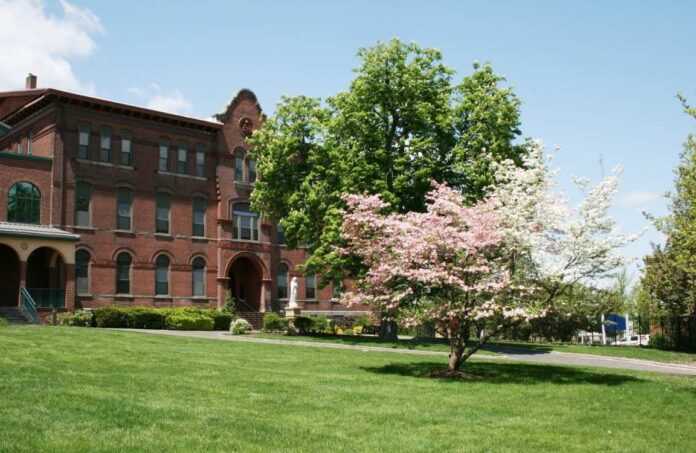

New Jersey’s nonprofit organizations play an essential role in the state’s economy and its communities, providing critical services across education, healthcare, social services, and countless other areas that often go quietly unrecognized. This ongoing series is dedicated to highlighting the nonprofit organizations making a genuine difference across the state, alongside the leaders, volunteers, and individuals who bring their missions to life every single day. The series begins in Newark, at St. Vincent Academy, where three women, a school president, a longtime board chair, and a recent graduate, together illustrate exactly the people, purpose, and impact behind the school’s work.
Saint Vincent Academy has served Newark since 1869, when the Sisters of Charity of Saint Elizabeth founded the school specifically to educate young women. More than a century and a half later, it remains the only four year Catholic high school exclusively for young women operating anywhere in the city, a distinction that carries genuine weight given how much the surrounding urban landscape has changed since the school’s founding. The academy serves a genuinely diverse population of urban young women, many coming from families navigating real economic and societal challenges, and it has built its entire educational philosophy around combining rigorous academic preparation with values based Gospel teaching, creating a highly supportive, disciplined community rather than treating academics and character formation as separate pursuits.
That approach has produced genuinely extraordinary academic outcomes over the decades. St. Vincent Academy maintains a consistent 100 percent graduation rate alongside a 100 percent college acceptance rate for its graduating seniors, a track record sustained across a student body of roughly 200 to 235 students spanning grades nine through 12. The school backs that academic rigor with genuinely modern facilities, including two state of the art biomedical science labs, and it maintains an unusually favorable student to teacher ratio of roughly 7 to 1 or 8 to 1, giving students the kind of individualized attention that larger schools simply cannot replicate. Beyond the classroom itself, the school’s Students in Community program formally integrates student volunteer work and local career development directly into the high school curriculum, ensuring students graduate with genuine real world engagement rather than academic preparation alone. The academy has maintained continuous accreditation through the Middle States Association of Colleges and Schools Commission on Secondary Schools since 1990, a formal marker of the consistent institutional quality underlying all of these outcomes.
Behind those numbers sits Joan Tyburczy, who stepped into the role of school president a few years ago carrying genuine institutional depth, having spent 18 years teaching in the school’s freshman program before serving five additional years as principal. Following her beloved predecessor, Sister June Favata, who built a powerful and lasting legacy of excellence at the school, Tyburczy has become a strong guiding influence in her own right, helping St. Vincent Academy navigate genuine shifts in the broader academic world, from evolving learning techniques and shifting workforce expectations to the extraordinary impact of artificial intelligence and rapid technological change. Staying ahead of those currents while keeping the school genuinely poised for whatever comes next sits at the very core of how St. Vincent Academy approaches its mission today.
Tyburczy’s own guiding philosophy centers on a deep commitment to combining exemplary education with genuine empowerment through faith. Students at St. Vincent face a genuinely rigorous secular curriculum, but they’re challenged just as seriously to look inward, develop a real moral compass, think critically, and accept a genuine obligation to serve others with compassion. To support that dual mission, the school’s coursework extends beyond traditional academic subjects into classes on social justice and current events, enriching students’ lives while encouraging them to enrich the lives of those around them in turn. As Tyburczy moves through the student body day to day, guiding, encouraging, and supporting the young women in her care, she consistently reminds them that each of them carries genuine purpose and genuine value, and that the world genuinely needs what they have to offer. Among the many lessons she’s carried through her years of leadership, she often returns to a handful of core truths, that there is always something left to give, that today’s failures become tomorrow’s solutions, that learning should remain a lifelong joy, that real success requires genuine partnership and trust in others, and that following one’s gut instinct in decision making should never be something to fear.
Where Tyburczy leads from within the school itself, Board Chair Regina Daly has spent 32 years demonstrating exactly why people choose to dedicate themselves to St. Vincent Academy’s mission in the first place. Regina and her husband Emmett have long believed that access to a genuinely good education represents the single best hope for the future, a conviction that took shape when they were still young adults themselves and first committed to helping ensure educational access for students in underserved communities who couldn’t otherwise afford strong academic opportunities. That mission led them to Sister June Favata in September 1994, connecting through their mutual involvement with Student Partner Alliance, a nonprofit where Emmett serves as president and Regina manages financial matters. During that very first conversation, Sister June described the genuinely impressive accomplishments of St. Vincent’s students, and Regina found herself immediately drawn to both the organization and the young women it served.
Over the past three decades, Regina’s involvement with St. Vincent Academy has evolved considerably, moving from assisting with bookkeeping matters into mentoring, serving on the advisory board, taking on the role of treasurer, and eventually becoming chair of the board of directors. Throughout that entire evolution, what has mattered most to Regina has never been the title itself, but rather showing up meaningfully at every level of school life, sitting on the sidelines during softball games, filling seats in the audience at plays and spring concerts, taking photos at pre-prom gatherings, attending holiday parties, mentoring individual students, and participating in graduation ceremonies, seven of them so far. With a genuinely sharp eye on the school’s financial realities, Regina has consistently highlighted the critical work carried out by the advancement and development committees, drawing attention to a significant funding gap the school navigates every year, with roughly $22,000 needed per student annually against just $6,300 collected through tuition alone. Across more than three decades in various roles, Regina has distilled her experience into a handful of consistent lessons, understanding an organization’s financial reality deeply, getting involved at every level to genuinely appreciate its mission, supporting education for all as society’s best hope, and actively advocating for the organization by introducing its mission to anyone new she meets.
The genuine impact of that combined leadership shows clearly in the story of Di’Dyana Rutty, a member of St. Vincent Academy’s Class of 2026. After spending the majority of her childhood in Newark’s public school system, Di’Dyana began considering different paths for her future as she approached grammar school graduation, prompted in part by a guidance counselor who pushed her to think seriously about her high school options, and by her own parents, who had expressed hope for a stronger educational path for their daughter. That guidance counselor eventually introduced her to St. Vincent Academy, and after submitting her application, Di’Dyana was accepted into the school’s Promise Scholar Program, receiving a full four year scholarship to attend.
When she first arrived at St. Vincent, Di’Dyana was genuinely shy, hesitant to raise her hand in class and prone to second guessing herself. That didn’t last long. Over time, she found herself part of a genuine community that allowed her to become fully herself, one where teachers recognized potential in her before she recognized it in herself, challenging her not just academically but personally, asking questions that forced deeper, more critical thinking, and encouraging her to speak up even when her voice felt small. Through that sustained encouragement, Di’Dyana gradually stepped into leadership roles throughout the school, serving as president, vice president, and secretary of multiple clubs, and co-founding programs both on and off campus, steadily recognizing the genuine capability she possessed all along.
Just as meaningful to her experience was the genuine sisterhood she found among her classmates, girls she has come to consider true sisters rather than simply schoolmates. When Di’Dyana lost her mother at the end of her sophomore year, it was that same sisterhood that stood beside her and lifted her up through prayer and support, a bond that extended beyond her own graduating class to include underclassmen she now considers like little sisters of her own. As her confidence grew, so did her academic performance, supported directly by the school’s Student Services team, whose staff provided consistent guidance, resources, and encouragement, reminding her repeatedly that opportunities she once assumed were out of reach were genuinely within her grasp. With that support behind her, Di’Dyana applied through the QuestBridge National College Match, an organization connecting high school seniors with leading American colleges and full four year scholarships, and she was ultimately selected among roughly the top 10 percent of QuestBridge applicants awarded a scholarship. This fall, she will attend Boston University.
When Di’Dyana received that acceptance letter, she understood immediately that the achievement belonged to considerably more than herself alone, to every teacher who urged her forward, every friend who supported her, and every member of her community who believed in her potential before she fully believed in it herself. Reflecting on her full journey from that shy, hesitant freshman to the confident young woman preparing for Boston University, she traces it all back to a single turning point, the Promise Scholarship that first gave her access to St. Vincent Academy. That scholarship offered her considerably more than a simple opportunity. It gave her an education that shaped her, a community that supported her, and a future that once felt entirely out of reach. For Di’Dyana, and for every other student who walks through St. Vincent Academy’s doors under that same program, the Promise Scholarship remains exactly what its name suggests, a genuine promise that individual potential will be recognized, that real opportunity will be extended, and that young women like Di’Dyana will have the chance to grow fully into who they are meant to become.
















