
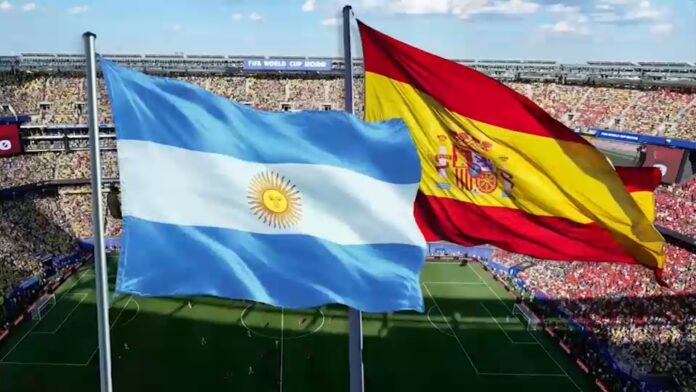

Some sporting events fill a stadium. Others stop the world entirely. Today’s 2026 FIFA World Cup Final between Spain and Argentina, kicking off at 3 p.m. Eastern at New York New Jersey Stadium in East Rutherford, belongs unmistakably to the second category. It is a collision between two of the most complete national programs the sport has produced in this generation, a genuinely rare generational confrontation between a 39-year-old icon and a 19-year-old heir apparent, and the single most anticipated match international football has staged in years.
Fan Guide: Getting to New York New Jersey Stadium & Key Players to Know
Getting There: Parking & Gate Times
- Parking lots open: 10:00 AM
- Stadium gates open: 11:00 AM
- Closing ceremony begins: 1:30 PM (headlined by Post Malone)
- Kickoff: 3:00 PM Eastern
Transit & Access Tips
- NJ Transit rail service launched 30 minutes earlier than usual (starting 10:30 AM) to help manage historic traffic volume
- Arrive early: with 80,663 fans expected plus road closures throughout East Rutherford, allow extra time beyond a typical event day
- Venue is entirely cash-free — bring a card or mobile payment method
- Clear Bag Policy is in full effect — no backpacks or large non-transparent bags; clear totes/backpacks are the safe option
- Bring your ticket and ID; allow time to pass through security given the scale of the event
Pregame & Halftime Entertainment Schedule
- 1:30 PM: World Cup Closing Ceremony, headlined by Post Malone, featuring Tom Cruise, Jennifer Hudson, Robbie Williams, and IShowSpeed
- 3:00 PM: Kickoff, Spain vs. Argentina
- Halftime: Concert curated by Chris Martin (Coldplay), featuring BTS, Shakira, Madonna, and Justin Bieber
- Postgame: Trophy presentation, attended by President Trump and FIFA President Gianni Infantino
Team Breakdown & Key Players
Spain (La Roja)
Head Coach: Luis de la Fuente Tournament Record: 7-0-1 (one scoreless draw vs. Cape Verde; six straight knockout wins) Goals Conceded: 1 (across 7 matches — best defensive record in the tournament) Path to the Final:
- Round of 32: def. Austria, 3-0
- Round of 16: def. Portugal, 1-0
- Quarterfinal: def. Belgium, 2-1
- Semifinal: def. France, 2-0
Players to Watch:
- Rodri (Midfielder): 648 completed passes this tournament, most of any player in the competition; the structural engine of Spain’s possession game
- Mikel Oyarzabal (Forward): Team’s leading scorer, 5 goals
- Lamine Yamal (Winger, age 19): Barcelona prodigy, working back from a pre-tournament injury; elite one-on-one dribbler on the right wing
- Mikel Merino (Midfielder): Scored match-winning goals in back-to-back knockout rounds
Argentina (La Albiceleste)
Head Coach: Lionel Scaloni Tournament Record: Defending champions; 18 goals scored, most in the tournament Signature Trait: 9 of 18 goals scored in the 75th minute or later Path to the Final:
- Round of 32: def. Cape Verde, 3-2
- Round of 16: def. Egypt, 3-2 (comeback win)
- Quarterfinal: def. Switzerland, 3-1 (extra time)
- Semifinal: def. England, 2-1 (trailed, scored twice late)
Players to Watch:
- Lionel Messi (Forward, age 39): 8 goals in 7 matches this tournament; all-time World Cup leading scorer with 21 career tournament goals; playing in his final World Cup
- Lautaro Martinez (Forward): Scored the semifinal winner; 3 tournament goals
- Enzo Fernandez (Midfielder): Scored the semifinal equalizer; drives Argentina’s midfield buildup
Head-to-Head History
- All-time meetings: 14
- Record: 6 wins Spain, 6 wins Argentina, 2 draws
- Most recent meeting: Spain won 6-1 (2018 friendly)
- Pre-match win probability: Spain 59%, Argentina 41% (per Opta supercomputer model)
Quick Reference: By the Numbers
| Category | Spain | Argentina |
|---|---|---|
| Goals scored | — | 18 (tournament high) |
| Goals conceded | 1 | — |
| Tournament record | 7-0-1 | 7-0-0 |
| Key stat | Rodri: 648 passes | Messi: 8 goals, 21 career WC goals |
| Style | Possession, defensive discipline | Absorb pressure, late-game strikes |
MetLife Stadium has taken on its temporary tournament identity as New York New Jersey Stadium for the duration of the World Cup, and today’s final caps a run that already included hosting the 2025 FIFA Club World Cup final and both of that tournament’s semifinals. The stadium holds 80,663 spectators in its football configuration, and this afternoon that capacity crowd will be joined by hundreds of millions more watching around the globe, a viewership expected to rank among the largest in the history of televised sport. Placing the final in the New York metropolitan area reflects the tournament’s broader ambitions for its first American hosting in more than three decades, situating the match directly across the Hudson from the Manhattan skyline while giving New Jersey itself a genuinely historic moment on the world sporting stage.
The two finalists arrived here by traveling almost entirely opposite roads through the tournament, and that contrast is exactly what makes today’s matchup so compelling. Spain, under head coach Luis de la Fuente, entered the World Cup as reigning European champions after winning all seven matches at Euro 2024, and they have carried that same controlled, technically dominant identity straight through this tournament. Their only blemish across eight matches was a scoreless draw against Cape Verde in group play, followed by six consecutive wins of escalating authority, a 3-0 rout of Austria in the Round of 32, a 1-0 win over Portugal in the Round of 16 that sent Cristiano Ronaldo home without ever lifting the trophy, a 2-1 quarterfinal win over Belgium, and a genuinely commanding 2-0 semifinal shutout of France in which Kylian Mbappé and Ousmane Dembélé never found their footing. Spain has conceded a single goal across the entire tournament, a defensive record that borders on historic given the caliber of attacking talent they’ve faced along the way.
The numbers behind that dominance trace directly back to midfielder Rodri, who has completed 648 passes this tournament, more than any other player in the competition, functioning as the connective tissue between Spain’s defense and attack. Mikel Oyarzabal leads the team with five goals, while 19-year-old Barcelona prodigy Lamine Yamal has remained a persistent threat on the right wing even while working back from a pre-tournament injury, his ability to beat defenders one on one already drawing comparisons to the finest wide players the sport has ever produced.
Argentina’s path tells an entirely different story. The defending champions have not won by suffocating opponents with organization or overwhelming statistical control. They have won because they have Lionel Messi, and because when matches tighten deep into the second half, Messi continues finding moments no one else in the sport can manufacture. Argentina has scored 18 goals at this World Cup, more than any other team, and nine of those goals have arrived in the 75th minute or later, a pattern that reflects exactly how Lionel Scaloni’s side is built to absorb pressure and strike late. Their knockout run reflected that identity directly, a 3-2 win over Cape Verde, a dramatic 3-2 comeback against Egypt in the Round of 16, a 3-1 extra time win over Switzerland in the quarterfinals, and a 2-1 semifinal win over England in which Argentina trailed before scoring twice late to advance.
Messi enters today’s final having scored eight goals in seven matches, making him the all time leading World Cup goal scorer with 21 tournament goals across his career, a record that continues to defy every conventional expectation about what a 39-year-old should still be capable of on football’s biggest stage. Lautaro Martinez, who scored the semifinal winner, and Enzo Fernandez, who scored the semifinal equalizer and continues to drive Argentina’s midfield, round out a squad that remains genuinely formidable well beyond its most famous player.
Beyond the tactical matchup, today’s final carries a human storyline that elevates it well past even its considerable competitive stakes. A photograph exists, taken years ago during a charity event organized by Diario Sport and UNICEF, showing a baby receiving a hug from Lionel Messi. That baby was Lamine Yamal. The image resurfaced and went viral after Yamal’s own father shared it following Euro 2024, and the symbolism of that same child now taking the field opposite the man who once held him, in the biggest match either player will ever compete in, is the kind of story no work of fiction would dare invent. Yamal himself told RAC1 before the Euro 2024 final that his dream was for Spain to win the European Championship and Argentina to win the Copa America specifically so he could one day face his childhood hero in a competitive match. Both of those wishes have already come true, and today the two meet for the very first time on football’s largest possible stage.
Strip away the narrative and what remains is a genuinely fascinating tactical puzzle. Spain’s single conceded goal across the tournament represents the central challenge facing Argentina, whose entire approach depends on Messi manufacturing something no defense can answer. Spain has already shown it can neutralize attackers of the caliber of Mbappé, Dembélé, Bruno Fernandes, and Kevin De Bruyne, though whether that same defensive discipline can contain Messi remains the question the entire sport is asking today. Argentina’s habit of scoring late sets up the central tension of the match directly. If Spain can carry a clean scoresheet into the final twenty minutes, their tournament record suggests they close matches out efficiently. If the score remains level entering that same stretch, Argentina’s pattern of late breakthroughs becomes a genuinely different proposition altogether.
The head to head history between these two programs offers little in the way of a clear edge either way. Across 14 international meetings, the two sides have split evenly with six wins apiece and two draws, a rare level of competitive balance between two of the sport’s most accomplished national teams. Spain enters as the favorite by most quantitative measures, with pre-match models assigning them roughly a 59 percent probability of victory, buoyed by their defensive record, their technical superiority, and a 37 match unbeaten run across all competitions. Argentina, though, won the 2022 title as considerable underdogs against France, and a team carrying the greatest individual player in the sport’s history, appearing in what is widely understood to be his final World Cup, is never a team to dismiss regardless of what the numbers suggest beforehand.
Whatever the final scoreline reads this evening, today’s match arrives already positioned as one of the defining moments in the history of the sport’s showcase event, a fitting conclusion to a tournament that brought the World Cup back to North American soil for the first time in more than three decades, introduced Cape Verde as the smallest nation ever to reach the knockout stage, ended Mexico’s four decade Round of 16 drought, crowned Mbappé as the tournament’s all time leading scorer, and now closes with Lionel Messi’s final World Cup appearance decided on a field in New Jersey, in front of 80,000 spectators and an audience of hundreds of millions watching from every corner of the globe.
















