
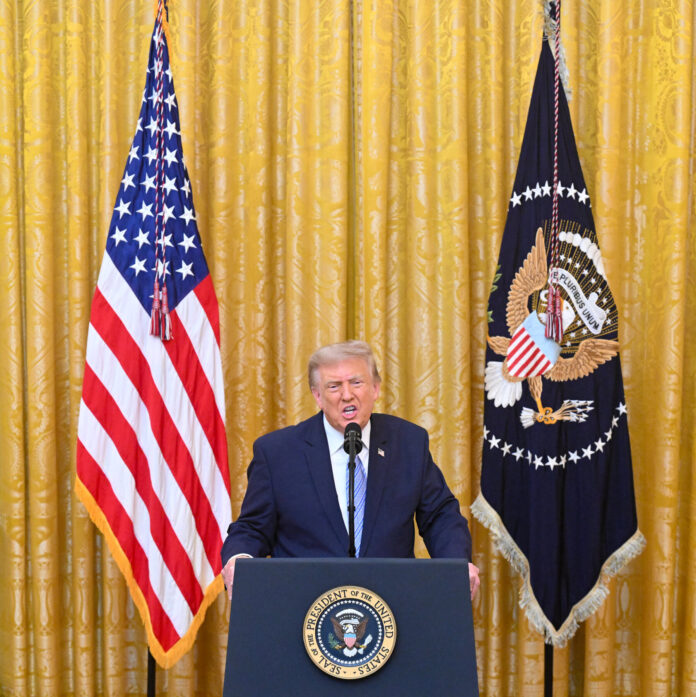

President Trump’s primetime address from the White House East Room on election integrity has drawn a genuinely stark, predictably divided reaction from New Jersey’s political establishment, with state Democrats condemning the speech as a dangerous attempt to sow doubt ahead of the midterms while state Republicans largely stood behind the administration’s messaging.
New Jersey Democratic leaders responded to the address with pointed criticism, framing it as an attempt to use the platform of the presidency to spread unsubstantiated claims about the integrity of past and future elections. U.S. Senator Andy Kim characterized the speech in a statement shared on Instagram as reflecting a president struggling politically and looking ahead to a midterm cycle he expects to lose, arguing that the speech’s real purpose was to redirect public attention away from other pressing issues, including foreign policy concerns, the rising cost of living, and controversy surrounding immigration enforcement actions. New Jersey Democratic State Committee Chairman Leroy J. Jones Jr. offered an even sharper response through a statement released via Insider NJ, describing the primetime address as resembling the kind of doubt casting rhetoric one might expect ahead of a contested election rather than a formal presidential address, going so far as to suggest the remarks could have been delivered from considerably less official surroundings than the White House itself.
State Senator John F. McKeon of the 27th District issued his own detailed statement responding directly to the address, framing it as another attempt to undermine public confidence in the country’s democratic institutions by reviving claims about election integrity that McKeon said have already been repeatedly rejected by courts, election officials, and independent reviews. McKeon argued that repeatedly questioning legitimate election outcomes without credible supporting evidence weakens public trust and fuels division rather than uniting the country, and he emphasized that secure elections and broad ballot access represent complementary goals rather than competing ones. McKeon also directed specific criticism at the SAVE Act, a piece of legislation he described as being marketed as an election security measure while actually risking the disenfranchisement of millions of eligible voters through burdensome new documentation requirements, a concern he raised despite existing federal law already prohibiting noncitizens from voting in federal elections. McKeon closed his statement by framing America’s long tradition of peaceful power transfers and respect for the rule of law as dependent on every eligible voter being able to cast a ballot freely, every lawful vote being counted accurately, and every candidate accepting the eventual outcome.
New Jersey Republicans took a considerably different position, largely aligning with the administration’s broader messaging rather than distancing themselves from the speech’s more contested claims. Rather than pushing back on assertions made during the address regarding potential election system vulnerabilities, state GOP figures instead echoed the administration’s criticism of major television networks, including ABC and NBC, after Trump accused those networks of participating in what he characterized as a plot by choosing to air his address on their digital streaming platforms rather than their primary cable broadcast channels. State Republican leaders, including State Committee Chair Bob Hugin and gubernatorial candidate Jack Ciattarelli, have continued projecting a unified party front heading into the current election cycle, explicitly aligning themselves with the president’s broader policy agenda and pushing back directly against the kind of criticism state Democrats have leveled at the administration.
The sharply divided reaction reflects a broader, ongoing national pattern in which claims about election security and integrity have become a genuinely defining partisan fault line, with Democrats generally characterizing repeated questioning of past election outcomes as corrosive to public trust in democratic institutions, and Republicans generally framing continued scrutiny of election systems and media coverage as a legitimate and necessary form of oversight. Both sides in New Jersey have used this particular address as an opportunity to reinforce those broader positions ahead of the upcoming midterm elections, ensuring that questions about election administration, media coverage, and voter access are likely to remain a central point of contention in New Jersey politics well before voters head to the polls this fall.
















