
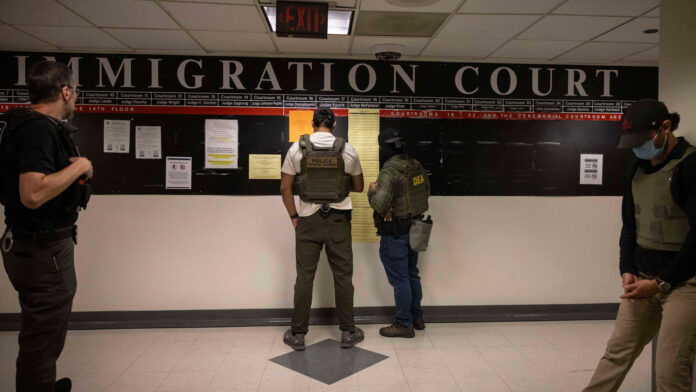

New Jersey operates two separate federal immigration courts, both falling under the jurisdiction of the Executive Office for Immigration Review, a branch of the U.S. Department of Justice responsible for adjudicating removal proceedings nationwide. Understanding which court handles which cases, and how each one actually operates day to day, matters considerably for anyone navigating the system, whether directly or on behalf of a family member, friend, or client.
The primary distinction between New Jersey’s two immigration courts comes down to a single factual question, whether the individual facing removal proceedings is currently held in federal custody. The Newark Immigration Court handles administrative cases for individuals who are not currently detained but still fall within the court’s regional jurisdiction. That court operates out of the Peter Rodino Federal Building at 970 Broad Street, Room 1200, in Newark, and keeps standard business hours Monday through Friday from 8 a.m. to 5 p.m. Anyone filing paperwork with the Newark court should be aware of a recent administrative change affecting how payments are processed. Paper checks and money orders are no longer accepted for filing fees, and all official payments must now be submitted electronically through the EOIR Payment Portal instead. For direct inquiries, the Newark court can be reached at 973-645-3524 or by email at Newark.Immigration.Court@usdoj.gov.
The Elizabeth Immigration Court handles an entirely different category of cases, primarily those involving individuals currently held in federal custody or immigration detention facilities. That court is located at 625 Evans Street, Room 148A, in Elizabeth, and it operates Monday through Friday from 8 a.m. to 4 p.m., with a midday closure for lunch from noon to 1 p.m. The Elizabeth court can be reached directly at 908-787-1355 for questions related to detained cases.
Certain court policies apply consistently across both New Jersey facilities. Immigration hearings are generally open to public attendance without requiring advance notification, giving family members, advocates, and members of the press a genuine ability to observe proceedings directly. That openness comes with one firm restriction, however, since cameras, cell phones, and any other recording devices are strictly prohibited inside courtroom spaces, meaning observers can watch proceedings unfold but cannot document them electronically while inside the room.
For individuals or families who need assistance navigating either court system, community legal resources do exist. Organizations such as Northeast New Jersey Legal Services provide community based legal representation and help guiding individuals through removal defense proceedings, offering a resource for those who might not otherwise have access to an attorney during what is often a genuinely high stakes legal process.
That access to representation has become an increasingly urgent issue as immigration attorneys across the state have grown more vocal in criticizing how cases are currently being handled within New Jersey’s immigration court system. Some attorneys have described the current pace and posture of proceedings using genuinely pointed language, characterizing the system as functioning more like what they call a deportation machine than a deliberative legal process built around individualized case review. That criticism has been fueled in part by specific cases attorneys point to as illustrative of the broader pattern, including instances where individuals with deep, longstanding ties to their communities have nonetheless been denied bond and treated as flight risks. One such case involved a homeowner who had lived in the country for two decades, had no criminal record, was married to a U.S. citizen, and had two children born on American soil, circumstances that attorneys argue should have weighed heavily in favor of release pending further proceedings, yet which reportedly did not prevent a bond denial in that particular case.
It’s worth being clear that this characterization reflects the perspective of immigration attorneys and advocates who work directly within the system and have grown critical of current enforcement trends, rather than an official position taken by the courts or the Department of Justice itself. Immigration proceedings, particularly around bond determinations and flight risk assessments, involve considerable judicial discretion, and reasonable people, including judges, attorneys, and policymakers, continue to disagree sharply over how that discretion should be exercised in any individual case. For anyone directly navigating New Jersey’s immigration court system right now, understanding both the practical logistics of where and how each court operates, and the broader debate currently surrounding how cases are being adjudicated, offers essential context for what has become an increasingly closely watched corner of the state’s legal landscape.
















