
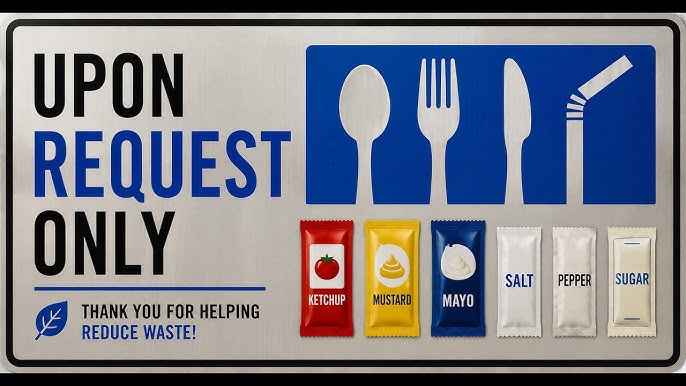

New Jersey restaurants are facing a genuinely significant operational shift beginning August 1, 2026, as the state’s Skip the Stuff law officially takes effect, prohibiting food establishments from automatically handing out single-use plastic utensils and condiment packets. Signed into law last January by outgoing Governor Phil Murphy, the measure is designed to meaningfully reduce the volume of single-use plastic entering New Jersey’s waste stream and waterways, applying broadly across dine-in, takeout, delivery, and drive-thru orders at restaurants, cafés, food trucks, vendor stations, and cafeterias alike.
Under the law’s core requirement, disposable forks, knives, spoons, and condiment packets can only be provided when a customer specifically requests them, ending the long-standing default practice of tossing plastic utensils into every takeout bag regardless of whether the customer actually needs them. That same request-only standard extends directly into digital ordering as well, requiring third-party delivery apps and online ordering platforms to change their default settings to no utensils or condiments, forcing customers to actively opt in rather than removing utensils manually from an order that includes them by default.
Dine-in service faces its own distinct set of rules under the law. Full-service restaurants with seating for 10 or more customers are prohibited from using single-use plastic utensils for on-site diners entirely, and instead must provide reusable, washable silverware for anyone eating a sit-down meal on the premises. Establishments looking to maintain self-serve utensil stations can still do so, but those dispensers must hand out individual utensils one at a time rather than offering the pre-bundled plastic cutlery packs that have become a common feature of self-serve areas in fast casual restaurants.
Enforcement under the law follows a graduated, three-tier structure designed to give businesses room to adjust before facing serious financial consequences. A first offense results in a formal warning rather than an immediate fine, giving establishments an initial opportunity to correct course. A second offense carries a fine of up to $100 per day, while a third offense and any subsequent violations carry fines of up to $250 per day, a penalty structure clearly designed to escalate meaningfully for businesses that continue noncompliance after already being warned and fined once. Revenue collected through those fines flows into the state’s Clean Communities Program Fund, supporting local litter cleanup and public education efforts, with up to 30 percent of collected funds retained directly by the municipality or certified enforcement agency responsible for the citation.
The law does carry several specific exemptions worth understanding. Pre-packaged food items that have a straw, utensil, or condiment attached during manufacturing, think juice boxes or pre-packaged salad kits, remain exempt from the new restrictions, since those items were never part of the restaurant’s own point-of-sale utensil distribution in the first place. Certain institutions also receive extended compliance timelines, with K-12 schools given a full five-year grace period to adjust and food court vendors given two years, while correctional and healthcare facilities remain exempt under specific defined conditions given the unique operational needs those environments carry. Single-use sauce cups used to serve sides of sauce or dressing during dine-in service remain permitted as well, distinguishing them from bundled condiment packets included automatically with a to-go order.
This law addresses a genuine gap in New Jersey’s broader single-use plastic regulatory framework. While the state has already banned single-use plastic bags and most paper bags, no comparable statewide policy previously existed for disposable cutlery, condiments, or other food and beverage accessories. That gap had already prompted several individual municipalities, including Hoboken, Red Bank, Garwood, and Eatontown, to enact their own local ordinances restricting single-use utensils, mirroring similar policies already in place in New York City, California, and Washington state, even as broader statewide action had previously stalled amid pushback from the restaurant industry over cost concerns and enforcement complexity for small businesses specifically.
State Senators Bob Smith and Raj Mukherji introduced the Skip the Stuff measure specifically to minimize litter, conserve resources, and reduce the overall volume of single-use items entering the waste stream, with companion legislation in the Assembly backed by Assembly members Alixon Collazos-Gill, Margie Donlo, and Shama Haider. The measure ultimately passed the Senate in a narrow 21-15 vote before clearing the Assembly by a wider 43-24 margin. Smith has expressed confidence that the law will meaningfully reduce the amount of litter accumulating within New Jersey communities, while Mukherji has been careful to clarify what the law does not do, emphasizing that it does not ban single-use plastic utensils outright at a customer’s favorite fast-food drive-thru, but rather curbs the excessive, automatic distribution of single-use plastics and condiments specifically when customers haven’t actually requested them.
The New Jersey Restaurant and Hospitality Association played a genuinely active role shaping the law’s final form as well. Amanda Stone, the association’s Vice President of Public Affairs, said the group was pleased that the final legislation incorporated several changes it had pushed for directly, including allowing restaurants to continue offering utensils and condiments through self-service areas and clarifying that items like soufflé cups and other single-use supplies remain available whenever a customer specifically requests them. Stone noted that throughout the legislative process, the association remained focused on ensuring the law achieves its intended environmental goals without placing undue operational burdens on restaurants, particularly small, independently owned businesses operating in genuinely fast-paced service environments. She also pointed to the law’s overall implementation approach, one that prioritizes education and compliance assistance ahead of punitive enforcement, as a meaningful way to help both businesses and consumers understand and adapt to the new requirements together.
In support of that education-first approach, the law specifically requires the New Jersey Department of Environmental Protection to run a 180-day public education campaign highlighting the benefits of reducing single-use utensil and condiment distribution. Ahead of the August 1 rollout, the NJDEP has already launched that campaign under the name Cut the Cutlery, giving businesses and consumers alike direct access to information about both the new requirements and the broader environmental and financial benefits behind them. The campaign’s online toolkit includes practical resources built specifically to help food establishments manage the transition smoothly, including training scripts for staff, downloadable flyers for in-store signage, and ready-made social media content businesses can use to inform their own customers ahead of the deadline.
With the compliance deadline now just weeks away, New Jersey restaurants across every format, from full-service dining rooms to fast casual counters to delivery-only kitchens, are working to adjust their operations ahead of August 1, giving the state’s food service industry a genuinely tight runway to implement a law that reshapes a habit most customers and businesses alike had simply never thought to question until now.
















