
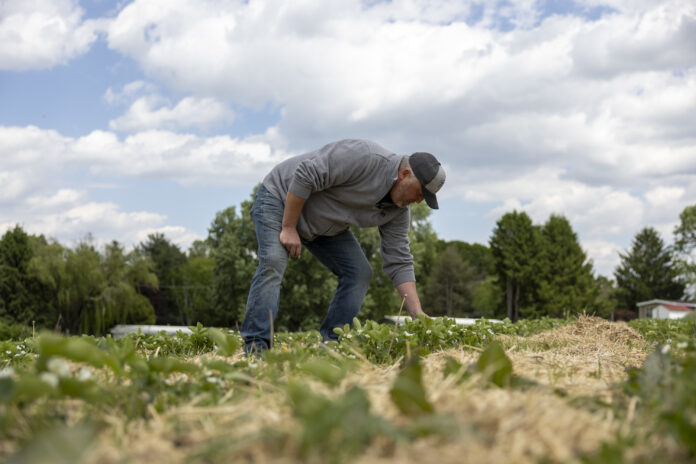

New Jersey’s fruit growers are accustomed to having the weather work against them, but they’ve never had to contend with something like this before. After a warm April saw temperatures close to 90 degrees at the beginning of the month, causing early perennial crops to bloom too soon, a colder snap that saw temperatures in the lower 20s persisted from April 19th to the 22nd, damaging many plants that had already begun to flower. This freeze that has already been damaging to farms has cost producers an estimated 300 million dollars in losses, with some families losing up to 95 percent of their crops, while being remembered as a freeze of a century.
The damage was not done evenly throughout the state’s agriculture industry, with tree fruits and berries being the hardest hit, as peaches, apples, sweet cherries, and Asian pears all saw significant losses to their crops at various points, with some reporting an entire harvest lost in the span of days. The damage to peaches and apples for instance, was nearly total for Russo’s Fruit and Vegetable Farm in Tabernacle, as well as Terhune Orchards in Mercer county, with both reporting upwards of 95 percent losses to their respective fruit crops. At the same time, vineyards and blueberry growers were also significantly impacted by the cold spell, which caught many crops unprepared during a critical time for their growth.
Not all growers were caught completely unaware however, as Alstede Farms in Chester used large fans to circulate the warmer air at the base of their trees up towards the branches, in order to prevent the frost from adhering to their crops. While this tactic did not prevent all damage, it was enough to keep a substantial amount of their yield, an advantage that very few small scale operations could afford to take advantage of due to the high cost of the equipment necessary to protect their crops in a similar manner.
The damage done by the cold snap was enough to prompt both state and federal responses, with the later being the most immediate relief for affected farmers. The governor of New Jersey, Mikie Sherrill, declared a state of emergency for the entire state, in an effort to streamline the response to the disaster, and expedite the process for any relief programs that farmers might need to apply to. This helped to ensure that the State would be able to get federal assistance as quickly as possible, which came in the form of the USDA declaring all 21 counties in New Jersey as disaster areas, following the assessment of the damage done to local crops. This is an important distinction, as it allows farmers who have lost significant portions of their yields to seek out emergency, low interest loans from the Farm Service Agency in order to help them weather the financial blow that the freeze has dealt them.
The freeze is just the latest in a long series of hardships for New Jersey’s farmers to deal with, as the state has seen a combination of localized droughts and a significant rise in fuel and fertilizer prices before the cold snap of April took out large chunks of the crop yield for the year. With many operations now seeing nearly every fruit crop taken away from them at once, many find themselves struggling financially at best and bankrupt at worst going into the summer. While some of the hardship can be offset with local support, as many community members have chosen to patronize local markets in order to help support the local economy, many New Jersey growers find themselves in a precarious financial position this year, having had to endure a confluence of events that have severely impacted their yields.
For the shoppers in New Jersey that choose to support local growers over larger scale operations, the most immediate effect of the freeze is that there is simply less produce to buy than in years past. With entire crops being lost in some instances, the amount of local food available for purchase is lower, and in some cases nearly nonexistent for certain growers who lost nearly everything to the cold snap. The local community has taken notice, as many organizations have pushed for people to buy local, in order to help support growers that have had to endure this difficult year. As a result, it would seem that the message has been heeded, as many local farms report high and growing demand for their produce this year, despite the losses they’ve endured at the hands of the weather. This trend may have been helped in part by a nationwide scare of food poisoning due to parasitic infections, which have been linked to major grocery store chains that buy in bulk from distant suppliers rather than local growers. With people being more aware of the dangers in the food supply chain than ever before, a local farm stand with a known grower behind it is suddenly much more desirable, even if that local stand has less produce available than it might have in previous years.
As such, New Jersey’s growers find themselves in an interesting position this summer, as they have less produce to sell, due to the harsh winter and late spring that has seen entire crops lost at once, while also seeing demand for what is available rise due to people turning to local farms for their agricultural needs. Whether or not this boon for local farmers lasts long enough to offset the losses they’ve incurred, or fade away when the news cycle moves on to something else entirely, may decide the fate of many small scale operations in the coming months.
















