
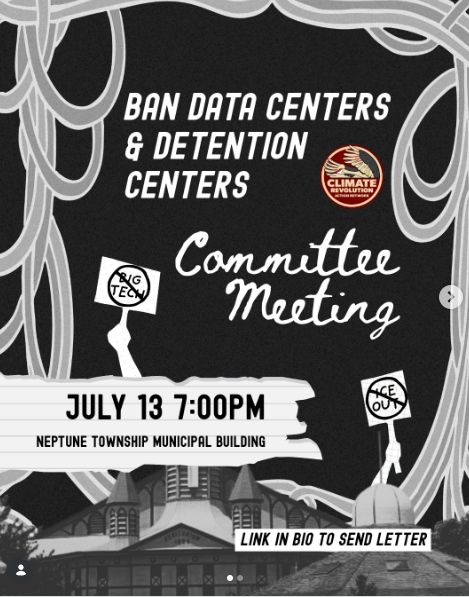

Neptune Township voted Monday to prohibit both large scale data centers and immigration detention facilities operated by Immigration and Customs Enforcement within its municipal borders, placing the township at the center of two of New Jersey’s most actively contested local policy debates at once. The vote makes Neptune the 25th municipality in the state to formally ban data centers, joining a rapidly growing list of towns that includes Andover Township, Millville, Red Bank, and Warren Township, all of which have adopted similar prohibitions in recent months as concerns over the industry’s local impact continue spreading statewide.
Neptune Township Deputy Mayor Derel Stroud framed the dual ban as a direct expression of the township’s governing priorities, arguing that both data centers and ICE facilities raise serious concerns spanning resource consumption, environmental impact, due process, and public safety. Stroud characterized the ordinance as a concrete test of a phrase many elected officials use freely but rarely back with actual policy, arguing that putting people first needs to translate into binding local law rather than remaining a talking point.
Neptune officials developed the ordinance in direct partnership with the Climate Revolution Action Network New Jersey, a Gen Z led environmental organization that has positioned itself at the forefront of the statewide push to block new AI data center development. Ben Dziobek, the organization’s executive director, described the Neptune vote as part of a broader national pattern of communities pushing back against data center development in their own backyards, arguing that residents nationwide are increasingly showing up to stop these facilities before they ever break ground. According to Dziobek, Neptune’s decision reflects local officials’ understanding that data centers contribute directly to rising utility bills, air pollution, and strain on local water supplies, concerns that have become a genuinely common thread running through similar bans passed across New Jersey over the past year. Dziobek was also candid that his organization sees individual town by town bans as an incomplete solution on their own, calling instead for the state legislature to pass a comprehensive moratorium on AI data center development across all of New Jersey rather than leaving each municipality to fight the same battle independently.
Neptune’s decision to pair its data center ban with a prohibition on ICE detention facilities places the township within a considerably more politically charged debate, one that touches directly on questions of immigration enforcement and the limits of local government authority over federal immigration policy. Dziobek explicitly linked the two prohibitions together as part of the same underlying fight, framing both as fundamentally about a town’s right to decide what gets built within its own borders and what does not. That framing reflects the perspective of Neptune’s officials and the advocacy organization that helped shape the ordinance, though it’s worth noting that bans on ICE detention facilities specifically have generated real legal and political debate in municipalities and states around the country, with critics of such measures generally arguing that immigration enforcement falls under federal rather than local jurisdiction, and supporters countering that local governments retain genuine authority over land use and zoning decisions within their own borders regardless of a facility’s federal purpose. That broader legal tension is likely to continue playing out well beyond Neptune Township as more municipalities across the country consider similar measures.
The rapid growth in New Jersey’s data center ban count, now standing at 25 municipalities and continuing to climb, reflects a genuinely significant statewide trend that shows no clear sign of slowing. Towns adopting these bans have consistently pointed to similar underlying concerns, the strain large data center campuses place on local electric grids and utility rates, the substantial water consumption required for cooling equipment, and broader worries about noise and neighborhood character in communities never built to accommodate large scale industrial infrastructure. With Neptune’s vote, that municipal level pushback has now expanded to explicitly include immigration enforcement infrastructure as well, signaling that at least some New Jersey towns increasingly view local zoning authority as a tool for shaping community identity and values on a genuinely broad range of issues, extending well beyond traditional land use concerns like housing density or commercial development.
















