
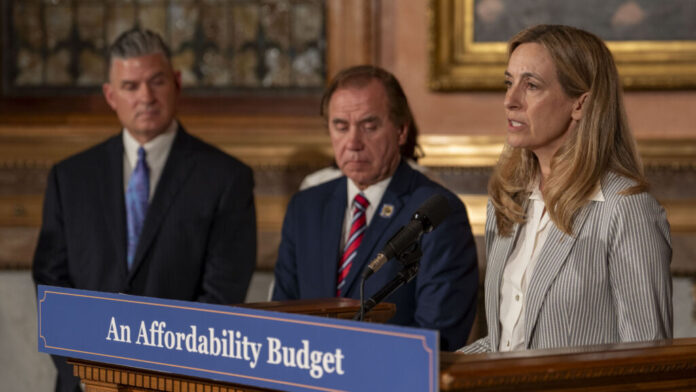

New Jersey is officially spending more money than it expects to collect in tax revenue this year, a structural gap that state lawmakers have chosen to close by pulling directly from the state’s multibillion dollar reserve fund rather than raising income or sales taxes on residents. Governor Mikie Sherrill signed a $60.7 billion state budget into law, one built around a $1.35 billion structural deficit that lawmakers decided to cover through a deliberate drawdown of New Jersey’s cash reserves. Even after that withdrawal, the state’s projected surplus still sits at a genuinely healthy $6.08 billion, giving officials a real financial cushion even as they intentionally spend down a portion of what had been an even larger reserve.
That budgetary decision has generated real debate in Trenton over whether it represents sound fiscal management or a risky long term habit. One Republican assemblyman offered a pointed characterization of the state’s reserve strategy, arguing plainly that a fund lawmakers keep draining by well over a billion dollars each year hardly qualifies as a good savings account in the first place. That criticism reflects a broader concern among fiscal watchdogs and some lawmakers that repeatedly tapping the surplus to cover recurring expenses, rather than reserving it strictly for genuine emergencies, could leave the state considerably more exposed the next time an actual crisis hits. Supporters of the approach, including the governor’s office, have countered that the surplus remains substantial enough to absorb this year’s spending decisions without meaningfully threatening the state’s overall fiscal stability, framing the drawdown as a deliberate, responsible tradeoff rather than reckless spending.
For anyone tracking New Jersey’s housing market, this budget fight carries real, direct relevance well beyond the abstract world of state fiscal policy. The single biggest reason this year’s budget grew so large in the first place is that the state redirected a record $4.1 billion directly into property tax relief programs, including ANCHOR, Senior Freeze, and Stay NJ. That direct injection of cash keeps meaningful money in homeowners’ pockets across the state, and it carries a genuinely important secondary effect for the housing market itself, making it considerably easier for seniors to remain in their homes rather than being forced into a sudden property sale simply because rising property taxes had become unaffordable on a fixed income.
The expansion of the Stay NJ program stands out as one of the most consequential pieces of this year’s budget for homeowners specifically. Lawmakers used the state’s surplus to significantly broaden the program, and seniors earning $100,000 or less annually are now eligible for a substantial $6,500 annual property tax credit. Lowering that effective tax burden for older homeowners does more than provide simple financial relief. It also helps preserve stability across New Jersey’s suburban neighborhoods, since fewer seniors being pushed out of longtime homes by unaffordable property taxes means fewer of those homes suddenly entering the market at once, which in turn helps keep already tight local housing inventory from loosening in ways that could otherwise happen if large numbers of older residents were forced to sell simultaneously.
The budget also extends real support toward the opposite end of the housing market, with lawmakers increasing funding allocations specifically for first time homebuyer assistance programs. That expanded funding translates directly into structural down payment grants designed to help entry level buyers compete more effectively in New Jersey’s famously fierce bidding wars, where all cash investors and buyers with substantial existing equity have historically held a significant structural advantage over first time buyers relying entirely on financing. By strengthening down payment assistance, the state is attempting to level that playing field at least somewhat, giving first time buyers a genuine fighting chance in a market that has made homeownership increasingly difficult for anyone without substantial savings already in hand.
Fiscal experts have raised real concerns about whether this approach can hold up over the longer term, even while acknowledging the immediate benefits it delivers to homeowners today. Continually dipping into the state surplus to fund what are fundamentally recurring, ongoing tax credit programs, rather than genuine one time expenses, creates a structural pattern that becomes considerably harder to sustain the longer it continues. If the state’s surplus drops too far over the next two years, future lawmakers could find themselves forced into a considerably less pleasant choice, either sharply cutting back the very housing and property tax relief programs residents have come to rely on, or enacting the kind of broad tax increases this year’s budget was specifically designed to avoid in the first place.
Taken together, this year’s budget represents a genuinely consequential bet for New Jersey homeowners and the broader housing market alike. In the short term, record property tax relief funding and an expanded Stay NJ program deliver real, tangible benefits, helping seniors stay in their homes and giving first time buyers a better shot at competing in a genuinely difficult market. Whether that approach proves sustainable, though, depends heavily on how state lawmakers manage the surplus going forward, and whether this year’s drawdown turns out to be a one time, strategically timed decision or the beginning of a pattern that leaves considerably less cushion available the next time New Jersey faces a genuine fiscal emergency.
















