
At a time when much of modern public life feels increasingly fragmented by politics, algorithms, economic anxiety, and nonstop digital noise, organizations rooted in live artistic experience continue serving a profoundly important role inside communities across New Jersey. They create gathering spaces. They preserve cultural traditions. They mentor young people. They provide access where access often does not exist. And in some cases, they completely alter the trajectory of a person’s life.
Few organizations in New Jersey embody that mission more completely than Jazz House Kids.
That reality was on full display on May 12, 2026, when Jazz House Kids Artistic Director and 11-time Grammy Award winner Christian McBride joined Founder and President Melissa Walker for the official launch of the 2026 Montclair Jazz Festival season, an evening that celebrated not only this year’s extraordinary lineup, but the larger cultural mission that has made Jazz House Kids one of the most respected arts education organizations anywhere in the region.
Held in front of supporters, artists, students, educators, and community leaders, the event reflected the growing national importance of an organization that has steadily transformed itself from a local educational initiative into a major cultural institution with influence extending far beyond Essex County.
The evening itself captured the atmosphere immediately.
Live student performances filled the room. Conversations unfolded around cocktails and hors d’oeuvres. Young musicians shared space with internationally recognized artists and longtime supporters. But underneath the social energy was something more significant: a clear demonstration of how arts education, mentorship, and community investment can work together to create long-term cultural impact.
That impact is now being recognized on a national level.
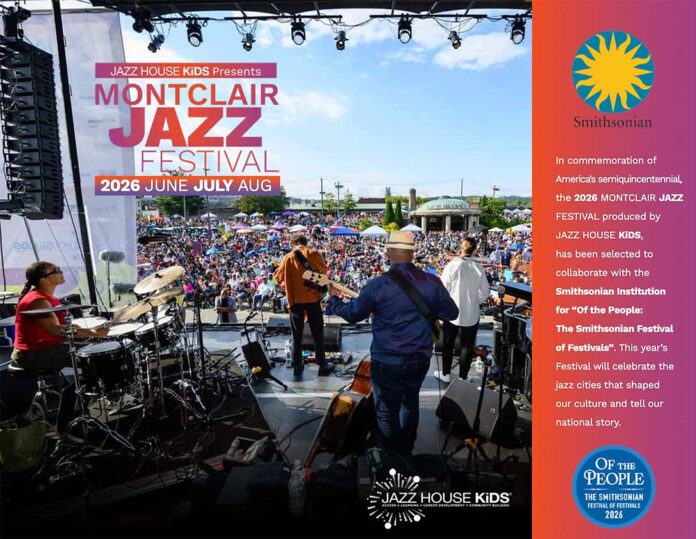
During the launch event, Melissa Walker announced that the 2026 Montclair Jazz Festival has officially been selected by the Smithsonian Institution as a collaborating festival for “Of the People: The Smithsonian Festival of Festivals,” part of the nationwide commemoration connected to the United States semiquincentennial.
The recognition represents a major milestone not only for Jazz House Kids, but for New Jersey’s broader arts community.
The Smithsonian partnership elevates the Montclair Jazz Festival into a national cultural conversation centered on democracy, identity, artistic expression, and public storytelling. Through the collaboration, participants are being encouraged to reflect on what democracy means in their own lives and communities during a period when questions surrounding civic identity, inclusion, and public dialogue have become increasingly urgent throughout the country.
That integration of arts education and civic engagement has become one of the defining strengths of organizations like Jazz House Kids.
The work extends well beyond performance training alone.
Students learn musicianship, certainly. But they also develop discipline, confidence, communication skills, collaboration habits, and a sense of creative identity that frequently shapes their lives long after individual performances end. Programs built around mentorship and artistic access often succeed because they provide young people with both structure and possibility simultaneously.
Jazz House Kids has spent years building exactly that kind of ecosystem.
Under the leadership of Christian McBride and Melissa Walker, the organization has consistently expanded its reach while maintaining a strong focus on educational accessibility and cultural preservation. The result is a model that feels deeply connected to both jazz tradition and modern community development.
That balance has helped make the Montclair Jazz Festival one of the most respected music events anywhere in New Jersey.
This year’s lineup reflects that status clearly.
The 2026 festival will feature an extraordinary collection of artists spanning multiple generations and styles within the broader jazz and contemporary music landscape. Dianne Reeves, one of the most celebrated vocalists in modern jazz history, joins the schedule alongside the Christian McBride Big Band with Bilal, Patrice Rushen, the Spanish Harlem Orchestra, and the Take Me to the River New Orleans All Stars featuring Cyril Neville.
Taken together, the lineup reflects not only musical excellence, but cultural breadth.
Jazz has always functioned as a living art form built through collaboration, improvisation, migration, and reinterpretation. The Montclair Jazz Festival continues embracing that reality by presenting artists who connect traditional jazz foundations to soul, funk, Latin music, New Orleans rhythms, contemporary vocal performance, and modern genre fusion.
The return of The Gotham Kings leading a New Orleans-style second line procession down Bloomfield Avenue reinforces that same philosophy.
The procession has become one of the festival’s defining visual and communal traditions because it transforms public space into participatory celebration. Audiences do not simply watch the music happen; they move through it together. The streets themselves become part of the performance environment.
That sense of collective experience has become increasingly valuable in modern arts culture.
Live music festivals now compete not only with other entertainment options, but with the broader fragmentation of public attention itself. The strongest festivals increasingly succeed because they create environments that feel immersive, local, and emotionally connected to their communities.
Montclair has become exceptionally effective at fostering that atmosphere.
The township’s growing reputation as one of New Jersey’s most culturally active communities has strengthened significantly over the last decade through its support of live music, film, visual arts, restaurants, independent businesses, and public arts programming. The Montclair Jazz Festival now operates as one of the clearest expressions of that identity.
But perhaps the most powerful aspect of the Jazz House Kids mission remains its focus on young artists themselves.
The event launch also highlighted the story of Newark native Christopher Taylor, whose path from local dance programs to the internationally renowned Alvin Ailey American Dance Theater serves as a powerful example of what sustained artistic support can accomplish.
Taylor’s journey reflects the exact type of outcome organizations like Jazz House Kids are designed to nurture.
His development was shaped not only by talent, but by access, mentorship, encouragement, and family support — particularly from a grandmother willing to invest in his artistic future early. Stories like his reinforce a reality often overlooked in broader arts discussions: talent alone is rarely enough. Opportunity infrastructure matters enormously.
Mentors matter.
Programs matter.
Communities willing to invest in young artists matter.
Without those structures, countless gifted young people simply never receive the chance to develop fully.
That is why arts organizations continue playing such an essential role across New Jersey.
They are not merely producing performances. They are building pipelines of confidence, expression, and long-term opportunity. In many cases, they are helping students imagine futures that previously felt inaccessible.
The economic and cultural implications of that work are substantial.
Arts organizations contribute to local business activity, tourism, nightlife, hospitality, education, and regional identity. But the deeper impact is often social rather than financial. They create spaces where people gather across generations, backgrounds, and experiences around something collaborative rather than divisive.
That dynamic feels increasingly important right now.
The arts remain one of the few public spaces where people routinely encounter empathy, complexity, vulnerability, and shared emotional experience without requiring ideological alignment beforehand. Music, dance, theater, and visual storytelling continue functioning as connective tissue inside communities that otherwise often feel disconnected from one another.
Jazz House Kids understands that responsibility clearly.
The organization’s success has never been built solely on performance quality, though the artistic standards remain exceptionally high. Its influence comes from the larger ecosystem it has created around mentorship, access, youth development, and cultural continuity.
The 2026 Montclair Jazz Festival now stands poised to reinforce that mission on an even larger stage.
For Explore New Jersey readers following the evolving cultural landscape of the Garden State, the continued rise of Jazz House Kids represents one of the most important arts stories unfolding anywhere in the region. What began as a local educational initiative has evolved into a nationally recognized institution helping shape how communities think about arts access, mentorship, civic dialogue, and cultural investment.
And in a moment when many institutions across the country continue struggling to create genuine human connection, organizations like Jazz House Kids are proving that music, mentorship, and community still have the power to change lives — one student, one performance, and one generation at a time.