
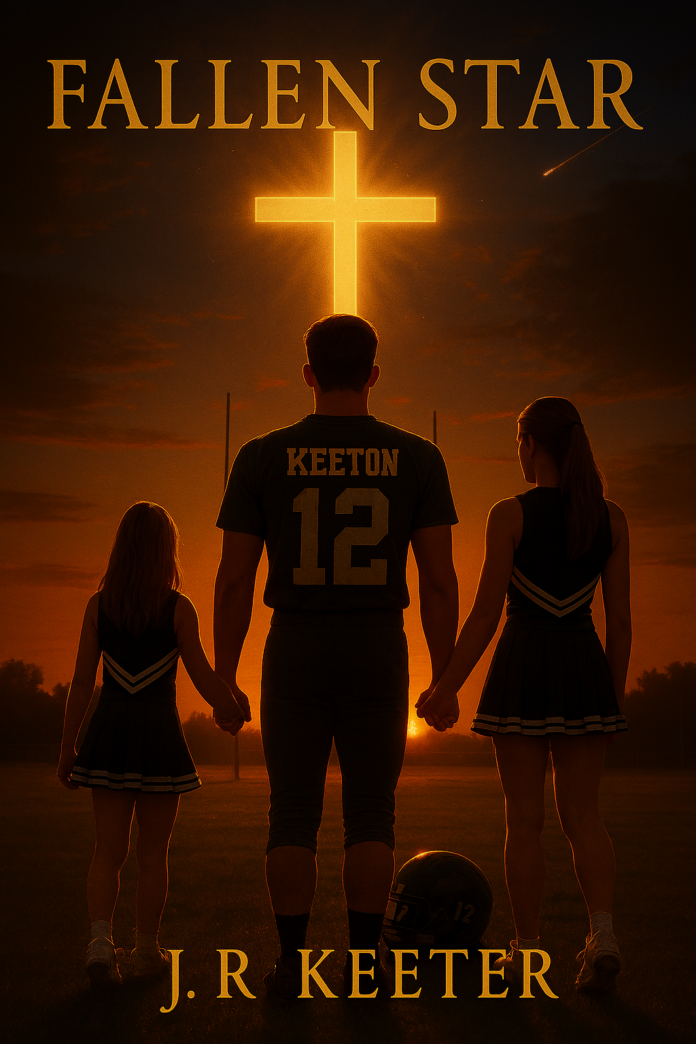

The setup of J.R. Keeter’s debut novel Fallen Star is not a comfortable one, and it is not meant to be. Jack Keeton was the kind of high school football player who makes a town feel proud of itself — a star with genuine NFL prospects, the sort of athlete who carries a community’s aspirations along with his own. Then during his senior year, his daughter Casey was killed in a botched robbery at a small-town café. The NFL dreams dissolved under the weight of grief. The life that had been building toward a specific future collapsed into a different one, defined not by what Jack achieved but by what was taken from him. Thirty-one years pass. And then a letter arrives — from the man on death row who killed Casey, asking for something that Jack Keeton has spent three decades deciding he would never give.
What follows in Keeter’s 116-page novel, published by Cadmus Publishing, is not a conventional thriller built around whether the killer deserves what he is asking for. It is something more uncomfortable and more interesting: a story about what Jack Keeton’s hatred has cost him across thirty-one years, what it would mean to release it, and whether forgiveness — a concept that the Christian tradition places at the center of its ethical framework while the human psychology of grief places at its most resistant periphery — is something a person does for the benefit of the one forgiven or primarily as an act of self-liberation. Keeter frames his protagonist’s journey explicitly as a reluctant one, and the reluctance is the novel’s central psychological and spiritual subject. Jack does not want to forgive. He has organized three decades of his life around not forgiving. The question the book poses is what it would mean to stop.
The novel’s decision to set the central confrontation thirty-one years after the inciting event is a deliberate structural choice that distinguishes Fallen Star from stories built around fresh grief. Fresh grief is understood even by people who have never experienced its specific form. Grief that has hardened across three decades into something else — into the specific calcification of a life that has been defined by absence and unresolved anger for longer than it was defined by the presence of the person lost — is a different psychological phenomenon, and one that fiction rarely examines with the sustained attention it requires. Keeter is interested in what happens to a person when the anger that initially served as a container for grief becomes indistinguishable from the grief itself, and when the identity that has organized around that anger is threatened by the possibility of its release.
The supernatural dimension of Jack’s journey — the novel unfolds not as a purely realistic narrative but as a story in which the process of confronting the killer on death row opens an encounter with deeper spiritual questions — reflects Keeter’s approach to Christian fiction as a genre. Christian fiction at its most serious is not simply fiction in which the characters happen to be Christian; it is fiction that takes seriously the possibility that the spiritual world operates in ways that the purely naturalistic framework of conventional literary realism does not accommodate. The encounters Jack experiences as he wrestles with the letter from death row, and the revelations about his daughter’s life that emerge through the process of engaging with the question of forgiveness, place Fallen Star within the tradition of Christian supernatural fiction that uses the inexplicable as a vehicle for examining the limits of what human understanding can account for on its own.
The discovery of secrets about Casey’s life that Jack uncovers through his journey adds a dimension to the forgiveness question that moves it beyond the binary of whether to forgive or not. What a father learns about a daughter he has been grieving for three decades — knowledge that the daughter herself could not share with him while she lived, that has been preserved in whatever form the book’s supernatural framework makes possible — changes the shape of what forgiveness means in this specific situation. It becomes not only about the man on death row but about the relationship between a father and a daughter, about what was known and unknown between them, and about the specific form that healing can take when the person whose absence defined the wound is also a participant in its possible resolution.
Keeter’s choice of a football star as his protagonist carries its own significance within the story’s thematic architecture. A man who was once defined by physical excellence, public recognition, and the momentum of a promising future — and who was stopped, by a single act of violence, from becoming the person that trajectory implied — carries a specific form of truncated identity that compounds the grief. Jack Keeton lost his daughter. He also lost the future self he had been becoming, the public identity that would have given his life its narrative shape. The person who receives the letter from death row thirty-one years later is both the father of the child who was killed and someone who has been living in the wreckage of a different kind of loss — the loss of the person he might have been if the robbery had not happened, if Casey had lived, if the trajectory of a promising senior year had continued toward its intended destination. Forgiveness, in that context, is not simply about releasing resentment toward another person. It is also about releasing the alternative life that resentment has kept imaginatively alive for three decades.
Fallen Star is available through Amazon and through major book retailers. At 116 pages, it is a novel whose brevity is appropriate to its form — the compressed moral and spiritual urgency of a story built around a letter from a condemned man, a father’s reluctant journey, and the specific question of whether the long road from grief to forgiveness is one that a person can choose to walk or one that has to be walked before the choice becomes possible. For readers of Christian fiction and for anyone interested in how literary fiction can approach the hardest questions of human psychology and spiritual obligation, it is a debut that takes its subject seriously and asks its central question without offering a comfortable answer on the way in.
















