
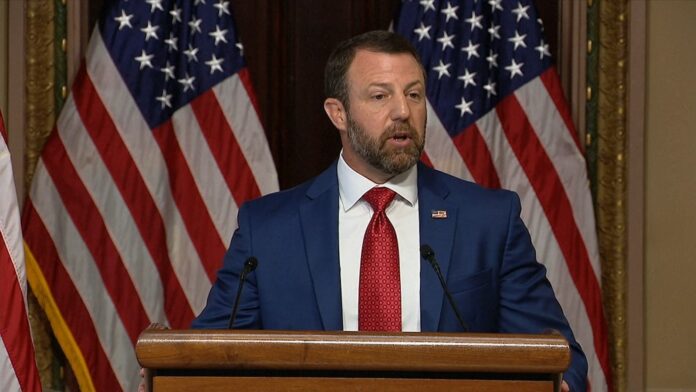

New Jersey found itself directly named this week in a new federal push around election security, after Department of Homeland Security Secretary Markwayne Mullin announced he had sent letters to secretaries of state in four states, including New Jersey, citing what he described as preliminary reviews of each state’s voter records. The announcement came just a day after President Trump delivered a primetime address on election integrity, and it has quickly become another flashpoint in the ongoing national debate over how states verify voter eligibility.
In a statement issued Friday, Mullin said a preliminary review conducted by the Department of Homeland Security found more than 250,000 people registered to vote across four states, California, New Jersey, Pennsylvania, and Nevada, whom the department identified as noncitizens. Mullin framed the issue as one that should transcend partisan lines, arguing that only American citizens should be electing American leaders, and said the department had put the governors of those states on notice, calling on them to work with federal officials to ensure elections remain free, fair, and honest. In his letter, Mullin specifically asked state election officials to review voter rolls for individuals who are not U.S. citizens, and he indicated that states declining to cooperate with that review would face consequences. Speaking with reporters Friday, Mullin said the department’s focus centered on ensuring voting machines are properly secured and that voter registration lists are appropriately reviewed, adding that any state choosing not to participate in that process would become a direct priority for federal scrutiny regarding who voted within its borders, along with accountability measures for the election officials overseeing those elections.
New Jersey Lieutenant Governor Dale Caldwell, who also serves as the state’s secretary of state, responded to the broader political moment earlier in the day, addressing President Trump’s Thursday night address directly and characterizing it as an attempt to instill fear rather than a legitimate, substantiated concern about the state’s election systems. Caldwell said he had not yet reviewed Mullin’s specific letter to New Jersey at the time he spoke with reporters, and he declined to comment on its contents until he had the opportunity to examine it directly.
The broader claim at the center of Mullin’s letters, that meaningful numbers of noncitizens are registering and voting in American elections, remains a genuinely contested empirical question, one that has produced sharply different findings depending on which organization conducts the research. The Brennan Center for Justice, generally regarded as left leaning in its policy orientation, reviewed the 2016 election and identified just 30 instances of noncitizen voting out of 23.5 million total votes examined. The Heritage Foundation, generally regarded as a conservative leaning organization, conducted its own review spanning a considerably longer period, from 2003 to 2023, and identified only 24 instances of noncitizen voting across that entire two decade span. Both figures, despite coming from organizations with very different political orientations, point toward the same broad conclusion, that confirmed instances of noncitizen voting remain exceedingly rare relative to the overall volume of ballots cast in American elections, even as the two organizations and the political constituencies aligned with them continue to disagree sharply over how much weight that rarity should carry in shaping national election security policy.
That empirical backdrop sits directly behind the current standoff between Mullin’s department and New Jersey’s own election leadership. Mullin has pointed to the department’s preliminary review as sufficient justification for demanding states scrub their voter rolls and cooperate with federal oversight, while Caldwell and other New Jersey officials have characterized the broader effort as overstated and politically motivated rather than grounded in genuine, widespread evidence of noncitizen voting actually affecting election outcomes. With Mullin’s letter now formally in New Jersey’s hands and Caldwell indicating he has yet to review its specific contents, the state’s official response is likely to take shape in the coming days, adding New Jersey directly to a national conversation over federal versus state authority in election administration that shows no sign of settling before the November general election arrives.
















