
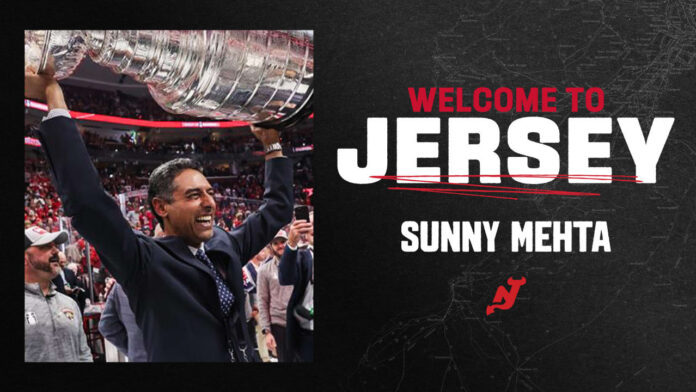

New Jersey Devils Name Sunny Mehta General Manager: A Franchise Reset Rooted in Data, Discipline, and a Return Home. The New Jersey Devils have made one of the most consequential decisions of their modern era, officially naming Sunny Mehta as the sixth general manager in franchise history. Announced on April 16, 2026, the move signals far more than a leadership change—it marks a philosophical shift at a critical juncture for a team that is no longer rebuilding, but now expected to contend. For a franchise with championship DNA and a rapidly maturing core, the hire represents a calculated step toward aligning talent, analytics, and organizational identity into a cohesive, winning model. Full team coverage and ongoing developments can be followed through the Explore New Jersey Devils hub at New Jersey Devils.
Mehta’s appointment comes in the wake of a disappointing 2025–26 campaign that saw the Devils fall short of expectations, finishing outside the playoff picture despite a roster loaded with young, high-end talent. The dismissal of Tom Fitzgerald earlier in the month opened the door for a reset, and ownership moved decisively to bring in a leader whose track record suggests both innovation and results. At 48, Mehta arrives with a resume that is as unconventional as it is compelling, combining elite-level analytics expertise with a proven ability to build championship-caliber teams.
For New Jersey, this is not just a new hire—it is a homecoming. Mehta’s roots in the organization run deep. A New Jersey native from Wyckoff, he began his NHL front-office career with the Devils, where he was instrumental in establishing one of the league’s earliest dedicated hockey analytics departments between 2014 and 2018. At a time when data-driven decision-making was still gaining traction across the NHL, Mehta was at the forefront, helping to reshape how teams evaluate talent, construct rosters, and prepare for competition.
His return comes after a transformative tenure with the Florida Panthers, where he served as assistant general manager and head of analytics. During that period, Florida emerged as one of the league’s most dominant teams, capturing back-to-back Stanley Cup championships in 2024 and 2025. Mehta’s influence on those rosters was significant, particularly in identifying undervalued players, optimizing lineup efficiency, and building a team capable of thriving under playoff pressure. His work in Florida established him as one of the most forward-thinking executives in the NHL, blending traditional hockey instincts with advanced statistical modeling in a way that produced tangible results.
What sets Mehta apart is not simply his reliance on analytics, but his ability to integrate those insights into the broader organizational structure. His philosophy is rooted in clarity and alignment—ensuring that coaches, scouts, and executives operate from a shared understanding of both data and on-ice performance. This approach eliminates the disconnect that can often exist between analytics departments and traditional hockey operations, creating a unified strategy that informs every decision from draft day to playoff execution.
For the Devils, this alignment arrives at a pivotal moment. The roster is anchored by one of the most dynamic young cores in the NHL, featuring players who are entering or approaching their prime. Jack Hughes continues to establish himself as a franchise cornerstone, while Luke Hughes, Jesper Bratt, and Simon Nemec represent a blend of skill, speed, and long-term potential that few teams can match. Captain Nico Hischier remains a central figure both on and off the ice, and decisions regarding his future will be among Mehta’s earliest and most important responsibilities.
The immediate challenge facing the new general manager is to transition the Devils from a team defined by potential to one defined by execution. That requires not only maximizing the existing core but also addressing the gaps that became evident during the past season. Depth scoring, defensive consistency, and playoff-ready physicality are all areas that will demand attention, particularly as the team looks to reestablish itself within a highly competitive Metropolitan Division.
Financially, the Devils are positioned with a degree of flexibility that allows for strategic maneuvering. With the NHL salary cap projected to rise, Mehta inherits a structure that, while carrying significant commitments to key players, still offers room for targeted additions. The balance between retaining core talent and introducing complementary pieces will be central to his approach, particularly as the organization evaluates long-term extensions and potential trade scenarios.
One of the more intriguing aspects of Mehta’s leadership will be his approach to asset management. Throughout his career, he has demonstrated a keen ability to identify inefficiencies in the market—players whose value is not fully reflected in traditional evaluations but who can make a meaningful impact within the right system. This strategy not only maximizes roster efficiency but also allows teams to remain competitive without overextending financially. For a Devils team looking to build sustainably, this philosophy could prove transformative.
Equally important will be decisions surrounding the coaching staff. Head coach Sheldon Keefe’s future remains a key storyline, and Mehta’s evaluation of the team’s direction will play a significant role in determining whether continuity or change is the best path forward. The ability to align coaching philosophy with roster construction is essential, particularly for a team seeking to establish a consistent identity both in the regular season and in the postseason.
Beyond the immediate roster and structural considerations, Mehta’s arrival carries symbolic weight. It represents a return to innovation for a franchise that has historically thrived when it has been ahead of the curve. From the defensive systems that defined its championship years to the early adoption of analytics, the Devils have often succeeded by embracing new ideas before they became standard practice. In Mehta, they have found a leader capable of continuing that tradition while adapting it to the modern NHL landscape.
His background outside of hockey further reinforces this perspective. Before entering NHL front offices, Mehta’s experiences ranged from professional jazz guitar to high-level finance and competitive poker—disciplines that require pattern recognition, risk assessment, and creative problem-solving. These skills translate directly to the complexities of roster construction and game strategy, offering a multidimensional approach that goes beyond conventional hockey thinking.
The formal introduction of Mehta is scheduled to take place at the Prudential Center on April 21, where he will outline his vision for the franchise and begin the process of implementing his strategy. For fans, analysts, and stakeholders across New Jersey, this moment represents the beginning of a new chapter—one defined by ambition, accountability, and a clear commitment to returning the Devils to contention.
As the offseason unfolds, every move will be viewed through the lens of this new leadership. Draft decisions, free-agent signings, and potential trades will all reflect Mehta’s approach, offering early insight into how he plans to reshape the team. The expectation is not simply improvement, but transformation—a shift from a team with promise to one that consistently delivers results.
For New Jersey, the message is clear. The hiring of Sunny Mehta is not a cautious step—it is a decisive move aimed at accelerating the franchise’s trajectory. With a foundation of elite young talent and a front office now guided by one of the most respected analytical minds in the sport, the Devils are positioning themselves to reenter the league’s upper tier. The work begins immediately, and the stakes could not be higher.
















