
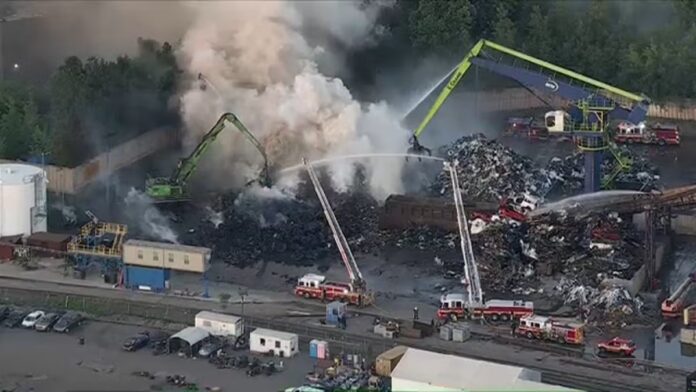

For years, residents of Camden have lived with a troubling reality that many believed had become an unacceptable part of daily life: recurring fires, smoke plumes rising above neighborhoods, emergency sirens, air quality concerns, and ongoing questions about industrial operations situated near homes, schools, businesses, and community spaces. Now, after another significant fire and years of mounting scrutiny, one of the city’s most controversial industrial facilities has announced a major operational change that could reshape the conversation about environmental accountability, industrial oversight, and community health in South Jersey.
European Metal Recycling, commonly known as EMR, has voluntarily shut down operations at its Camden scrapyard following yet another fire at the facility. The decision comes after what community advocates describe as a long history of incidents that have fueled frustration among residents and intensified calls for stronger regulatory enforcement. According to reports surrounding the facility, the scrapyard has experienced approximately 15 fires over the last six years, creating a pattern that many residents say can no longer be dismissed as isolated accidents.
The latest incident, a two-alarm fire that drew emergency responders and renewed public attention, appears to have become a turning point in a controversy that has been building for years. For many in Camden, the announcement represents more than a temporary operational shutdown. It symbolizes a growing demand for accountability and a broader examination of how industrial activities coexist with residential communities throughout New Jersey.
The closure arrives amid ongoing legal action by the State of New Jersey, which has filed a civil lawsuit alleging failures to adequately address operational problems and compliance issues at the facility. State officials have argued that repeated incidents raise serious concerns regarding management practices, environmental safeguards, and public safety obligations.
For residents living near the scrapyard, the latest developments validate concerns they have voiced repeatedly over the years.
Community members have long argued that the consequences of repeated fires extend well beyond the immediate danger of flames. Every incident raises questions about air quality, particulate matter, potential contaminants, and the cumulative effects of industrial accidents on neighborhoods that already face significant environmental burdens.
Many Camden neighborhoods have historically carried a disproportionate share of industrial infrastructure, transportation corridors, manufacturing facilities, waste operations, and logistics centers. Environmental justice advocates frequently point to the city as a prime example of how industrial development can place significant burdens on communities while delivering limited direct benefits to residents.
The EMR facility became one of the most visible symbols of those concerns.
Each fire generated renewed public anxiety, particularly when smoke drifted across residential areas. Families often found themselves asking the same questions: What was burning? What was entering the air? Were there long-term health implications? Could future incidents be prevented?
Those questions intensified with each subsequent fire.
The scrapyard occupies a strategic location within Camden’s industrial landscape, serving a role in the broader recycling and metals recovery economy. Scrap recycling remains an important part of modern manufacturing and sustainability efforts. Facilities like EMR process discarded metals that are ultimately returned to industrial supply chains rather than ending up in landfills.
Supporters of the recycling industry often note that metal recovery plays an essential role in reducing waste, conserving resources, and supporting domestic manufacturing. Recycling steel, aluminum, copper, and other metals requires significantly less energy than producing raw materials from newly mined resources.
However, Camden residents and environmental advocates have consistently argued that environmental benefits associated with recycling do not excuse operational failures or repeated safety incidents.
The debate surrounding EMR has therefore evolved beyond questions of industrial necessity and toward questions of accountability.
What level of risk is acceptable?
How many incidents constitute a pattern rather than isolated events?
What obligations do industrial operators have when facilities are located near densely populated neighborhoods?
How aggressively should regulators intervene when recurring problems persist?
These questions have become central to discussions about the future of industrial development not only in Camden but throughout New Jersey.
The latest fire also arrives during a period of heightened attention to environmental justice initiatives across the state. New Jersey has increasingly positioned itself as a national leader in addressing environmental inequities through legislation, regulatory reforms, and community engagement efforts.
Under environmental justice frameworks, regulators are encouraged to consider the cumulative impact of pollution sources on communities that have historically faced disproportionate environmental burdens. Camden is frequently cited as one of the communities where those considerations carry particular significance.
Residents have argued that repeated fires, air quality concerns, and industrial accidents cannot be evaluated independently from broader environmental conditions affecting the city.
For local advocates, the closure represents an acknowledgment that existing conditions were unsustainable.
Yet many community leaders emphasize that a shutdown alone does not resolve deeper concerns.
Questions remain regarding future site management, environmental monitoring, cleanup obligations, and potential redevelopment opportunities. Residents want assurances that any transition will prioritize public health and community interests rather than simply shifting problems elsewhere.
The future of the property itself is likely to become an important topic of discussion.
Camden has undergone significant redevelopment efforts over the past decade, attracting investment in education, healthcare, logistics, technology, residential development, and waterfront revitalization. Large-scale projects have transformed portions of the city while creating new opportunities for economic growth.
The potential reimagining of industrial sites has become part of that broader conversation.
Many residents and community organizations envision a future in which redevelopment aligns more closely with neighborhood priorities, environmental sustainability, and economic inclusion. Whether the EMR site eventually becomes part of such efforts remains uncertain, but the closure has already sparked discussions about what comes next.
The economic implications are also significant.
Industrial facilities provide jobs, generate tax revenue, and contribute to regional supply chains. Any operational shutdown raises concerns regarding workers, contractors, and related businesses. Policymakers and community leaders must now balance legitimate economic considerations with public safety and environmental protection concerns.
That balance represents one of the defining challenges facing communities throughout South Jersey.
Economic development remains essential, but increasingly, residents expect development to occur alongside robust environmental safeguards and transparent accountability measures. The era in which communities simply accepted repeated industrial incidents as unavoidable appears to be fading.
Camden’s experience reflects a broader shift occurring across New Jersey and the nation.
Residents are demanding greater transparency from corporations. Environmental justice considerations are becoming central to regulatory decision-making. Communities expect meaningful engagement rather than reactive responses after problems occur. Public officials face increasing pressure to demonstrate that regulatory frameworks are capable of protecting residents while supporting economic activity.
The story unfolding in Camden therefore extends beyond a single scrapyard.
It touches on questions of environmental stewardship, corporate responsibility, public health, urban redevelopment, regulatory enforcement, and community empowerment. It highlights the tensions that can emerge when industrial operations intersect with residential neighborhoods and illustrates the growing expectation that businesses operating within communities must maintain public trust through consistent performance and accountability.
For many Camden residents, the voluntary shutdown represents a moment that has been years in the making.
After more than a decade of concerns, repeated incidents, and growing public frustration, many see the closure as an acknowledgment that meaningful change was necessary. Whether it ultimately becomes a turning point in the city’s ongoing environmental justice journey will depend on what happens next.
As state regulators continue legal proceedings, community leaders advocate for long-term solutions, and policymakers evaluate future options, one thing remains clear: Camden residents have made their expectations known.
They want safe neighborhoods.
They want clean air.
They want accountability.
And after years of recurring fires and unanswered questions, they believe meaningful action is long overdue.
The closure of EMR’s Camden scrapyard may mark the end of one chapter in the city’s industrial history, but it is also likely the beginning of a larger conversation about what responsible development, environmental protection, and community partnership should look like in the future of South Jersey.
















