
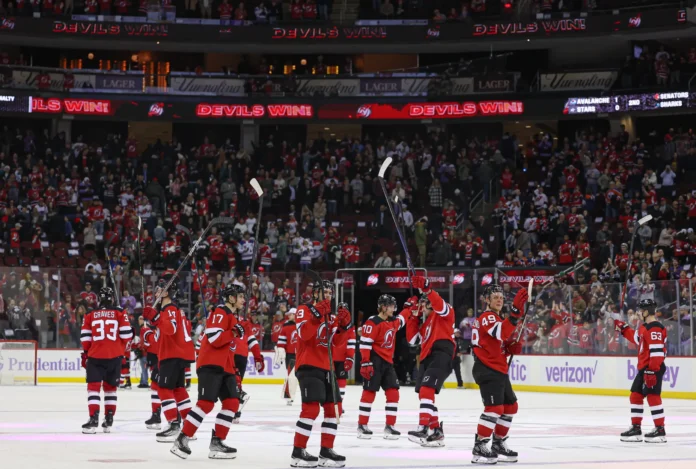

The New Jersey Devils delivered one final surge of energy and execution at Prudential Center, closing out their home schedule with a 4–3 overtime victory against the Ottawa Senators that felt far more significant than a typical late-season result. In a year where expectations outpaced outcomes, the performance served as both a reminder of the team’s ceiling and a clear illustration of the inconsistencies that ultimately defined their season. The full scope of what this game represents, and what comes next, continues to unfold across New Jersey Devils coverage as the organization transitions into one of its most important offseasons in recent memory.
From the opening puck drop, the Devils showed flashes of the structure and offensive identity that once positioned them as a legitimate contender. Nico Hischier set the tone early, capitalizing on sustained offensive zone pressure and finishing a net-front opportunity that reflected both awareness and execution. That line, anchored by physical play along the boards and quick puck movement through the slot, established early control and hinted at a game that could have easily turned into a dominant performance.
That early momentum extended into one of the more telling sequences of the night, a shorthanded goal that captured the team’s ability to generate offense under pressure. Jack Hughes created space through anticipation and touch, sending a controlled pass into open ice that allowed the play to develop at speed. The finish that followed was clinical, reinforcing the idea that this roster, when engaged and connected, can produce offense in multiple situations without relying solely on structured power play setups.
And yet, the second period exposed the exact issues that have lingered throughout the season. The Devils lost their pace, their urgency, and ultimately their grip on the game. Shot generation stalled, defensive structure loosened, and Ottawa took full advantage. What had been a controlled game quickly turned into a deficit, not because of a lack of talent, but because of a lapse in focus and execution. It was a sequence that has repeated itself too often this season, and one that underscores why this team is not preparing for playoff hockey.
What followed in the third period and overtime was a response that defines the dual nature of this roster. The Devils reasserted control, drove possession, and generated high-quality chances at a level that few teams in the league can match when they are fully engaged. Dawson Mercer’s equalizer showcased composure and skill, while the overtime period became a clinic in puck control and sustained offensive pressure. When the opportunity finally opened on the power play, Hischier once again delivered, finishing the sequence with authority and closing out the home schedule on a high note.
Beyond the result, several individual performances carried meaningful weight. Nico Daws provided stability in net, avoiding overcommitment and delivering key saves at critical moments. Defensive prospect Topias Vilen, making his NHL debut, displayed composure and positional awareness that suggest a player capable of contributing at this level moving forward. These are not just isolated positives. They are indicators of depth and development that will factor into offseason planning.
That planning is already underway. The Devils have finalized several roster moves heading into the season finale, including the reassignment of Lenni Hameenaho to Utica and the placement of Brian Halonen on waivers with the expectation of further AHL movement. More notably, Jacob Markstrom has been shut down for the final game as the organization prioritizes long-term health over short-term availability. These decisions reflect a team that has shifted fully into evaluation mode, balancing immediate performance with broader organizational strategy.
The larger context surrounding this moment cannot be ignored. The Devils will finish the season outside of the playoff picture, a result that has already triggered significant organizational change, including the departure of General Manager Tom Fitzgerald. The search for new leadership is underway, with a clear mandate to stabilize a roster that has demonstrated both high-end capability and frustrating inconsistency. With current draft lottery positioning offering a modest chance at a top selection, the front office will need to maximize every available asset in order to recalibrate the team’s trajectory.
Statistically, the foundation remains strong. Jack Hughes continues to drive elite-level production, while Hischier and Jesper Bratt provide consistent offensive support. The issue has never been the absence of talent. It has been the inability to sustain performance across all three periods and across the full season. That gap between potential and execution is what defines this offseason.
There is also a broader emotional layer to this moment. The final home game marked the end of an era in more ways than one, including the retirement of the controversial alternate jerseys that have been a point of debate throughout the fan base. While cosmetic, even that detail reflects a franchise in transition, one that is reassessing identity both on and off the ice.
As the Devils prepare for their season finale in Boston, the focus is no longer on standings but on direction. The overtime win against Ottawa does not change the outcome of the season, but it reinforces what this team can be when it plays with structure, urgency, and purpose. The challenge now is turning that version of the Devils into the standard rather than the exception.
For a team with this level of talent, the margin between disappointment and contention is thinner than it appears. What happens next will determine which side of that line the Devils occupy moving forward.
The search for the New Jersey Devils’ next General Manager is moving quickly following the firing of Tom Fitzgerald on April 6, 2026. Ownership is reportedly considering whether to split the roles of President of Hockey Operations and General Manager or keep them combined.
Confirmed & High-Interest Candidates
Sunny Mehta (Florida Panthers Assistant GM): A Wyckoff, NJ native and data science expert who previously worked for the Devils. The team has officially received permission to interview him.
Brendan Shanahan (Former Toronto Maple Leafs President): A former Devils player widely linked to the President of Hockey Operations role. Reports suggest there is a high probability of him joining the organization in some capacity.
Tyler Dellow (Carolina Hurricanes Assistant GM): Another former Devils analytics head with deep ties to the organization.
Jamie Langenbrunner (Boston Bruins Assistant GM): A fan favorite and former Devils captain.
John Chayka (Former Arizona Coyotes GM): Mentioned as a “wild card” candidate who was nearly hired by the team in 2020.
Secondary & Rumored Names
Mike Gillis: The former Vancouver Canucks GM is considered a candidate for a front-office makeover due to his previous success building contenders.
Jason Spezza (Pittsburgh Penguins Assistant GM): Viewed as a rising star in management, though his lack of experience might require a senior President like Shanahan above him.
Doug Armstrong (St. Louis Blues President/GM): Considered a long-shot “home run” hire, as he is relinquishing GM duties in St. Louis at the end of the season.
Interim Leadership
The Devils did not name an official interim GM for the remainder of the season. However, Martin Brodeur is currently serving as the unofficial acting General Manager and is heavily involved in the search committee alongside owners Josh Harris and David Blitzer.
















