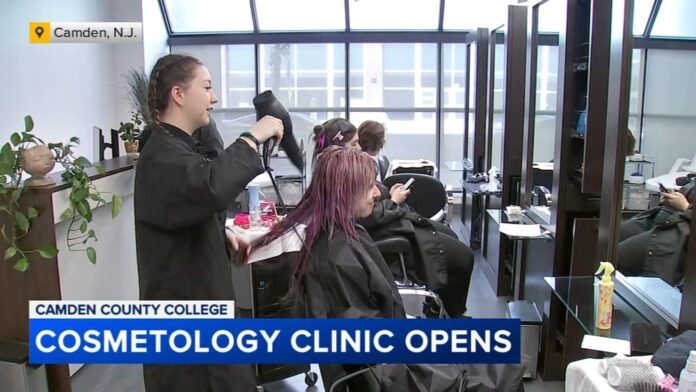

Camden County continues building momentum around workforce development, community revitalization, and career-focused education with the opening of a new cosmetology community clinic operated through Camden County College’s Cosmetology Program. Located in Camden City, the newly launched state-of-the-art training center represents a major investment in both student opportunity and accessible public services, creating a space where education, entrepreneurship, technical training, and community engagement intersect in a highly practical way.
At a time when vocational education and career certification programs are becoming increasingly important across New Jersey, the new clinic demonstrates how community colleges are evolving beyond traditional classroom models to create immersive, real-world training environments that directly connect students with professional experience. For Camden County College, the expansion of its cosmetology program into a fully operational public clinic reflects a broader commitment to workforce readiness and economic mobility.
The facility is designed not only as an educational space, but as a functioning professional salon environment where students can refine their skills while serving members of the public through reduced-price beauty and wellness services. The result is a dual-purpose model that benefits both aspiring cosmetologists and local residents seeking affordable access to professional hair and beauty care.
That combination of affordability, accessibility, and hands-on learning has become increasingly significant throughout New Jersey’s education and workforce development landscape.
Across the state, community colleges are expanding technical and career-oriented programming in response to growing demand for specialized trades and service professions. Cosmetology, in particular, remains one of the most resilient and entrepreneurial career sectors within the broader wellness and lifestyle economy. Unlike many industries vulnerable to automation or outsourcing, personal care professions continue relying heavily on human interaction, creativity, technical precision, and relationship-building.
The Camden County College clinic directly addresses that demand by giving students practical experience inside a modern salon setting before they enter the workforce professionally.
Inside the clinic, students work with industry-standard tools, salon equipment, and real client interactions under professional supervision, allowing them to develop both technical proficiency and customer service experience simultaneously. While classroom instruction remains foundational to cosmetology education, live-client environments create the conditions where students learn the pace, communication skills, adaptability, and professionalism required within real salon operations.
That real-world exposure is often what separates academic understanding from career readiness.
For the Camden community itself, the clinic also provides an important public service component. Reduced-cost haircuts, styling, and beauty treatments help expand access to professional personal care services that may otherwise be financially out of reach for some residents. In many communities, salons and barbershops serve as more than cosmetic spaces; they operate as social anchors, confidence-builders, and places of personal transformation.
The clinic embraces that role while simultaneously functioning as an educational platform.
The opening further reinforces the growing importance of lifestyle and wellness industries throughout New Jersey’s regional economy. Beauty, cosmetology, esthetics, and personal care services have evolved dramatically over the past decade, expanding beyond traditional salon models into a broader wellness-driven economy that intersects with fashion, self-care, entrepreneurship, social media branding, and community identity.
Today’s cosmetology students are not simply training for entry-level salon positions. Many are preparing for careers as independent stylists, salon owners, content creators, beauty educators, product consultants, or wellness entrepreneurs. The industry increasingly rewards technical skill alongside branding, communication, and client relationship management.
Facilities like Camden County College’s new clinic are being built with that modern reality in mind.
The emphasis on state-of-the-art infrastructure signals that the college recognizes the rapidly evolving expectations within the beauty and wellness sector. Modern salon environments now incorporate advanced coloring techniques, textured hair specialization, wellness-focused treatments, digital scheduling systems, and customer experience design that mirror broader shifts occurring throughout the service economy.
For students, training within a contemporary professional setting can dramatically improve confidence and employment readiness upon graduation.
At the same time, the clinic’s opening contributes to larger conversations surrounding economic investment and neighborhood activation within Camden City itself. Educational institutions increasingly play a direct role in urban revitalization efforts, particularly when programs create visible community-facing services that generate daily activity and practical local value.
By establishing the clinic within Camden City, Camden County College helps reinforce the idea that career education and public engagement can operate hand-in-hand rather than separately. The clinic creates a visible connection between student success and community participation, strengthening ties between the college and the residents it serves.
That visibility matters.
Programs rooted in technical education often produce some of the most immediate economic impact because students can transition quickly into active professions, local businesses, and entrepreneurial ventures. Cosmetology in particular remains highly entrepreneurial, offering pathways toward independent income generation, small business ownership, and long-term career sustainability.
For many students, cosmetology programs provide access to professional opportunities that are creative, flexible, and community-oriented while avoiding the financial burdens often associated with four-year academic tracks. Community college-based technical programs therefore continue playing an increasingly important role in workforce development across New Jersey.
The Camden County College clinic also reflects broader changes in how education itself is being experienced. Increasingly, successful career programs emphasize immersive, applied learning rather than purely theoretical instruction. Students today often seek environments where they can immediately connect coursework to tangible professional outcomes.
The clinic embodies that philosophy directly.
As clients enter the space for services, they simultaneously become participants in the educational process itself, helping students gain practical repetition and confidence in real time. That interaction creates a dynamic learning environment where technical growth, communication, professionalism, and creativity all develop together.
Beyond the educational and economic dimensions, the opening also speaks to larger lifestyle trends reshaping New Jersey communities. Personal wellness, grooming, and self-care have become increasingly central to how people engage with both their personal identity and everyday routines. Salons and beauty spaces today frequently function as lifestyle destinations that blend aesthetics, confidence, wellness, and social interaction into one experience.
By creating a clinic that is both educational and community-facing, Camden County College positions itself within that evolving lifestyle landscape while providing students direct exposure to the realities of modern beauty culture and customer engagement.
Coverage throughout Explore New Jersey’s lifestyle section increasingly highlights how education, wellness, entrepreneurship, and community development continue overlapping across the state. The opening of the Camden County College cosmetology clinic sits directly within that intersection.
What ultimately makes the project especially meaningful is that it serves multiple purposes simultaneously without compromising any of them. It is a workforce training center, a public service resource, an economic development initiative, an educational investment, and a community engagement project all operating under one roof.
For Camden City, the clinic represents another example of practical, visible investment in opportunity and neighborhood growth. For students, it provides a direct bridge between learning and career development. And for the broader New Jersey community, it reinforces the expanding role community colleges continue playing in shaping workforce readiness, entrepreneurship, and accessible education throughout the state.
As the clinic begins serving clients and training the next generation of beauty professionals, it also underscores something larger happening across New Jersey: the growing recognition that education works best when it connects directly to community, creativity, and real-world experience.