
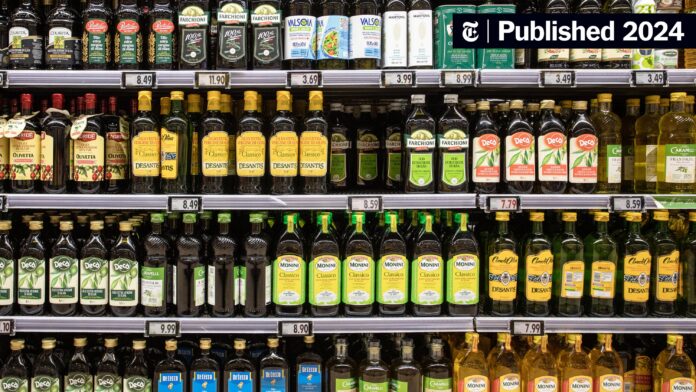

New Jersey may not immediately come to mind when Americans think about olive oil, Mediterranean agriculture, or international food trade policy, but behind the scenes, the Garden State quietly serves as one of the most important gateways in the nation for imported olive oil distribution. Now, a growing trade dispute centered around proposed import tariffs is placing New Jersey directly at the heart of a much larger conversation involving food costs, global agriculture, consumer pricing, supply chains, and international commerce.
The North American Olive Oil Association, headquartered in Neptune, New Jersey, has formally urged the federal government to exempt olive oil from potential new tariff actions, arguing that additional import costs would unnecessarily punish consumers at precisely the moment global production prices are finally beginning to stabilize after several years of severe climate-driven shortages and supply disruptions.
While the issue may initially sound like a niche trade debate involving commodity pricing and international agricultural policy, the implications stretch far beyond specialty grocery aisles or restaurant kitchens. Olive oil has evolved into one of the most widely consumed pantry staples in the United States, increasingly central to American cooking habits, restaurant operations, wellness culture, and modern dietary trends. Because the overwhelming majority of olive oil sold domestically is imported, policy decisions made in Washington could have direct consequences for consumers throughout New Jersey and the country as a whole.
For New Jersey specifically, the debate carries even greater economic significance due to the state’s critical logistical role in global food distribution networks. A substantial portion of imported olive oil entering the United States moves through the Port of New York and New Jersey, one of the largest and most strategically important shipping hubs in North America. From there, products are warehoused, processed, distributed, marketed, and transported nationwide through a vast regional infrastructure tied directly to food importation and supply chain operations.
That means the tariff conversation is not simply about grocery pricing. It is also about jobs, logistics, transportation, distribution networks, import operations, warehousing, retail supply systems, and the broader economic ecosystem tied to international food commerce throughout the region.
The North American Olive Oil Association’s position is rooted heavily in market timing. According to industry leaders, global olive oil production costs are finally beginning to ease after years of unprecedented turbulence caused largely by severe climate conditions across major olive-producing regions. Countries such as Spain, Italy, Greece, and parts of North Africa experienced devastating drought conditions and extreme weather cycles in recent years, dramatically reducing harvest yields and pushing worldwide olive oil prices to historic highs.
Consumers across the United States felt those impacts immediately. Grocery shelves saw dramatic price increases. Restaurants faced escalating ingredient costs. Smaller food businesses struggled to absorb surging wholesale expenses. Even ordinary households noticed the difference as olive oil prices climbed sharply across nearly every major retailer.
Now, as international production slowly rebounds and commodity costs begin stabilizing, the NAOOA argues that new tariffs would effectively erase those gains before consumers ever experience meaningful relief at checkout counters.
The association’s argument centers on a straightforward economic concern: if global supply conditions are improving naturally, artificially increasing costs through tariffs could prolong inflated retail pricing unnecessarily. In other words, even as worldwide markets attempt to normalize after years of agricultural disruption, government-imposed trade barriers could keep prices elevated for American consumers despite improving international production conditions.
That debate arrives during a particularly volatile period for global trade policy and food economics overall. Inflation, supply chain fragility, geopolitical instability, shipping costs, labor shortages, and climate variability have collectively transformed agricultural commodities into increasingly politicized economic battlegrounds. Essential consumer staples once viewed as relatively stable now exist inside highly sensitive global systems vulnerable to disruptions at nearly every stage of production and transportation.
Olive oil represents a particularly compelling example because the United States simply does not produce enough domestically to meet national demand. While American olive oil production has grown modestly over the last decade, particularly in California, imported oil still dominates the overwhelming majority of the market. That dependency makes international pricing structures and trade policies extraordinarily influential in determining what consumers ultimately pay.
For New Jersey, the conversation also highlights the state’s often-overlooked importance within national food infrastructure systems. While much public attention surrounding New Jersey’s economy focuses on pharmaceuticals, finance, shipping, technology, and transportation, agriculture and food logistics remain deeply woven into the state’s broader economic identity.
The Port of New York and New Jersey functions not merely as a transportation hub, but as a critical gateway for international commerce entering the northeastern United States. Countless imported food products — including olive oil — move through the region before reaching supermarkets, restaurants, wholesalers, and consumers throughout the country. Changes affecting import volume, pricing, or trade regulation therefore carry direct downstream consequences for businesses operating throughout New Jersey’s transportation and warehousing sectors.
At the same time, olive oil itself has evolved far beyond its traditional niche status in American food culture. Once viewed primarily as a specialty Mediterranean product, olive oil is now deeply integrated into mainstream cooking, wellness lifestyles, restaurant menus, and health-conscious diets nationwide. It is associated heavily with heart health, anti-inflammatory diets, culinary quality, and contemporary nutrition trends. As a result, significant price swings affect not only gourmet consumers, but ordinary households increasingly relying on olive oil as an everyday kitchen staple.
The NAOOA’s public stance reflects broader concerns developing throughout the food import sector regarding how tariff strategies impact consumer affordability. Industry groups across multiple agricultural categories have increasingly warned that tariffs often create downstream inflationary pressures that ultimately reach shoppers, restaurants, and small businesses far more aggressively than policymakers sometimes anticipate.
In the olive oil sector specifically, pricing sensitivity has become particularly pronounced following several consecutive years of historic production instability. Severe droughts throughout southern Europe sharply reduced harvest yields while global demand remained relatively strong, creating supply shortages that reverberated throughout international markets. Those pressures exposed just how interconnected modern food systems have become.
Now, as environmental conditions begin improving and production rebounds modestly, many within the industry view the current moment as an opportunity for pricing stabilization and market recovery. The introduction of new tariffs threatens to interrupt that process.
The debate also underscores a much larger issue increasingly confronting global agriculture: climate volatility. Olive oil markets have become a clear illustration of how extreme weather patterns can rapidly reshape international commodity economics. Heat waves, drought conditions, water shortages, and unpredictable growing seasons are no longer isolated anomalies but recurring challenges altering agricultural forecasting worldwide.
As climate instability intensifies, food pricing itself may become increasingly vulnerable to disruption. Trade policy decisions layered on top of already unstable agricultural systems therefore carry amplified consequences for both producers and consumers alike.
Within New Jersey, where food distribution infrastructure plays such a major regional role, these issues carry practical as well as political importance. Import businesses, logistics operators, retailers, wholesalers, shipping companies, restaurant groups, and regional distributors all operate downstream from the international commodity systems now under debate.
At the consumer level, the issue ultimately comes down to accessibility and affordability. Olive oil has become embedded within countless American households not as a luxury, but as a routine part of cooking and daily nutrition. Industry leaders argue that maintaining stable access to affordable olive oil supports not only consumer choice but broader public health and dietary trends increasingly encouraged nationwide.
For the North American Olive Oil Association, headquartered quietly in Neptune while influencing policy conversations with national implications, the current fight represents far more than a trade technicality. It is a battle over how food systems, agricultural economics, consumer pricing, and international commerce intersect during an era defined by both inflation concerns and global supply instability.
And for New Jersey, the controversy once again demonstrates how deeply connected the state remains to the movement of goods, global commerce, and the economic realities shaping kitchens far beyond the Garden State itself. While consumers may never see the warehouses, shipping terminals, trade offices, and logistical networks operating behind the scenes, many of the products filling supermarket shelves each week pass through systems deeply tied to New Jersey’s economy.
As federal officials continue evaluating potential tariff actions, one thing has become increasingly clear: this is no longer merely a conversation about imported olive oil. It is a broader reflection of how global trade policy, climate pressures, food affordability, and regional economic infrastructure are becoming inseparably linked in modern America.
















