
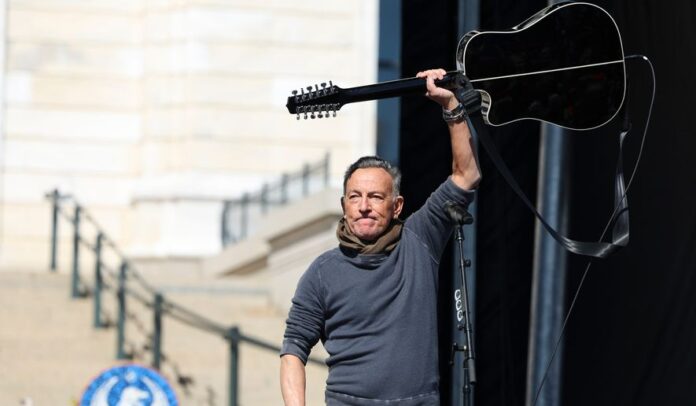

For decades, Bruce Springsteen has occupied a uniquely complicated place in American culture. He is simultaneously one of the most commercially successful artists in rock history and one of the few remaining arena-level performers still deeply associated with working-class identity, political conscience, and social commentary. That combination has always made Springsteen larger than music itself. He is not simply judged as a songwriter or entertainer. He is constantly pulled into broader national arguments about patriotism, class, wealth, labor, politics, protest, and the meaning of America itself.
That reality exploded once again this week after billionaire entrepreneur Elon Musk publicly attacked Springsteen on X, calling the New Jersey icon an “America-hating idiot and billionaire hypocrite” following Springsteen’s criticism of recent federal budget cuts connected to the Department of Government Efficiency, commonly known as DOGE. The online confrontation immediately became national news not merely because of the celebrity status of the two figures involved, but because the exchange represents something much deeper currently unfolding inside American culture: a widening battle over wealth, influence, political responsibility, and whether artists should continue using public platforms to challenge government policy.
At the center of the controversy was Springsteen’s now heavily discussed onstage speech during his current Land of Hope and Dreams tour. Introduced under the title “This Is Happening Now,” the speech reflected themes that have long existed throughout Springsteen’s career — concern for working people, frustration over economic inequality, and criticism toward systems he believes abandon vulnerable communities. While Springsteen did not directly mention Musk by name during the performance, his remarks focused sharply on the dismantling and severe reduction of USAID funding, claiming that “the richest men in America have abandoned the world’s poorest children to death and disease.”
The statement immediately reverberated politically because USAID cuts have become one of the most controversial components of DOGE’s broader restructuring agenda. Supporters of the cuts argue they reduce waste, fraud, and unnecessary federal spending. Critics argue the reductions devastate humanitarian assistance, disease prevention programs, and food access initiatives across some of the world’s poorest regions.
Musk, who has increasingly become one of the public faces associated with DOGE’s aggressive budget philosophy, responded swiftly and aggressively on X after a viral post circulated highlighting Springsteen’s estimated billionaire status while criticizing wealthy elites. Musk’s retaliation escalated quickly, branding Springsteen an “America-hating idiot and billionaire hypocrite” while simultaneously defending the USAID cuts as necessary reforms intended to eliminate corruption and fraud.
Predictably, the internet transformed instantly into ideological trench warfare. Political commentators, entertainment outlets, social media personalities, partisan media ecosystems, and fans on both sides rushed to frame the exchange according to preexisting narratives. Conservative media figures criticized Springsteen for using concert stages to deliver political speeches and mocked the use of teleprompters during portions of his remarks, framing the speech as performative outrage from an out-of-touch celebrity elite. Meanwhile, Springsteen supporters defended not only his right to speak politically, but also the consistency of his decades-long public advocacy for labor rights, food banks, veterans, anti-poverty organizations, and working-class communities.
Yet beneath the noise of social media outrage cycles lies a much more interesting and important question, especially for New Jersey residents who have watched Springsteen evolve from Asbury Park club musician into one of the defining cultural figures of modern America. The real story here is not simply whether Elon Musk insulted Bruce Springsteen. The deeper story is why Springsteen continues provoking reactions this intense after nearly fifty years at the top of American music.
Part of the answer lies in the fact that Springsteen has never functioned comfortably as a neutral celebrity. Unlike many legacy rock stars who eventually retreat into nostalgia branding, casino tours, and commercially safe public personas, Springsteen has consistently insisted on engaging directly with political and social issues, even when doing so alienates portions of his audience. That willingness has defined him since the beginning.
The irony is that Springsteen’s critics have often misunderstood his relationship with patriotism entirely. For decades, portions of the political world attempted to simplify Springsteen into either a patriotic symbol or an anti-American protest figure depending on which narrative suited them at a given moment. In reality, Springsteen’s work has almost always existed in the uncomfortable middle ground between love of country and disappointment in its failures.
That complexity is precisely why his music has endured across generations. Songs like “Born in the U.S.A.” were famously misunderstood because audiences often heard only the explosive chorus while missing the despair, disillusionment, and social criticism embedded within the verses. Springsteen’s catalog consistently examines America through the eyes of workers, veterans, struggling families, forgotten towns, factory laborers, immigrants, and people trapped somewhere between hope and economic collapse.
In many ways, his recent comments about USAID follow directly from that same worldview. Whether audiences agree with him politically or not, Springsteen’s remarks were entirely consistent with the social conscience present throughout his artistic career. He has long framed wealth, power, and political leadership through moral questions surrounding responsibility toward vulnerable people.
That consistency also complicates accusations of hypocrisy. Critics point toward Springsteen’s billionaire status as evidence that his working-class identity no longer feels authentic. Yet even critics often acknowledge that Springsteen has maintained a remarkably sustained record of charitable involvement, local philanthropy, labor advocacy, food-bank support, veterans causes, and community-centered fundraising throughout his career. The tension surrounding his wealth reflects a larger American discomfort with celebrity activism generally: audiences increasingly question whether extremely wealthy public figures can authentically speak on behalf of ordinary people while simultaneously benefiting from extraordinary financial success.
Musk himself embodies a completely different version of modern American power and influence. Where Springsteen represents cultural mythology rooted in labor, artistry, blue-collar identity, and emotional storytelling, Musk represents technological disruption, corporate scale, futurism, social media dominance, and aggressive anti-bureaucratic rhetoric. Their clash therefore feels symbolic far beyond the immediate policy dispute. It resembles a confrontation between two entirely different visions of modern American influence.
What makes the story especially fascinating from a New Jersey perspective is how deeply Springsteen remains intertwined with the identity of the state itself. To many outside observers, Springsteen is not merely from New Jersey. He represents New Jersey. The Shore bars, highways, diners, industrial towns, boardwalks, factories, suburbs, and working-class landscapes woven throughout his music became part of how the entire country imagines the state culturally. His connection to New Jersey remains emotional rather than merely geographical.
That is why moments like this resonate differently here than they do nationally. In New Jersey, Springsteen is not viewed solely as a celebrity commenting on politics. He is viewed as a hometown figure who has spent decades carrying pieces of the state’s cultural identity onto global stages. Whether residents agree with every political statement he makes often becomes secondary to the larger sense that he has consistently remained emotionally connected to the communities and social realities that shaped him.
The broader cultural conversation surrounding this dispute also exposes how modern celebrity conflict increasingly functions as political proxy warfare. Musk and Springsteen are not simply arguing about budget policy. They have become avatars for competing cultural coalitions projecting larger frustrations about wealth, patriotism, government responsibility, celebrity activism, and public morality.
What often gets lost in these arguments is the role art itself historically plays in democratic societies. Artists have always challenged power structures, criticized policies, questioned leadership, and inserted moral arguments into public discourse. From folk singers to punk bands, protest poets to filmmakers, socially engaged art has always provoked backlash from people uncomfortable with entertainers moving beyond entertainment.
Springsteen understands that dynamic better than almost anyone alive. He has spent nearly half a century being alternately praised and condemned for speaking publicly about social issues. Yet he continues doing it anyway, likely because separating his political conscience from his artistic identity would fundamentally alter who he is as a songwriter and performer.
Meanwhile, Musk’s aggressive response reflects how social media platforms have completely transformed modern celebrity conflict. Decades ago, disagreements like this might have unfolded through press interviews or carefully managed public statements. Today, billionaires, musicians, politicians, athletes, and media figures battle publicly in real time before millions of users, with outrage amplified algorithmically almost instantly.
That environment rewards escalation rather than nuance, which partially explains why debates surrounding Springsteen so quickly become emotionally charged. Nuanced conversations about foreign aid policy, humanitarian funding, or government efficiency rarely drive engagement online. Personal attacks, celebrity insults, and ideological tribalism do.
Still, regardless of where audiences fall politically, the exchange ultimately reinforces something undeniable about Bruce Springsteen’s enduring cultural relevance. Very few artists in their seventies still possess the ability to command national political headlines through concert speeches. Even fewer still provoke reactions powerful enough to draw direct public retaliation from one of the world’s richest and most influential figures.
That reality alone speaks volumes about Springsteen’s continued place within American culture. Decades into his career, he remains more than a musician. He remains a symbol people continue fighting over because his music, public identity, and political voice still carry emotional weight within larger national conversations about what America is, who it serves, and who gets left behind.
















