

New Jersey’s cultural identity has always been shaped by the intersection of histories, communities, and traditions that stretch back centuries, but few events illustrate that layered heritage more powerfully than the annual Pinkster Spring Festival at Historic New Bridge Landing in River Edge. Returning on Sunday, May 17, 2026, the festival once again places one of the nation’s oldest and most historically significant celebrations into the spotlight, transforming the Bergen County historic site into a living reflection of early American cultural exchange, resilience, music, storytelling, and springtime tradition.
Hosted by the Bergen County Historical Society, the Pinkster Spring Festival is far more than a seasonal community gathering. It is an immersive cultural and historical experience that reconnects modern audiences with a tradition that evolved from Dutch Pentecost observances into what historians now recognize as the oldest African American holiday in the United States. Through music, dance, historical interpretation, foodways, and educational programming, the event creates a rare opportunity to experience a deeply important chapter of American history not as static information, but as something alive and communal.
Set against the backdrop of Historic New Bridge Landing, one of New Jersey’s most significant Revolutionary War-era sites, the festival carries a sense of authenticity that few historical events can replicate. The preserved buildings, open grounds, and colonial-era atmosphere allow visitors to step directly into an environment where the past feels physically present rather than reconstructed from a distance.
That atmosphere becomes especially meaningful within the context of Pinkster itself.
Originally derived from the Dutch religious observance of Pinksteren, or Pentecost, Pinkster celebrations emerged throughout colonial New York and New Jersey as Dutch settlers established communities across the region. Over time, however, the holiday evolved into something much larger and culturally distinct. Enslaved African Americans throughout the Hudson Valley and surrounding areas were often granted limited time away from labor during the Pinkster period, allowing families and communities to gather, celebrate, exchange traditions, perform music and dance, and preserve cultural identity in spaces otherwise constrained by slavery.
As generations passed, Pinkster transformed into a uniquely African American celebration rooted in resilience, expression, memory, and communal gathering.
That evolution is central to the modern festival’s purpose.
The Bergen County Historical Society has increasingly emphasized not only the Dutch roots of the holiday, but also the essential role African American communities played in reshaping and sustaining Pinkster as a living cultural tradition. The result is an event that does more than recreate colonial customs; it actively explores how traditions evolve through cultural intersection and historical struggle.
One of the festival’s most powerful recurring moments is the pouring ceremony led by BCHS Trustee Muriel Roberts, scheduled this year for 1:15 p.m. and 2:15 p.m. The ceremony honors ancestors who have passed while creating space for remembrance, reflection, and historical acknowledgment. Rather than functioning merely as performance, the ritual serves as a bridge between historical education and cultural continuity.
That focus deepens further during Roberts’ educational talk at 2:30 p.m., which examines how Pinkster evolved from a Jersey Dutch spring celebration into an early African American holiday deeply connected to family reunification, cultural preservation, and communal identity. In a cultural moment where historical interpretation increasingly matters, the festival offers audiences a more nuanced understanding of early American life and the complex intersections that shaped it.
At the same time, the Pinkster Spring Festival remains joyful, interactive, and highly accessible for families and visitors of all ages.
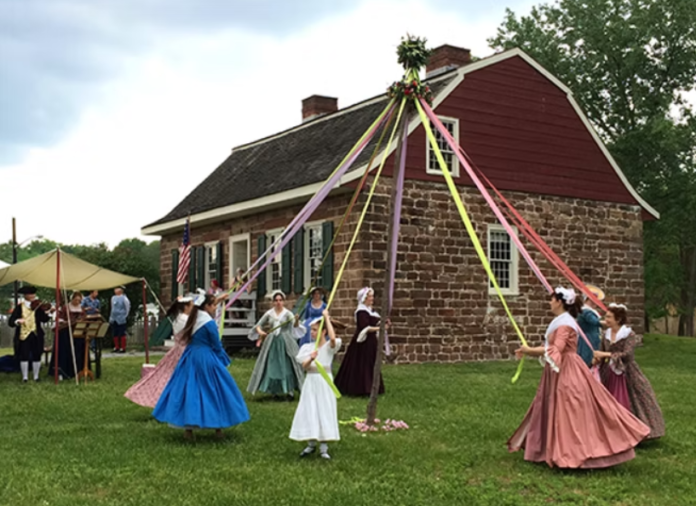
Throughout the afternoon, Historic New Bridge Landing becomes filled with live music, dancing, demonstrations, games, crafts, and community activity that recreate aspects of colonial life while maintaining a celebratory atmosphere rooted in spring renewal. The Tricorne Dance Ensemble, under the direction of dance mistress Denise Piccino, returns with performances of traditional 18th-century dances, including the festival’s iconic Maypole dances scheduled for 1:30 p.m. and 3:30 p.m.
The visual spectacle of dancers circling the Maypole captures one of the festival’s most recognizable traditions, blending European folk customs with the uniquely American evolution of Pinkster itself. The performance also reinforces the festival’s broader emphasis on participation and movement rather than passive observation.
Music plays an equally central role throughout the day. Period musicians Ridley and Anne Enslow provide historically inspired performances featuring fiddle and hammered dulcimer, helping establish the immersive atmosphere that has become one of the festival’s defining strengths. The use of live acoustic instrumentation throughout the grounds adds texture and rhythm to the experience while reinforcing the event’s commitment to historical authenticity.
Historical demonstrations further deepen the festival’s educational value. Interpreters throughout the site showcase open-hearth cooking techniques, including the preparation of traditional Pinkster cakes and gingerbread inside historic out-kitchens that recreate colonial foodways with remarkable detail. Visitors can observe the processes, ingredients, and methods used centuries ago while gaining a deeper understanding of everyday life during the colonial era.
Additional demonstrations often include broom making, lacemaking, and other traditional crafts that illustrate the labor, artistry, and practical skills embedded within early American domestic life.
The festival’s interactivity remains one of its most important features.
Rather than separating historical interpretation from entertainment, the Pinkster Spring Festival integrates both into a shared experience designed to engage visitors directly. Families can participate in colonial-era games, hands-on activities, and scavenger hunts that encourage exploration of the grounds through QR-code technology and self-guided discovery.
That blend of historical authenticity and modern accessibility has helped position the festival as one of New Jersey’s most distinctive cultural events.
For younger visitors especially, the festival provides a rare educational experience that feels immersive rather than instructional. Children are able to move through living history environments while interacting directly with music, food, games, and storytelling traditions that make historical themes tangible and memorable.
The setting itself significantly amplifies the experience. Historic New Bridge Landing has long served as one of Bergen County’s most important preservation sites, with buildings and landscapes tied directly to Revolutionary War history and early American settlement. Events like Pinkster demonstrate how historic preservation can extend beyond architecture into cultural memory and community engagement.
Within the broader context of New Jersey’s arts and culture landscape, the festival also reflects the state’s increasing commitment to inclusive historical storytelling. Cultural organizations throughout New Jersey continue reexamining how local history is presented, emphasizing narratives that acknowledge both complexity and diversity within the region’s development.
Pinkster represents one of the clearest examples of that effort succeeding.
By foregrounding both Dutch and African American influences, the festival avoids reducing history into simplified narratives. Instead, it embraces the layered realities of early American life while creating space for celebration, reflection, and education simultaneously.
That balance helps explain why the Pinkster Spring Festival continues drawing audiences year after year.
For visitors attending the 2026 event, the experience offers much more than a traditional spring festival. It becomes an opportunity to engage with one of America’s oldest surviving cultural traditions in an environment where history feels immediate, personal, and communal.
The combination of music, dance, storytelling, food, ritual, and historical interpretation transforms Historic New Bridge Landing into something larger than a museum or event venue. For one afternoon, it becomes a living cultural crossroads where centuries of tradition continue speaking directly into the present.
And in doing so, the Pinkster Spring Festival continues preserving not only history itself, but the human stories and cultural resilience that shaped it.
















