
In an era when discussions about public education often focus on budgets, policies, curriculum debates, and administrative decisions, a remarkable story unfolded in South Jersey that reminded communities across the state of something equally important: the power of student voices and the profound impact school leadership can have on a community.
What began as an administrative reassignment proposal quickly evolved into one of the most compelling examples of student advocacy and civic engagement seen in New Jersey this year. In Audubon, students, parents, teachers, alumni, and residents rallied together to oppose the proposed transfer of Junior-Senior High School Principal Jeff Lebb, creating a grassroots movement that ultimately persuaded the Board of Education to reverse course and keep him in place.
The outcome was not only a victory for the students who organized the effort but also a powerful lesson in civic participation, community leadership, and the unique role schools play as the heart of local neighborhoods.
The story began when the Audubon Public School District announced plans to reassign Principal Jeff Lebb from Audubon Junior-Senior High School to Mansion Avenue Elementary School. While administrative transfers are not uncommon within school systems, the reaction from the Audubon community was immediate, emotional, and unusually organized.
Within hours of the announcement, students began mobilizing.
What happened next demonstrated how quickly modern communities can unite around a shared cause. Students launched petitions, organized discussions, coordinated outreach efforts, and spread information throughout the school and broader community. Parents joined the effort. Alumni weighed in. Residents who had watched the district evolve over the years began voicing concerns about the proposed change.
The response reflected more than simple opposition to a personnel move. It revealed the extent to which many students and families believed Principal Lebb had become an important part of the culture, stability, and identity of the high school.
As support continued to grow, a petition opposing the transfer rapidly accumulated thousands of signatures. Students organized demonstrations and publicly expressed concerns that changing leadership at the junior-senior high school could disrupt momentum, relationships, and programs that had become important parts of the educational experience.
What made the movement particularly noteworthy was the leadership role students themselves assumed throughout the process.
Across New Jersey, educators frequently encourage students to become engaged citizens, participate in government, advocate for causes they believe in, and learn how public institutions function. In Audubon, students took those lessons and applied them in real time.
They organized peacefully. They communicated their concerns clearly. They participated in the democratic process. They attended public meetings. They built coalitions with parents and community members. Most importantly, they made their voices impossible to ignore.
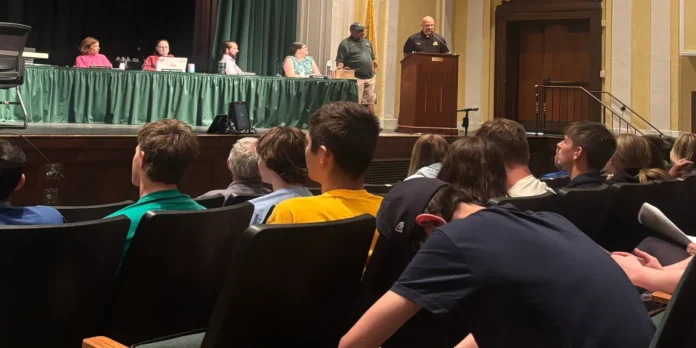
By the time the Board of Education convened its public meeting, anticipation had grown throughout the district.
Hundreds of students, parents, educators, residents, and supporters packed the venue, transforming what might otherwise have been a routine school board session into one of the most closely watched local education meetings in recent memory.
For hours, community members shared testimony and personal stories.
Students spoke about mentorship, leadership, and the impact a principal can have on daily school life. Parents described the importance of consistency and trust within educational environments. Community members discussed the value of maintaining stability within a school that serves as a cornerstone of local life.
The public comment period became a reflection of something often overlooked in conversations about education: schools are more than buildings and administrative structures. They are communities built upon relationships.
Teachers influence students. Coaches inspire athletes. Counselors guide young people through difficult transitions. Principals shape school culture, set expectations, establish priorities, and help define the environment in which learning takes place.
The passionate response from Audubon residents demonstrated that educational leadership is often measured not only through academic outcomes but also through trust, accessibility, visibility, and community engagement.
As the evening progressed, it became increasingly clear that the proposal had become far larger than an internal staffing decision.
Instead, it had evolved into a broader conversation about transparency, communication, community involvement, and the relationship between school leadership and public trust.
Observers noted that the level of student participation was particularly striking.
Many of the students who spoke had never before addressed a public governing body. Yet they demonstrated confidence, preparation, and a clear understanding of how civic institutions function. Their willingness to participate directly in the decision-making process became one of the defining themes of the evening.
For educators across New Jersey, the events in Audubon offered a compelling example of civic education in action.
Textbooks can explain how public meetings work. Classroom discussions can explore democratic principles. But few educational experiences are more meaningful than witnessing students engage directly with the institutions that affect their lives.
As public comments concluded and board members deliberated, attention shifted toward the final decision.
After hours of testimony and community input, the Board of Education voted 9-3 to reject the transfer proposal, effectively allowing Principal Lebb to remain at Audubon Junior-Senior High School.
The decision was met with an emotional response from supporters who had spent days organizing, advocating, and participating in the process.
For many students, the outcome represented validation that their voices mattered.
For parents, it demonstrated that public engagement can influence local decision-making.
For community members, it reinforced the idea that school governance functions best when transparency, communication, and public participation remain central components of the process.
The broader significance of the Audubon story extends well beyond one principal, one school, or one district.
Across New Jersey, educational communities continue to navigate complex challenges. Schools face evolving academic expectations, staffing considerations, budget pressures, technological change, mental health concerns, and shifting demographic realities. Throughout these discussions, maintaining strong relationships between schools and the communities they serve remains essential.
The Audubon experience serves as a reminder that educational leadership is not solely about management and operations. It is also about connection.
Successful schools often thrive because students feel supported, families feel heard, teachers feel empowered, and administrators build trust over time. When those relationships are strong, communities frequently rally to protect and preserve them.
The events in Audubon also highlight an encouraging trend emerging throughout New Jersey education: students are increasingly willing to participate in civic life.
Whether addressing school policy, community issues, environmental concerns, or educational priorities, young people across the state are demonstrating a growing understanding that meaningful change often begins with engagement.
Rather than remaining passive observers, Audubon students became active participants in the process.
They organized. They advocated. They listened. They spoke. They learned how local government functions. They experienced firsthand how public institutions respond to community input.
Those lessons may ultimately prove as valuable as any classroom assignment.
The outcome also reinforces an important principle for school districts throughout New Jersey. Educational decisions are often most successful when stakeholders understand the reasoning behind them and have opportunities to contribute to the conversation. Community trust is strengthened through transparency, dialogue, and meaningful engagement.
In Audubon, those conversations became intense, emotional, and highly visible. Yet they also demonstrated the strength of a community that cares deeply about its schools and the people who lead them.
As students return their focus to academics, athletics, clubs, and preparing for the future, this chapter will likely be remembered as more than a debate over a principal’s assignment.
It will be remembered as a moment when a community came together, when students discovered the power of their collective voice, and when local government responded to an engaged and determined public.
For Audubon, the story ends with continuity in leadership.
For New Jersey, it stands as a powerful example of civic participation, educational engagement, and the enduring connection between schools and the communities they serve.
In a time when many young people are often accused of being disconnected from public life, the students of Audubon delivered a compelling reminder that the next generation is paying attention, speaking up, and prepared to shape the future of their communities.
Nothing was publicly cited as being “wrong” with Principal Jeff Lebb. The school administration did not claim he was performing poorly or facing disciplinary action.
Instead, the situation boiled down to standard district restructuring and administrative privacy:
- In-District Reassignment: The proposal was an “in-district transfer” to place him at Mansion Avenue Elementary School, a common administrative practice to shuffle leadership.
- Personnel Confidentiality: Under New Jersey state law, specific reasons for administrative transfers are treated as confidential personnel matters and cannot be publicly disclosed by school officials.
- Community Backlash: Parents and students heavily criticized the administration’s decision, viewing the sudden move as a “power trip” or an unnecessary disruption to a highly trusted high school leader.
Because the public felt the high school was benefiting immensely from his direct, student-focused leadership, they issued a symbolic vote of no confidence against Superintendent Sandra Allen for trying to move him