
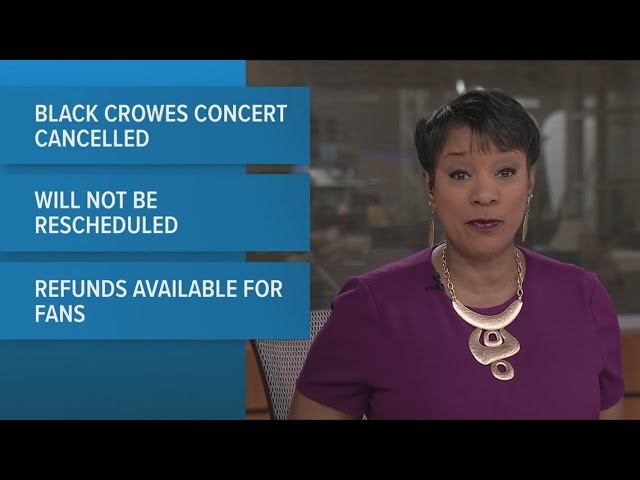

For New Jersey concertgoers, the announcement arrived with little warning and plenty of disappointment. The scheduled June 20, 2026 appearance by the Black Crowes at Prudential Center in Newark has officially been canceled, removing one of the summer’s most anticipated classic rock events from the Garden State concert calendar and leaving fans searching for answers.
According to the official explanation, the cancellation stems from international shipping and customs complications connected to the band’s upcoming European tour schedule. Management cited issues surrounding the early shipment of production equipment and touring infrastructure overseas, creating a conflict that ultimately forced the cancellation of the Newark stop.
On paper, the explanation appears straightforward. International touring has become increasingly complex in recent years. Customs documentation, carnet requirements, shipping schedules, transportation costs, and production logistics can create significant challenges for artists moving large-scale concert equipment between continents. For major touring acts, even minor disruptions can produce cascading effects throughout an entire schedule.
Yet the cancellation has generated considerable discussion among fans and industry observers because of one critical detail: the Newark show appears to be the only casualty.
Other dates on the Black Crowes’ current tour itinerary remain intact, including several performances in the same general region. Nearby concert stops and outdoor amphitheater appearances continue to move forward as planned, leading many fans to question whether logistics alone tell the complete story behind the canceled Prudential Center appearance.
The situation has become one of the most talked-about concert developments in the New Jersey music community this month.
For fans throughout the Garden State, the Newark performance represented a rare opportunity to see one of rock’s most enduring bands in a major arena setting. Since their emergence in the late 1980s, the Black Crowes have maintained a loyal following through a blend of Southern rock, blues, hard rock, and classic American songwriting traditions.
Songs such as “Hard to Handle,” “She Talks to Angels,” “Remedy,” and numerous other staples helped establish the band as one of the defining rock acts of their generation. Even decades later, their concerts continue to attract audiences eager to experience the group’s signature blend of swagger, musicianship, and improvisational energy.
The Newark date also carried additional significance because it paired the Black Crowes with Whiskey Myers, a band whose popularity has steadily expanded through a combination of Southern rock authenticity, relentless touring, and a rapidly growing fan base.
On paper, the pairing appeared designed to attract multiple generations of rock fans.
Yet the Prudential Center presents unique challenges for any touring act.
As one of the premier arenas in the Northeast, the venue is capable of hosting nearly 20,000 concertgoers depending on stage configuration. While the building regularly accommodates major global superstars, arena bookings represent a significantly different business equation than theaters, amphitheaters, casinos, or performing arts centers.
Filling an arena requires a substantial ticket-buying audience, particularly in a region as competitive as the New York-New Jersey metropolitan area, where fans often have dozens of entertainment options competing for attention on any given weekend.
That reality has fueled speculation that factors beyond shipping logistics may have contributed to the decision.
Industry veterans often note that concert cancellations rarely stem from a single issue. Touring economics, production costs, venue expenses, staffing requirements, insurance, transportation, marketing commitments, and ticket sales all contribute to whether a show ultimately proceeds.
While the official explanation focuses on overseas shipping requirements, some observers have questioned whether broader business considerations may have played a role in the final outcome.
Adding to the conversation is the timing of the cancellation itself.
The announcement follows a period of heightened public attention surrounding the band after a widely discussed concert incident earlier this year generated headlines across entertainment media and social platforms. While artists routinely weather controversy without long-term consequences, moments that dominate online discussion can influence public perception and affect consumer behavior, particularly when ticket sales remain ongoing.
Whether those events had any measurable impact on the Newark date remains impossible to verify publicly. Nonetheless, the proximity between recent headlines and the cancellation has become part of the broader discussion among fans attempting to understand why the show disappeared from the schedule.
For New Jersey music fans, however, the immediate concern is less about speculation and more about the loss of a major summer concert opportunity.
New Jersey has long served as one of the most important live music markets in America. From arena concerts in Newark to stadium events in East Rutherford, from theater performances in Red Bank and Morristown to festival stages along the Jersey Shore, the state consistently attracts some of the biggest touring acts in the world.
The cancellation of any major show inevitably creates disappointment, particularly when fans have already made travel plans, hotel reservations, dinner reservations, or coordinated group outings around a concert experience.
Fortunately, ticket holders are expected to receive automatic refunds through primary ticketing platforms. Those who purchased through official channels should see funds returned to their original payment methods according to the timelines provided by their ticket vendors. Fans who acquired tickets through resale marketplaces or secondary brokers may need to work directly with those providers to resolve refunds and credits.
While the Newark date may be gone, the broader summer concert season throughout New Jersey remains exceptionally strong.
Across the state, amphitheaters, arenas, theaters, casinos, clubs, boardwalk venues, and outdoor festivals continue to present one of the busiest live entertainment calendars in recent memory. From legacy rock acts and contemporary chart-toppers to Americana artists, indie performers, jazz ensembles, and local favorites, New Jersey remains one of the country’s premier destinations for live music.
That larger context is important because it reinforces a reality that often gets overlooked whenever a high-profile cancellation occurs: New Jersey’s music scene remains remarkably resilient.
One canceled arena date may dominate headlines for a few days, but the overall strength of the state’s concert ecosystem continues to thrive. Every week, thousands of music fans attend performances throughout the Garden State, supporting artists at every level and helping sustain one of the most vibrant live music cultures in the nation.
The Black Crowes cancellation may ultimately remain exactly what management says it is: a logistical casualty of international touring demands. Or it may become one of those industry stories where fans continue debating the underlying reasons long after the official explanation has been issued.
Either way, the canceled Newark appearance serves as another reminder of the increasingly complicated business of modern touring. Moving artists, crews, equipment, staging, lighting, and production elements across multiple countries and continents requires extraordinary coordination. Even established acts with decades of experience are not immune to unexpected disruptions.
For now, New Jersey fans who hoped to see the Black Crowes at Prudential Center will have to look elsewhere if they want to catch the band this summer. While the Newark stop has vanished from the calendar, the conversation surrounding its cancellation continues to grow, becoming one of the more intriguing live music stories of the 2026 concert season.
In a region where live music remains woven into the cultural fabric of everyday life, any major cancellation attracts attention. When that cancellation involves a legendary rock band, a major arena, and lingering questions that extend beyond the official explanation, it becomes more than just a scheduling update—it becomes a story that music fans across New Jersey will continue discussing long after June 20 passes.
















