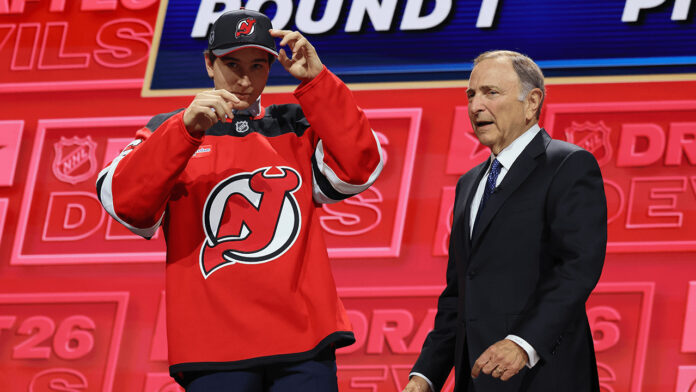

The New Jersey Devils made one of the most intriguing selections of the 2026 NHL Entry Draft on Friday night in Buffalo, choosing Swedish center Alexander Command with the 12th overall pick — a choice that signals not just a talent acquisition, but a philosophical shift in how this franchise intends to build its future.
Inside KeyBank Center, as Commissioner Gary Bettman read out the name, even Command himself appeared momentarily stunned. It was an honest reaction, and in some ways, it captured exactly what made this pick fascinating. Here was a teenager from Danderyd, Sweden who had just learned that one of the most storied franchises in the Eastern Conference had decided, in front of thousands of hockey fans and a national television audience, that he was the right man to help lead their next era.
The Devils thought long and hard about this selection. Fans speculated about the big, physical wingers available. Some scouts expected New Jersey to lean toward a different kind of offensive profile. But General Manager Sunny Mehta charted his own course, and when the dust settled in Western New York, it was a two-way Swedish center with 44 points in 30 games who was heading to the Garden State.
Who Is Alexander Command?
Born June 16, 2008, in Danderyd, Sweden, Alexander Command stands 6-foot-1 and weighs 187 pounds — a frame that, at 17 years old, still has room to grow into. He spent the 2025-26 season playing for Örebro HK’s under-20 program in Sweden’s J20 Nationell, one of the most competitive junior hockey leagues in the world. And he did not just play — he dominated.
Finishing among the league’s top scorers, Command recorded 17 goals and 27 assists, numbers that placed him firmly in the conversation not just as an interesting European prospect but as one of the most well-rounded offensive performers at his age level in the entire continent. NHL Central Scouting ranked him 11th among international skaters entering the draft, but his actual draft board position across various analytical models and scouting services ranged considerably wider — from a clear first-round talent to someone a handful of teams had pegged comfortably inside the top 12.
The Devils believed he belonged in the 12 slot, and a growing chorus of draft analysts are likely to agree that New Jersey got tremendous value.
The Case for Command: A Two-Way Profile Unlike Any Other
What separates Command from many of the other high-ceiling offensive prospects in this draft class is the volume and variety of what he brings to the rink each night. While plenty of teenagers can light the lamp or create space with speed, Command does those things while also functioning as a genuinely committed defensive center — a combination that is rarer than it sounds at the junior level and almost vanishingly rare at 17.
The analytical community had been paying close attention to Command long before draft night. His shot volume in the J20 Nationell was eye-catching, averaging more than six attempts per game — a number that places him in elite territory among even the best players in the league. But the statistic that really turned heads was where he was generating all that offensive activity: Command spent more than half of his ice time in the neutral zone and defensive end, and still produced at a rate that would lead most leagues.
He also recorded 1.24 hits per game, a figure that speaks to his willingness to engage physically. For a teenager of his age and skill level, that kind of physical commitment is a genuine differentiator. Most high-end offensive prospects at the junior level pick their spots, avoiding confrontation in favor of protecting the puck. Command, by contrast, seems to seek out contact and use it as a tool.
What the Scouts Are Saying
The scouting reports on Command tell a consistent story. Players who process the game quickly, create under pressure, win battles along the boards and around the crease, and do it all without ever having an off shift — these are the prospects that NHL organizations spend years searching for.
What stands out most in Command’s case is the processing speed. The ability to read a play before it fully develops, to feel pressure coming and already have a solution in motion — that is the trait that tends to survive the transition from elite junior hockey to professional hockey. Skating can improve. Strength always increases with time and a proper NHL training program. But that internal clock, that instinct for where the game is going, is either there or it isn’t. By all accounts, Command has it in abundance.
His forechecking is another element that scouts have highlighted repeatedly. He does not simply apply token pressure in the offensive zone — he hunts pucks, creates defensive breakdowns through intelligent reading of the play, and consistently generates possession in areas of the ice where most teenagers simply cannot function. The motor he plays with was described by multiple evaluators as among the highest they had seen from any European prospect in years.
That combination — offensive production, defensive engagement, physical play, elite processing — is not something scouts encounter often in a player his age. That is precisely why the comparisons to Nico Hischier, the Devils’ own captain and one of the most complete two-way centers in the game, are both significant and deliberate.
The Hischier Connection and What It Means for New Jersey
The comparison to Nico Hischier is not a casual one. Hischier was the first overall pick in the 2017 NHL Draft. He has spent his entire career proving that a center can anchor a team’s identity through compete level, two-way play, and consistent excellence rather than through singular offensive brilliance alone. He is the gold standard for the kind of player Command is projected to become.
Mehta’s fingerprints are all over this pick, and the reasoning becomes clear when you understand his history with the franchise. The General Manager has long been credited — some might say legendarily so — with a prescient evaluation of Jesper Bratt well before the rest of the league caught on. His confidence in Swedish players with elite competitive engines and underappreciated point production is not new, and it is rooted in a genuine understanding of what the Swedish junior system demands and what it reveals about a player’s character.
Sweden’s top junior league is not a soft environment. The players who thrive there at 17 do so because they possess a tenacity and a cognitive ability that sets them apart from their peers globally. When a player not only thrives there but does so while also demonstrating defensive responsibility and physical aggression, it is a signal that serious evaluators cannot ignore.
Mehta did not ignore it. He bet on Command in the first round, at 12th overall, in front of the entire league.
The Bigger Picture: What This Pick Says About the Devils
There has been a persistent critique of the New Jersey Devils for the better part of the last decade. For a team that has legitimate top-six talent — with Jack Hughes operating as one of the most gifted pure offensive players in the NHL and Nico Hischier providing the ideal two-way anchor at the top of the lineup — the rest of the roster has often seemed unable to match the intensity and identity that the top line sets.
It is a strange feeling to watch a team that has elite players but lacks a consistent culture of compete from line one through line four. The Devils have been a difficult team to play against in spots — the Swiss contingent of Hischier, Timo Meier, and Jonas Siegenthaler, along with veteran presence from Brenden Dillon, have supplied moments of physical engagement and edge. But the consistency simply has not been there, and it has shown when the games tighten in the playoffs.
Adding a player like Alexander Command is a declaration of intent. It says that this organization values what Hischier brings — not just the points, but the relentless pace, the defensive commitment, the willingness to engage in the hard areas of the ice — and wants to multiply it throughout the lineup. Command is being drafted to become the third-line center behind Hughes and Hischier. If he develops as projected, he gives New Jersey three centermen who can all be trusted when the game is on the line.
That is a foundation. That is how deep teams are built.
Looking at the Path Forward for Command
It is worth noting that Command did not spend his entire season in the junior ranks. He dressed for a handful of games with the Örebro HK senior squad in the Swedish Hockey League — one of the world’s top professional leagues — giving him a taste of the speed and structure that awaits at the next level. That experience matters. Not every 17-year-old earns professional minutes, and the fact that Örebro trusted him in those moments speaks volumes about how the organization internally valued his game.
The expectation is that Command will return to Sweden next season in a larger role, likely serving as one of Örebro’s primary contributors at the SHL level before eventually making the jump to North America. The timeline for his NHL debut is not yet locked in — development for high-end European prospects rarely moves in a straight line — but the tools are in place for an impressive and relatively swift ascent.
His shot volume, physicality, and processing ability are traits that tend to translate across levels. The main adjustment will be pace and the reduction in time and space that the professional game demands. Based on everything scouts have observed, Command is exactly the kind of player who does not struggle with that adjustment because he was already playing faster than his competition at the junior level.
New Jersey Devils Hockey Is About to Get Harder to Play Against
The phrase “harder to play against” has floated around Devils circles for the better part of two seasons. It is easy to say and considerably harder to actually construct. Selecting big bodies or players with physical reputations is only part of the equation — you need players who combine that physicality with skill and compete, or you end up with a team that takes penalties and finishes last in possession metrics.
Command does not fit that one-dimensional mold. He is not a fighter or an enforcer. He is something more valuable: a skilled, intelligent hockey player who also happens to be physically engaged on every shift, who happens to forecheck with genuine intent, and who happens to play the defensive side of the game as if he actually values it.
That is the profile that championship teams are built around. You do not win in May with a lineup full of players who skate around looking for the path of least resistance. You win with players who take the hard path, who create problems for the opposition every single shift, and who make the star players’ lives easier by doing the necessary unglamorous work.
With Hughes providing the offensive brilliance that the league does not have an answer for when he is at his best, and Hischier providing the model two-way center performance at the top of the lineup, Command gives the Devils the potential to have that same identity extend through the heart of the lineup. A third-line center who can match the compete level and style of play of your first-line center is not a luxury — it is a necessity.
The Verdict on the Pick
Draft night selections are inherently speculative. Players develop differently, organizations go in unexpected directions, and the teenager who looks like a perfect fit at 17 does not always become the player everyone imagined. That is the nature of the business.
But within the context of everything that is known about Alexander Command right now — the production in one of the world’s premier junior leagues, the physical profile that already stands out at this level, the processing ability that scouts consistently highlight as exceptional, and the character of a player who has reportedly told teams directly that he simply hates losing — this appears to be an outstanding pick for the New Jersey Devils.
Sunny Mehta made a bold choice. He passed on players who may have been safer bets, more conventional selections, prospects with higher floors and perhaps lower ceilings. He chose a player who, at 17 years old, plays with the energy and commitment of someone with a lot more to lose, and who does it while producing at a first-round level in a league where most teenagers simply survive.
New Jersey Devils fans have spent years watching this franchise try to find its identity beyond its two franchise players. Alexander Command, center, Örebro HK, Sweden — pick 12 in the 2026 NHL Entry Draft — might just be the clearest statement yet about exactly who the Devils want to be.
The foundation is in place. Now comes the work of building something that lasts.