

The legal foundation of the American real estate economy rests on an infrastructure that most people never think about and that, in more than 3,000 county offices across the country, remains startlingly analog: the deed, the mortgage record, the tax assessment, and the chain-of-title documentation that together establish who owns what land and what claims exist against it. Balcony, a property data infrastructure company headquartered in Hoboken, New Jersey, has spent the past several years building the technology layer designed to modernize that system, and its latest expansion — a new wave of county government partnerships across Kentucky — marks the next stage in what has become one of the more consequential quiet transformations underway in American local government technology.
The company’s Keystone platform, which aggregates fragmented land records, tax assessment data, and geographic information systems into a single, searchable, auditable digital registry, has now moved beyond its New Jersey origins to take root in Kentucky county clerk’s offices, following a model that began with a landmark agreement with Hopkins County earlier this year. The expansion reflects both the specific technical value proposition Balcony has built and a broader moment of accelerating momentum across the government technology and property technology sectors, with the company’s growth trajectory suggesting it has identified a genuine and underserved need at the most fundamental layer of American property law administration.
What Balcony Actually Builds
To understand why a company most New Jersey residents have likely never heard of is attracting attention from county governments across multiple states, it helps to understand precisely what problem Balcony’s technology is designed to solve. County clerk and recorder offices across the United States are the legal custodians of property records — the deeds that establish ownership, the mortgages and liens that establish financial claims against a property, the tax assessment data that determines what an owner owes, and the GIS mapping data that establishes a parcel’s physical boundaries and characteristics. In the overwhelming majority of American counties, these records exist across multiple disconnected systems, often maintained by different departments using different software, with historical documents frequently existing only in physical or scanned-but-unstructured form that makes comprehensive searching difficult or impossible without manually cross-referencing multiple sources.
Balcony’s Keystone platform addresses this fragmentation directly. The system converts unstructured land records — deeds, mortgages, tax assessments, and GIS data — into structured, searchable information organized within a unified, parcel-based framework. Every record connects at the parcel level, creating what the company describes as a 360-degree view of a property’s complete legal and financial history. Property history is organized into a clear, chronological chain of title, with every deed, transfer, lien, and related transaction recorded in sequence and logged in real time, creating what amounts to a permanent, tamper-resistant audit trail and government-verified record of ownership. For county staff who have historically needed to manually reconcile information across multiple disconnected systems to answer a single question about a property’s status, Keystone consolidates that process into a single searchable interface.
The technology underlying this consolidation draws on both artificial intelligence, which the platform uses to index and organize property data and to power threat detection capabilities through a function the company calls mTrace, and blockchain infrastructure, specifically built on the Avalanche network, which provides the tamper-resistant verification layer that gives county officials and the public confidence that historical records have not been altered or corrupted. Gregg Lester, Balcony’s co-founder and co-CEO, has been explicit that the company’s positioning is deliberately collaborative rather than disruptive: Keystone is designed to function as a layer that works alongside existing county systems and existing county clerk operations rather than attempting to replace the institutional role those offices play. That framing matters significantly in the government technology sector, where vendors promising to fully replace legacy government systems have historically struggled to gain the trust of the public officials whose institutional knowledge and statutory authority remain essential to how property records actually function as legal instruments.
The Kentucky Expansion: Hopkins County and What Comes Next
Balcony’s move into Kentucky represents a deliberate geographic expansion beyond the company’s New Jersey base, and the structure of the Kentucky partnerships reflects lessons clearly drawn from the company’s earlier work in Bergen County. In February 2026, Balcony signed a two-year agreement with the Hopkins County Clerk’s Office to modernize the county’s land record management systems, unifying land records and tax assessment data using the Keystone platform. The agreement gives Hopkins County the same parcel-based, chronologically organized chain-of-title infrastructure that Balcony has built for its New Jersey government partners, consolidating what had previously been siloed systems into a single, searchable environment.
Lester’s public statement on the Hopkins County agreement framed the partnership within a broader institutional argument about what property records infrastructure actually represents for a community. Property records, in his characterization, form the foundation of trust between governments and the communities they serve. The Keystone platform’s purpose, in that framing, extends beyond operational efficiency into something closer to a civic infrastructure investment: streamlining government operations while safeguarding public trust, unlocking smarter data for better decision-making, and establishing a more transparent, accessible, and future-ready approach to land record management that other counties across the country can adopt as a model.
The Hopkins County deployment is explicitly framed by the company as a template rather than an isolated engagement — language that signals Balcony’s ambition to use its Kentucky foothold as a foundation for expansion to additional counties across the commonwealth and, eventually, across the broader landscape of more than 3,000 county-level government offices nationwide that maintain the land records underlying trillions of dollars in American real estate value. The continued growth of Balcony’s Kentucky partnerships in the months following the Hopkins County agreement reflects exactly that trajectory unfolding in practice.
The New Jersey Foundation Behind the National Expansion
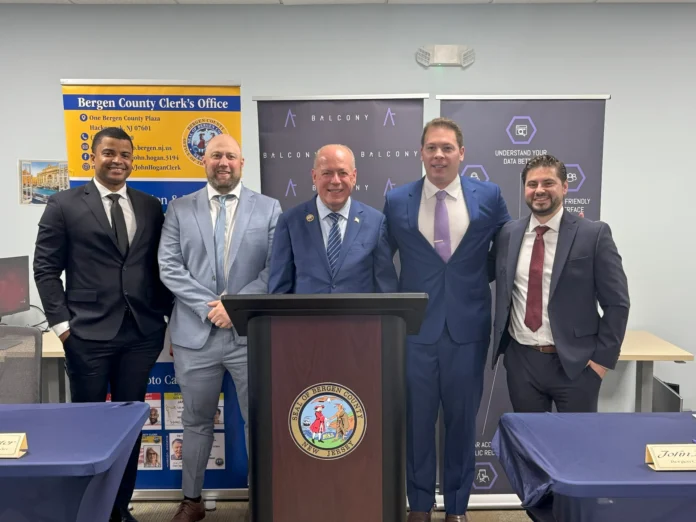
Balcony’s Kentucky growth does not exist in isolation from the company’s deep operational roots in New Jersey, where its corporate headquarters in Hoboken anchors a body of government partnership work that established the company’s credibility and technical capability before it ever expanded beyond state lines. The signature achievement of that New Jersey foundation is the company’s May 2025 agreement with the Bergen County Clerk’s Office — a five-year contract to digitize and transition 370,000 property deeds, representing an estimated $240 billion in real estate value, onto Balcony’s secure, blockchain-backed platform. Industry analysis has characterized the Bergen County agreement as the largest government-level deed tokenization project undertaken in the United States to date, a distinction that gave Balcony the kind of large-scale public sector reference deployment that government technology vendors typically require before other jurisdictions will seriously consider adopting unproven infrastructure for records this legally and financially consequential.
Beyond Bergen County, Balcony’s New Jersey footprint extends to active deployments managing on-chain infrastructure and property data layers for several additional municipalities, including Camden, Morristown, Fort Lee, and Cliffside Park — a geographic spread across the state that demonstrates the platform’s applicability across municipalities of significantly different size, economic profile, and administrative capacity. In Orange, New Jersey, Balcony’s property compliance tracking software produced a specific and quantifiable public benefit: by analyzing discrepancies across the city’s municipal databases, the platform identified more than $1 million in previously unrealized municipal revenue that had gone uncollected due to gaps in real estate compliance tracking. That outcome represents precisely the kind of concrete, dollars-and-cents value proposition that distinguishes Balcony’s pitch to county and municipal governments from more speculative blockchain applications: the platform does not merely modernize record-keeping in the abstract, it identifies specific revenue that a government was legally owed but had failed to collect because its existing systems could not surface the discrepancy.
In total, Balcony’s New Jersey government partnerships now encompass more than 460,000 properties representing approximately $290 billion in real estate value brought onto the company’s secure data network — a scale of public sector deployment within a single state that few government technology startups achieve before expanding nationally, and that gives the company’s Kentucky expansion a credibility foundation built on demonstrated performance rather than unproven promises.
A Company Built on New Jersey Soil, Now Building National Infrastructure
Balcony was co-founded in 2021 by Dan Silverman, with Gregg Lester serving as co-founder and co-CEO alongside him, and the company has continued to operate its corporate headquarters in Hoboken even as its government partnerships have expanded across state lines. In May 2026, the company announced a $12.7 million seed funding round led by Blockchange Ventures, bringing its total capital raised to $14 million — financing explicitly earmarked to accelerate engineering development, scale go-to-market operations, and expand Keystone deployments across county and state governments nationwide. As of that announcement, Balcony’s Keystone infrastructure was reported to be helping government agencies across the United States manage and secure more than $400 billion in total property value on the platform, a figure that reflects the combined scale of its New Jersey deployments, its Kentucky expansion, and additional government partnerships across the country.
The company’s growth has occurred against the backdrop of a broader acceleration in both the proptech and government technology sectors. Property technology sector funding rose substantially in the first quarter of 2026 according to industry tracking, and government technology deal volume reached record levels in 2025, reflecting a national moment of accelerated public sector investment in modernizing the technology infrastructure that underlies basic government functions. Balcony’s positioning within that broader trend — targeting county governments specifically, rather than consumer-facing real estate technology, and layering blockchain-based security and verification over existing legacy systems rather than attempting wholesale replacement — has differentiated the company from both consumer proptech platforms and from the established government records software incumbents that have historically dominated the sector without offering the tokenization and tamper-resistant verification capabilities that Balcony’s blockchain architecture provides.
The company has also achieved validation beyond its commercial government contracts: Balcony was named a finalist in the U.S. Army’s xTechSearch program, a recognition that signals interest in the company’s threat detection and data security capabilities from a defense-adjacent context, and that suggests the underlying verification and tamper-resistance technology Balcony has built for county property records may carry applications extending beyond the civilian government records market the company has primarily targeted to date.
Why This Matters for New Jersey
For a state whose national reputation in the technology sector has historically been shaped by its proximity to and competition with New York City, Balcony represents a different and increasingly significant model: a New Jersey-headquartered company building genuinely foundational infrastructure technology, securing landmark public sector contracts within its home state before that work, in turn, becomes the demonstrated credibility that opens doors to government partnerships in other states entirely. The Bergen County deal did not simply digitize 370,000 New Jersey property deeds — it became the proof of concept that has now carried Balcony’s technology into Kentucky county clerk’s offices and positioned the company for continued national expansion.
That trajectory — New Jersey origin, New Jersey government partnership at landmark scale, followed by national expansion built on that foundation — is precisely the kind of technology sector success story that the state’s economic development community has worked to cultivate, and Balcony’s Hoboken headquarters and continued operational presence in the state as its national footprint grows represents a genuine win for New Jersey’s standing within the broader government technology and property technology sectors. As more of the more than 3,000 county offices across the United States that maintain the legal bedrock of American real estate ownership begin to confront the limitations of fragmented, legacy record-keeping systems, the company doing the most consequential work to solve that problem is one that calls Hoboken, New Jersey, home.
















