
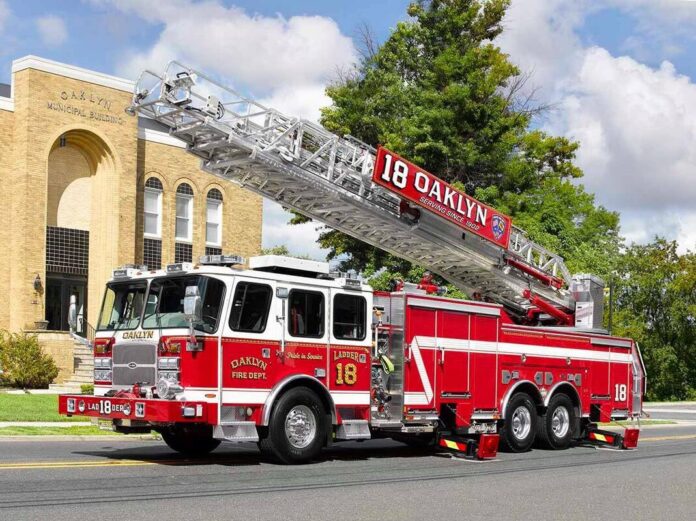

For more than a century, the volunteer firefighters of Oaklyn, New Jersey, have gathered each year to recognize the member of their company whose service over the preceding twelve months most embodied the standard the department holds for itself: the calls answered without hesitation, the training hours logged beyond what was required, the willingness to be the one who shows up. This past March, at the Oaklyn Fire Department’s 124th annual Awards Dinner, that recognition went to Megan Capobianco — and in doing so, the department marked a milestone that had eluded it across twelve full decades of institutional history. Capobianco became the first woman in the 124-year existence of the Oaklyn Fire Department to be named Firefighter of the Year, an honor made all the more notable by the fact that she had been a member of the department for barely two years at the time her peers voted to give it to her.
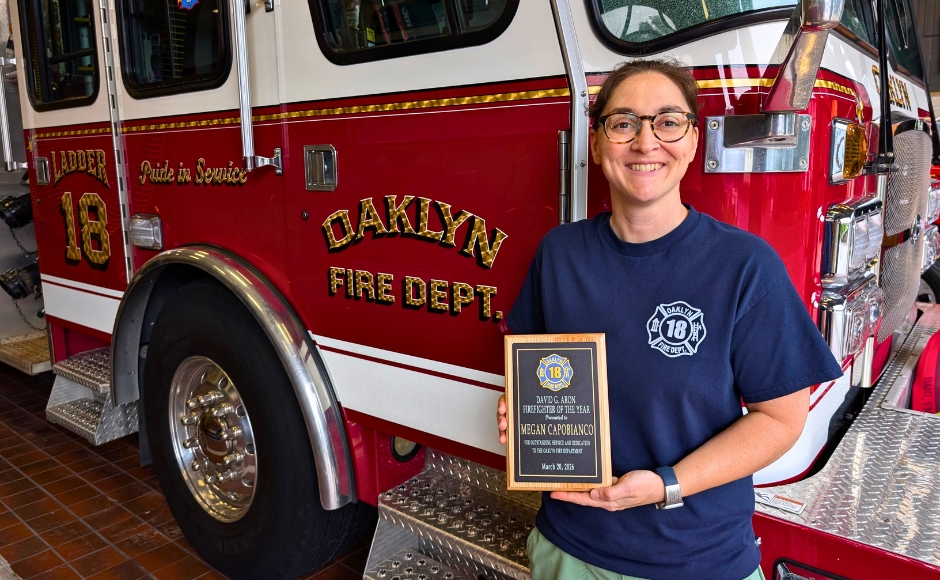
The speed of Capobianco’s rise within Oaklyn’s volunteer ranks is, by any reasonable measure of how volunteer fire service careers typically develop, extraordinary. Volunteer fire departments across New Jersey and the country generally operate on a model where institutional trust, leadership opportunities, and peer recognition accumulate gradually, built through years of demonstrated reliability before a member earns the kind of department-wide respect that translates into a peer-voted honor like Firefighter of the Year. Capobianco compressed that typical trajectory into roughly twenty-four months, distinguishing herself through what colleagues have described as a combination of relentless enthusiasm, consistently high active service hours, and a level of personal dedication to the department’s mission that became impossible for her fellow firefighters to overlook when it came time to cast their votes for the year’s top honor.
What makes Capobianco’s path into the Oaklyn Fire Department particularly compelling is that firefighting was never her original plan. She had set her sights on a career in the United States military, pursuing that path with the same seriousness and commitment that would later define her approach to volunteer fire service. A medical disqualification, however, closed off that path before it could fully begin — the kind of disqualifying circumstance that ends military aspirations for a meaningful number of otherwise qualified and motivated candidates each year, regardless of their determination or physical capability in every other respect. For many people, a medical disqualification from a long-held career goal might have prompted a pause, a period of reassessment, or a pivot toward an entirely unrelated field disconnected from the original impulse to serve. Capobianco instead redirected that same desire to serve directly into her own community, channeling the discipline and commitment she had been prepared to bring to military service into volunteering with the Oaklyn Fire Department instead.
That redirection turned out to be remarkably well-suited to her evident strengths. Volunteer firefighting, like military service, demands physical readiness, the ability to perform under high-stress and rapidly evolving conditions, sustained commitment to ongoing training, and a willingness to subordinate personal convenience to the needs of a team and a community when an alarm sounds at any hour of the day or night. The same qualities that had made Capobianco a serious and motivated military candidate translated directly into the qualities that make an exceptional volunteer firefighter, and her two years of service with Oaklyn’s department suggest that her colleagues recognized that translation clearly and consistently enough to elevate her above firefighters with considerably more tenure when the time came to select the department’s top honoree for 2025.
The historical weight of Capobianco’s recognition deserves to be understood in its full context. The Oaklyn Fire Department’s founding predates the automobile’s widespread adoption in American life, predates both world wars, and has spanned the entire arc of how volunteer fire service in small New Jersey communities has evolved from its earliest organizational structures into the modern, professionally trained volunteer departments that continue to serve as the backbone of fire protection in hundreds of New Jersey municipalities too small to support full-time paid departments. Across that entire span — 124 years of company meetings, training nights, structure fires, vehicle extrications, and the full range of emergency calls a small Camden County department responds to in a given year — no woman had previously received the department’s Firefighter of the Year distinction. That fact alone says something significant about the historical demographics of volunteer fire service broadly, a field that has, like much of the fire service nationally, been slow to reflect the gender diversity present in the broader communities these departments protect. Capobianco’s recognition does not erase that history, but it does mark a clear and overdue turning point in how the Oaklyn department recognizes excellence among its own ranks.
Her formal recognition came during the department’s 124th Awards Dinner, an annual tradition through which Oaklyn’s volunteer firefighters gather to honor the service of their colleagues over the preceding year — a ceremony that, in a small department built on volunteer commitment rather than paid employment, carries genuine significance as one of the only formal, public moments when that service receives institutional acknowledgment. Receiving the department’s top individual honor at that dinner, in front of fellow firefighters who had spent the preceding year working alongside her on calls, training exercises, and the unglamorous routine maintenance that keeps a volunteer department functioning, represents validation from the exact peer group whose opinion carries the most weight in an organization built on mutual trust and shared risk.
Capobianco’s story has since been documented by local journalist Matt Skoufalos, whose ongoing coverage of Oaklyn and the broader Camden County fire service community has chronicled the department’s calls, leadership, and institutional milestones for NJ Pen, the regional news outlet covering Camden County communities including Oaklyn, Collingswood, Haddon Township, and the surrounding area. Skoufalos’s reporting on Capobianco’s barrier-breaking achievement situates her story within the broader context of a local fire service community that has, in recent years, actively worked to recruit new volunteer members — the Oaklyn department, like many small-town volunteer companies across New Jersey, has explicitly opened its recruitment to both men and women in good health from Oaklyn and the surrounding municipalities of Collingswood, Haddon Township, and Audubon, recognizing that the long-term sustainability of volunteer fire protection depends on drawing from the fullest possible pool of motivated, capable community members rather than relying on demographically narrower recruitment patterns that have historically limited who saw firefighting as a realistic path of service.
For the young women of Oaklyn and the surrounding Camden County communities who may be considering paths of service to their own towns, Capobianco’s two-year journey from a closed-off military career to the top individual honor in a 124-year-old fire department offers a specific and powerful example: that the desire to serve a community does not require a single predetermined path, that determination and consistent effort can compress what might otherwise be a much longer road to institutional recognition, and that a 124-year barrier, once broken, opens a door that the next generation of local volunteers can walk through with the knowledge that it has already been done. Capobianco did not set out to make Oaklyn fire department history when a medical disqualification redirected her ambitions toward her own hometown. She simply showed up, consistently, for two years, until her colleagues recognized that what she brought to the department deserved the department’s highest individual honor — and in doing so, she changed what the next 124 years of Oaklyn Fire Department history will look like for the women who follow her into the company.
















