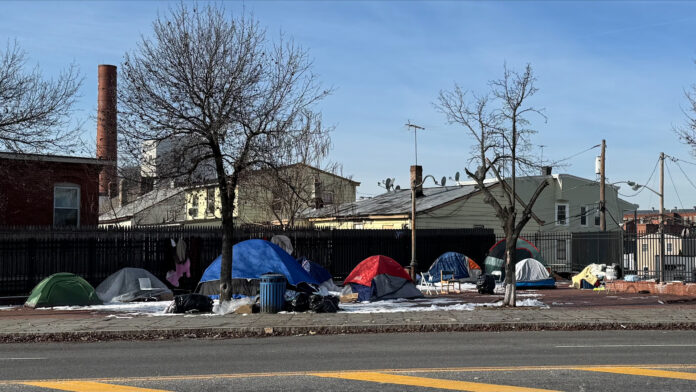

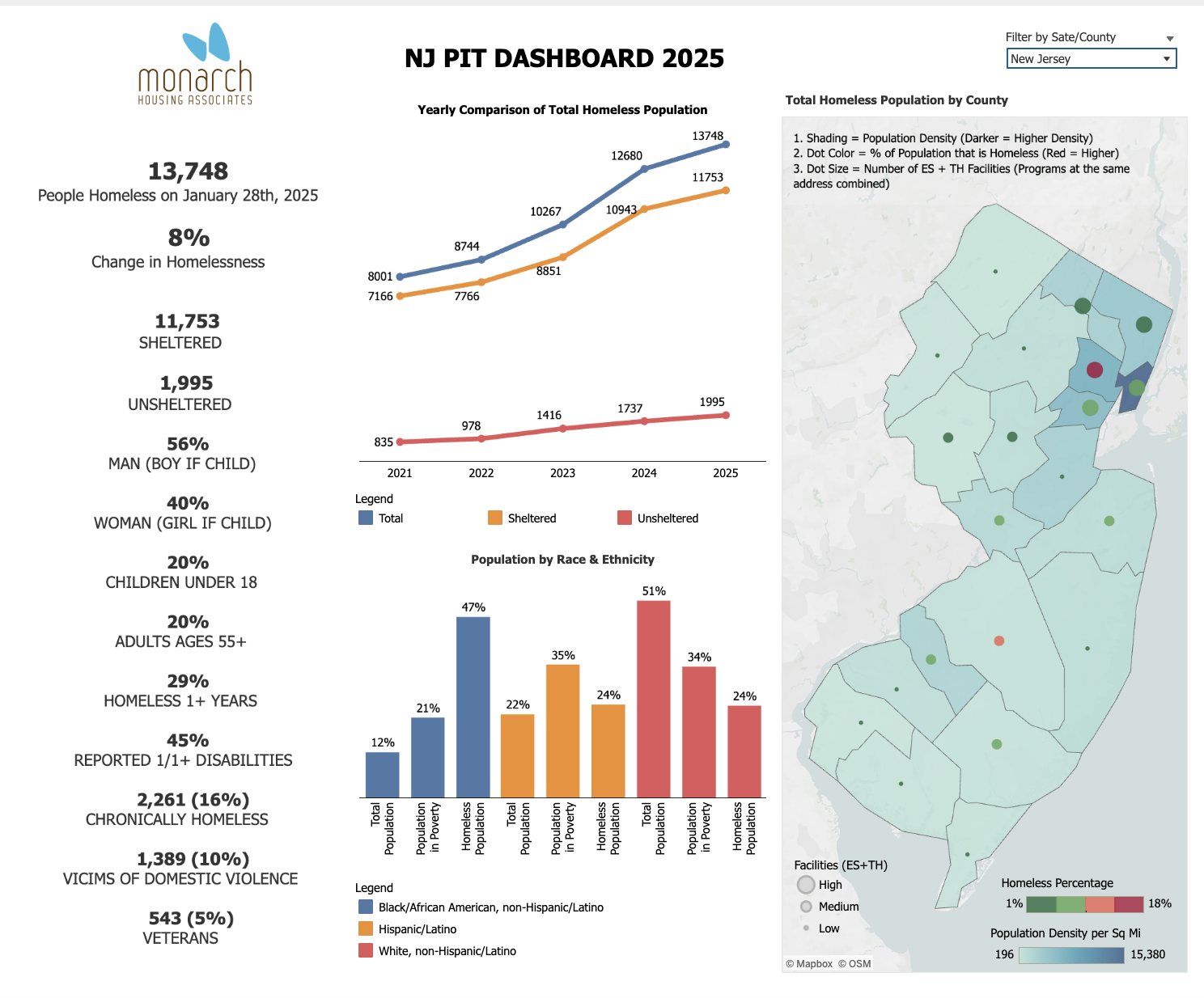
On a single night in late January, teams of volunteers and outreach workers fanned out across all 21 New Jersey counties — into shelters, train stations, soup kitchens, wooded encampments, and parked cars — to conduct the state’s federally mandated annual count of every person experiencing homelessness on that specific date. What they found, when Monarch Housing Associates finished compiling the results, was the highest number recorded in New Jersey in more than a decade: 13,748 people without stable housing, a figure that represents an 8.4 percent increase over the previous year’s count and a nearly 70 percent surge since 2021. Five years earlier, the same annual count had identified 8,097 people experiencing homelessness statewide. The trajectory between those two figures — a near-doubling in half a decade — describes a crisis that has moved well past the point where any single explanation or any single policy response can adequately address it.
The Point-in-Time count, coordinated by Monarch Housing Associates on behalf of the New Jersey Housing and Mortgage Finance Agency for the thirteenth consecutive year, is the primary instrument the federal government uses to determine housing and homelessness assistance funding for the state, and it has tracked a consistent upward trend with troubling regularity. Of the 13,748 individuals counted this year, the majority — 11,753 people — were found in some form of sheltered location: emergency shelters, hotel and motel placements funded through emergency assistance programs, transitional housing, or safe haven programs. The remaining nearly 2,000 individuals were unsheltered entirely, found sleeping outside, in vacant or abandoned structures, in vehicles, or in other locations never intended for human habitation — a category of homelessness that has more than doubled in New Jersey since 2022, driven in significant part by an emergency shelter system that now operates consistently above 90 percent capacity on any given night, leaving outreach workers with nowhere indoors to refer people even when shelter placement would otherwise be the appropriate and available response.
Taiisa Kelly, who leads Monarch Housing Associates as its chief executive, has been direct about what the annual count actually represents and what it does not. The Point-in-Time count, she has noted, provides a consistent, methodologically stable assessment of trends over time, but it captures only a single night’s snapshot rather than the full scope of housing instability across an entire year — meaning the true number of New Jersey residents who experience homelessness at some point during 2026, even briefly, is almost certainly substantially higher than the January count alone suggests. Katelyn Ravensbergen, a senior associate at Monarch, has tracked the underlying growth rate with similar precision: homelessness in New Jersey has risen at an average annual rate of approximately 14 percent since 2021, a pace that, in her assessment, has consistently outstripped the rate at which the state’s housing assistance infrastructure has been able to expand to meet it.
The forces driving that trajectory are, by this point, well documented and largely undisputed among the researchers and service providers who track the crisis most closely. The expiration of New Jersey’s pandemic-era eviction moratoriums removed a temporary but significant buffer that had kept tens of thousands of vulnerable tenants housed during the most acute phase of the COVID-19 economic disruption, and the rental market that emerged in the moratoriums’ absence has proven brutally unforgiving for low-income and fixed-income households. Average one-bedroom apartment rents across New Jersey have climbed by hundreds of dollars per month in the years since, a rate of increase that has dramatically outpaced wage growth for the low-wage workers and fixed-income residents most vulnerable to housing instability in the first place. Formal evictions, filed at a volume that now significantly exceeds the capacity of the state’s available eviction prevention and legal aid resources, remain the single leading direct catalyst pushing individuals and families out of stable housing — a dynamic compounded by the rise of so-called soft evictions, in which people staying in informal arrangements with friends or family members, without their own lease or legal housing protection, are asked to leave when those arrangements become untenable.
The demographic data embedded within this year’s count reveals disparities that have remained remarkably and troublingly consistent across multiple years of tracking, suggesting structural rather than incidental causes. Black New Jersey residents, who make up approximately 12 percent of the state’s overall population, account for 47.4 percent of the state’s unhoused population — a gap between general population share and homelessness prevalence that researchers and advocates consistently point to as evidence of the compounding effects of historical housing discrimination, employment disparities, and unequal access to the kind of family wealth and homeownership that functions as a buffer against housing instability for many white New Jersey households. Roughly one-third of all individuals counted as homeless this year belonged to families with at least one child under 18, a figure that places the crisis squarely within New Jersey’s school systems, pediatric healthcare networks, and child welfare infrastructure rather than confining it to the adult-only population that homelessness is sometimes mistakenly assumed to affect exclusively. Veterans, a population whose homelessness rates the state and federal government have specifically targeted through dedicated programming for more than a decade, nonetheless saw their numbers rise as well, with 543 veterans counted this year, a 4.8 percent increase over the previous count. Sixteen percent of the total unhoused population met the formal criteria for chronic homelessness — meaning they had experienced long-term or repeated housing instability compounded by a disabling physical or mental health condition, the population segment that service providers consistently identify as requiring the most intensive and sustained intervention to achieve lasting housing stability.
The geographic distribution of New Jersey’s homelessness crisis varies considerably by county, reflecting both the concentration of urban poverty in the state’s largest cities and the increasingly visible spread of housing instability into suburban and even rural communities that have not historically associated themselves with the crisis. Essex County, anchored by Newark’s dense urban core, continues to house the largest total unhoused population of any county in the state, a reflection of the concentrated poverty, limited affordable housing stock, and strained social service infrastructure that has long defined New Jersey’s largest city. Monmouth County, however, recorded the most severe single-year percentage increase anywhere in the state this year, with unhoused individuals rising by roughly 40 percent — a spike driven substantially by the Jersey Shore region’s soaring real estate values, which have pushed rental costs in formerly accessible shore communities to levels that increasingly exclude the service workers, retirees, and fixed-income residents who have lived in those communities for decades. Suburban and rural counties including Sussex and Middlesex have likewise recorded significant percentage increases in residents seeking homelessness services, evidence that the crisis is no longer confined to the urban corridors where it has traditionally been most visible, even as the total volume of people affected remains highest in the state’s cities.
The financial argument for sustained and expanded investment in homelessness prevention and housing-first interventions has accumulated substantial supporting evidence from other states’ experience, and advocates including Kelly have made that case explicitly to New Jersey policymakers in the context of looming federal funding cuts. The underlying logic holds that unhoused individuals who remain without stable housing for extended periods inevitably generate costs to the public system regardless of whether those costs appear in a housing budget line item: emergency room visits for conditions that routine primary care could have managed, jail and court costs associated with the criminalization of public sleeping and encampments that a growing number of New Jersey municipalities have adopted in recent years, and the ongoing operational costs of emergency shelter systems that function as a perpetually overcrowded stopgap rather than a pathway to permanent housing. States including Colorado and Utah have implemented versions of the Housing First model — an approach that prioritizes moving people directly into permanent housing without requiring sobriety, employment, or other preconditions first, paired with voluntary supportive services — and have documented research suggesting that the upfront cost of permanent housing placement, combined with rapid rehousing assistance and landlord mediation services, produces better long-term outcomes and lower total public expenditure than a reactive system built around emergency shelter and crisis response alone.
The policy distinction that advocates draw between homelessness and other social challenges like hunger is a specific and deliberate one. Where hunger can, in principle, be addressed through a sufficient and consistent supply of food distributed to people in need, homelessness is widely understood among researchers and service providers as a structural problem shaped by housing supply shortages, legal and bureaucratic barriers to assistance, and a persistent inflow of newly homeless individuals generated by sudden life crises — a lost job, a medical emergency, a sudden eviction — that no amount of existing shelter capacity alone can fully absorb or prevent. For that reason, the policy framework many homelessness researchers now advocate for is not an absolute elimination of homelessness, which they regard as an unrealistic standard given the inevitability of individual crises in any sufficiently large population, but rather what is termed a Functional Zero approach: a system robust enough that homelessness, when it does occur, is rare, brief, and non-recurring, with sufficient housing and support infrastructure to move people out of homelessness quickly rather than allowing episodes to become chronic.
That framework now confronts a federal funding environment that advocates describe as actively working against the goal it is meant to serve. The federal budget legislation signed into law on July 4 is projected to result in approximately 350,000 New Jersey residents losing Medicaid coverage and 424,000 families losing some or all of their Supplemental Nutrition Assistance Program benefits — reductions to safety net programs that homelessness researchers consistently identify as upstream prevention mechanisms, since the loss of healthcare coverage or food assistance frequently functions as the precipitating crisis that pushes already financially fragile households into the formal homelessness system. Congressional budget negotiations for the coming fiscal year are simultaneously expected to reduce funding for dedicated housing and homelessness service programs, with some federal programs facing elimination entirely, including the Home Investment Partnerships Program, which funneled $34.7 million into New Jersey’s counties and municipalities last year specifically to fund the development of new affordable housing units. Kelly has characterized the combined effect of these federal changes in stark terms, warning that the cuts threaten to destroy the very infrastructure the state currently relies upon to support its most vulnerable residents, arriving at precisely the moment when New Jersey’s own homelessness numbers are already climbing and its shelter system is already operating beyond sustainable capacity.
For New Jersey residents encountering these figures for the first time, the scale can be difficult to fully absorb: nearly 14,000 people, on a single January night, without stable housing in one of the wealthiest states in the country. But the trend line embedded within that number — an 8.4 percent single-year increase, a 70 percent rise since 2021, an unsheltered population that has more than doubled in four years — describes something more specific than a static crisis requiring sustained attention. It describes a system whose existing capacity is being outpaced by the rate at which New Jersey households are losing their housing, at exactly the moment when the federal resources historically available to help close that gap are being reduced rather than expanded. Whatever policy response the state ultimately settles on, the data collected this January makes one fact difficult to dispute: New Jersey’s homelessness crisis is not stabilizing, and the gap between the scale of the need and the scale of the available response continues to widen.