
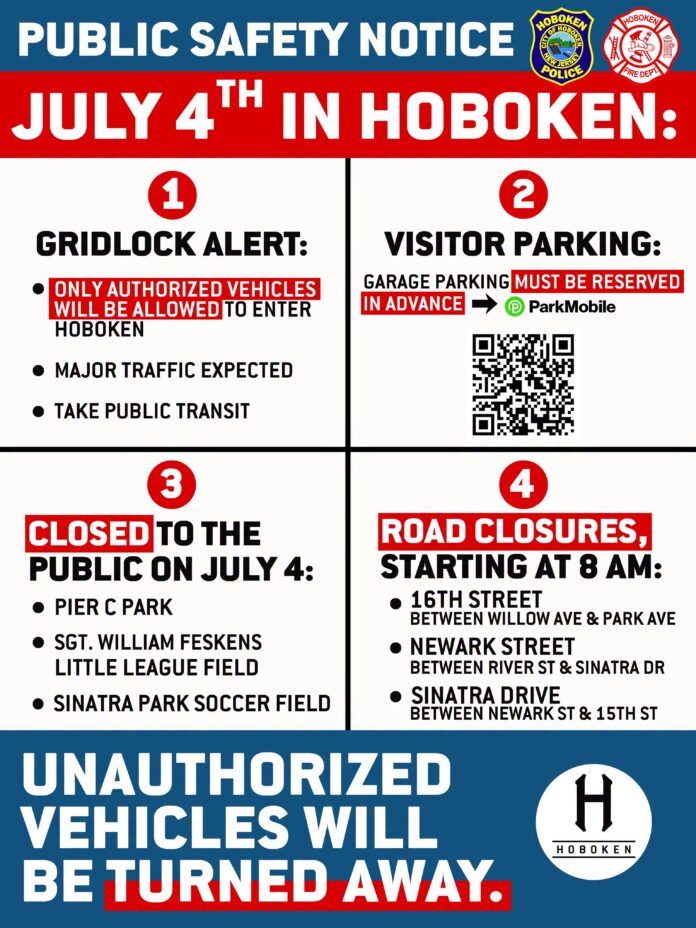

A claim spreading across partisan political blogs and local Facebook groups in the days leading up to the Fourth of July holiday asserts that Hoboken is requiring proof of residency before anyone can enter the city to watch its waterfront fireworks display, with at least one widely shared post framing the policy in deliberately provocative terms — “Papers, Please! ‘Sanctuary City’ Hoboken Demands Proof of Residency” — designed to recast a routine municipal traffic management plan as a borders-and-immigration controversy. The claim does not hold up against the city’s actual published policy. What Hoboken has implemented is a vehicle access restriction affecting cars attempting to drive into the city on July 4th, not a residency requirement governing who may walk, ride, or otherwise travel into Hoboken to celebrate the holiday. Anyone — resident or visitor, with or without identification — remains free to enter Hoboken on foot, by PATH train, by light rail, by ferry, or by rideshare, and to watch the fireworks from any of the city’s public waterfront parks entirely free of charge.
The policy that became the basis for this distorted characterization was announced by Mayor Emily B. Jabbour and the City of Hoboken in the days before the holiday, as the city prepared for what officials expect to be an unusually large convergence of holiday activity along the Hudson River waterfront. This year’s celebration coincides with several major simultaneous events: the Macy’s Fourth of July fireworks display, relocated to the Hudson River for the first time in a decade and marking the show’s 50th anniversary; the Sail 250 Parade of Sail, featuring tall ships and naval vessels moving through New York Harbor as part of the nation’s 250th anniversary commemorations; an International Naval Review and International Aerial Review; and FIFA World Cup-related festivities drawing additional crowds to the broader Hudson County waterfront. The confluence of that many large-scale public events on a single holiday weekend, layered onto a fireworks display that has historically drawn tens of thousands of spectators to Hoboken’s mile-long waterfront on its own, created the conditions city officials say necessitated a more aggressive traffic management approach than in previous years.
The specific public safety concern driving the policy is well documented and predates any of this year’s political distortion. Mayor Jabbour has referenced the city’s experience two years ago directly, describing a gridlock event that trapped vehicles attempting to leave Hoboken after the fireworks display for more than six consecutive hours — a duration of traffic paralysis severe enough that it left local police, ambulances, and fire apparatus effectively unable to navigate the city’s streets to respond to emergencies during that window. Hoboken’s Office of Emergency Management has characterized that prior gridlock event in stark terms: it was not simply an inconvenience for the drivers stuck in it, but a genuine public safety hazard in a densely populated city of roughly one square mile, where emergency response times depend entirely on streets remaining passable. Public Safety Director Ken Ferrante and the city’s OEM have built this year’s Limited Travel Access Plan specifically to prevent a recurrence of that scenario, rather than to restrict who is permitted to celebrate the holiday within city limits.
The mechanics of the actual policy, as published by the City of Hoboken, are vehicle-specific rather than person-specific, and the distinction matters considerably to understanding why characterizations of the plan as a residency or identification requirement for attendees are inaccurate. Beginning as early as 8 a.m. on July 4th, Hoboken police officers will be stationed at the city’s primary vehicular entry points, restricting incoming car traffic to a defined set of categories: Hoboken residents able to verify their address, typically through a valid driver’s license; individuals who can demonstrate proof of a prepaid, reserved parking space in one of the city’s designated municipal garages; people commuting into Hoboken for work at a business located within the city; rideshare vehicles; and public transit vehicles. Drivers who do not fall into one of those categories — most relevantly, drivers from outside Hoboken who are simply looking for a place to park their personal vehicle in order to watch the fireworks, or who are attempting to use Hoboken’s streets as a through-route to reach another destination — will be turned away at the entry checkpoints and redirected elsewhere.
What that policy explicitly does not restrict is everyone who is not arriving by personal vehicle, which in a transit-dense city like Hoboken — served directly by PATH train, the Hudson-Bergen Light Rail, NY Waterway ferry service, and NJ Transit bus and rail connections — represents the overwhelming majority of people who attend the city’s Fourth of July festivities in any given year. There are no checkpoints, identification checks, or residency verification requirements of any kind for pedestrians entering Hoboken on foot from neighboring Jersey City, Weehawken, or elsewhere, nor for anyone arriving via the city’s extensive public transit infrastructure. Hoboken’s public waterfront parks, including Pier A Park, Maxwell Park, Elysian Park, and Sinatra Park, along with the Little League Field, remain fully open to the public for fireworks viewing throughout the day, with no admission charge, no credential requirement, and no distinction drawn between residents and visitors in terms of who may use that public space.
City officials have been explicit and consistent in their public messaging that the preferred and actively encouraged method of reaching Hoboken on July 4th is public transit rather than a personal vehicle, regardless of whether a given visitor lives in Hoboken or elsewhere. Hoboken spokeswoman Marilyn Baer has pointed specifically to the unusual density of simultaneous waterfront events this particular weekend as the reason behind the scale of this year’s road closures, noting that drivers who have chosen to drive to and from Hoboken on past Fourth of July holidays have consistently caused the kind of significant gridlock that complicates emergency operations and slows emergency response across the entire city. That messaging — repeated across the city’s official communications, its Office of Emergency Management advisories, and coverage from regional outlets covering the holiday weekend — has remained focused throughout on vehicle volume and emergency access, never on restricting attendance by non-residents.
The mischaracterization of this policy appears to trace specifically to a small number of partisan political commentary accounts and blogs that elected to frame a parking and traffic management plan using language evocative of immigration enforcement and border control, despite the policy itself having no connection to immigration status, citizenship, or any of the legal and political questions that language deliberately invokes. The “Papers, Please” framing, paired with a reference to Hoboken’s status as a so-called sanctuary city — a separate and distinct municipal policy area concerning local law enforcement’s cooperation with federal immigration enforcement, unrelated to holiday traffic management — appears designed to manufacture a connection between two entirely unrelated municipal policy questions for the purpose of generating outrage and engagement rather than to accurately describe what the city has actually announced. Posts using this framing began circulating on social media and partisan New Jersey political blogs in the days immediately following the city’s official announcement of its traffic plan, and spread through shares and reposts faster than the more measured original reporting from local outlets that had accurately described the policy’s actual scope.
The practical guidance Hoboken has issued to residents and prospective visitors for the holiday is straightforward and consistent with the city’s stated public safety rationale. Those planning to drive into Hoboken should expect to be turned away at entry checkpoints beginning at 8 a.m. unless they fall into one of the specifically defined exempted categories, and should expect significant delays exiting any municipal or private parking garage in the city for an extended period after the fireworks conclude, based on patterns from prior years. Those without a specific need to bring a vehicle into the city are strongly encouraged to use the PATH train, the Hudson-Bergen Light Rail, NY Waterway ferry service, or NJ Transit bus and rail options instead, all of which face no restrictions whatsoever on July 4th. Temporary no-parking zones will be posted throughout the city in advance of the holiday to preserve emergency access lanes, with vehicles parked in violation of those restrictions subject to towing at the owner’s expense — a policy directly responsive to past years in which drivers, caught in gridlock, abandoned their vehicles in locations that blocked emergency response routes entirely.
For New Jersey residents trying to separate accurate information from politically motivated distortion ahead of the holiday, the underlying facts are not actually in dispute, despite the heated rhetoric surrounding them online. Hoboken has not implemented, proposed, or enforced any policy requiring proof of residency, identification, or any other credential to enter the city, attend its public Fourth of July celebrations, or watch its fireworks display from any of its public waterfront parks. What the city has implemented is a vehicle traffic restriction, applicable only to incoming cars and trucks, designed explicitly to prevent a repeat of a documented gridlock event that left emergency vehicles unable to navigate city streets for more than six hours during a previous year’s celebration. Anyone willing to walk, take transit, or arrive by rideshare faces no restriction of any kind, and the public parks where the fireworks will be visible remain, as they always have been, open to everyone.
















