

America’s 250th birthday arrived with the ambition of a World’s Fair and the execution of a county fair that ran out of attractions before the gates opened. The Freedom 250 “Great American State Fair,” organized by a White House-backed task force and set across the National Mall in Washington from June 25 through July 10, 2026, was conceived as the premier national commemoration of the Semiquincentennial — a 16-day exposition featuring state pavilions, military displays, celebrity performances, flyovers, a Ferris wheel, and the kind of spectacle that a country turning 250 might reasonably be expected to produce. What it produced instead has been documented by independent journalists, architecture critics, political correspondents, and ordinary visitors whose accounts describe an event that failed by nearly every metric its organizers announced in advance.
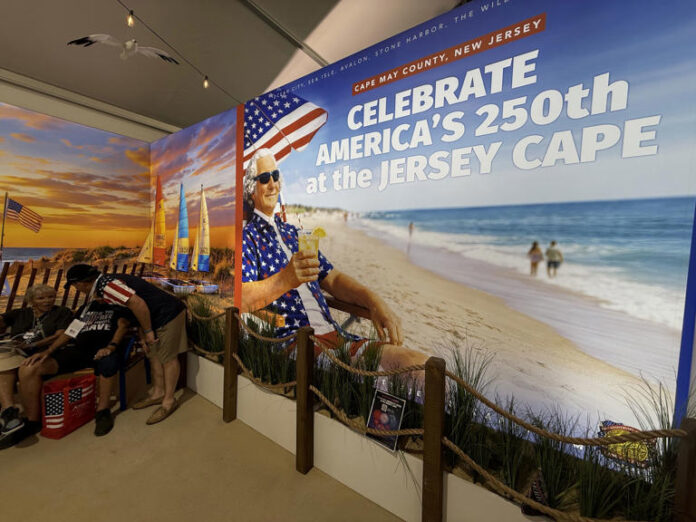
New Jersey’s relationship to the event is, in its own way, a compressed version of the national story the fair was supposed to tell but did not. Governor Mikie Sherrill, responding to constituent pressure and her own assessment of the event’s character, declined to commit state funds or official representation to the fair. Eleven states ultimately made the same decision. And when the official New Jersey presence disappeared from the fairgrounds, Cape May County and Congressman Jeff Van Drew stepped into the gap — funding and staffing a 25-by-30-foot exhibit of their own that put at least a piece of the Garden State on the National Mall. The choices made by Sherrill, Van Drew, and the Cape May County Board of Commissioners illuminate, in a state that contains both Democratic and Republican political centers of gravity, exactly how contested the meaning of patriotic commemoration has become.
What the Freedom 250 Fair Was Supposed to Be
The stated vision for the Great American State Fair was genuinely expansive. Freedom 250, the White House-backed organization that superseded the congressionally chartered America250 commission that had spent years planning the national commemoration, proposed a modern World’s Fair — a tradition with genuine American roots in the Chicago and St. Louis expositions of the nineteenth and early twentieth centuries, events that combined industrial display, cultural performance, and national self-presentation into something that drew millions of visitors and left lasting infrastructural and cultural legacies.
The Freedom 250 plan called for more than 150 exhibits representing all 56 states and territories, a Ferris wheel on the National Mall, state pavilions, military ensembles, film screenings, daily cultural programming, an opening parade, and a concert lineup of major artists. The National Mall between 4th Street and 14th Street was closed to the public for weeks of construction, disrupting traffic, displacing the beloved Smithsonian Folklife Festival to indoor space at the Arts and Industries Building, and generating the kind of logistical friction that a major event requires in order to justify itself by being genuinely major when it opens. The expectation communicated by organizers was hundreds of thousands of visitors on opening day and throughout the 16-day run.
What It Actually Was
On Thursday, the event’s opening day, the crowd beyond the gates was meager. The Ferris wheel — described as not very big — had the highest concentration of people anywhere on the Mall, and a line that had been waiting 20 minutes had not yet seen the ride run. By late afternoon and early evening, the sprawling stretches of open space remained conspicuously quiet as temperatures climbed on the National Mall.
The opening night kickoff rally on Wednesday, June 24th, produced the most scrutinized crowd size dispute of the event’s early days. An NBC News report noted that roughly half of those in Wednesday’s crowd of more than 1,000 wore Trump’s slogans or likeness on their clothes, and that for them, America’s 250th birthday was secondary to an opportunity to see the president. The Washington Post described the crowd as thinly covering an area about the length of the National Museum of American History, smaller than some summer outdoor movie screenings. President Trump subsequently wrote on Truth Social that the crowd was “packed to the brim” with at least 45,000 people, adding that “everybody stayed right until the end of my speech because they loved hearing about a truly successful America.” The New Republic reported that dozens of attendees were seen leaving during the speech, which was meant to kick-start the two-week event.
The state pavilion situation was, by accounts from multiple outlets, among the most visually arresting failures of the early days. Some states that declined to participate, like Vermont, had completely bare booths. Others, like North Carolina and Illinois, were being represented by companies or organizations from their state rather than official government delegations. The Maine pavilion featured a drab room with facts about the state and its trademark lobster on the walls. Oregon received a wall that simply said “the beaver state” and one wooden chair. “This one is boring!” a young boy said as he looked into the room and promptly walked out.
The entertainment situation deteriorated before opening day. A lineup that had originally included Morris Day and The Time, Young MC, The Commodores, Milli Vanilli, and Bret Michaels collapsed as artists began publicly stating they had been misled about the event’s partisan character. A Vanilla Ice concert was scrapped due to bad weather. Transportation Secretary Sean Duffy responded to the departing artists by calling them “libtards” — an offensive term — from the stage. The opening-night concert infrastructure experienced power outages. The Ferris wheel broke down due to generator issues on the first afternoon of operations.
The fair also features a replica of the controversial triumphal arch Trump wants to build directly across from the National Mall in Virginia. Critics described the aesthetic of the overall fairgrounds as “chintzy” and “tacky,” with some comparing the plywood construction aesthetic to a temporary installation that had not been fully completed. A live cow on the premises, named after First Lady Melania Trump by visitors who noted a similarity in hair coloring, became a symbol of the event’s general tone.
The fair kicked off with a presidential rally that struck many observers as overtly political. The 16-day event is run by Freedom 250, a White House-backed organization that has been accused of bypassing an existing bipartisan group formed years ago for the same purpose. The congressionally chartered America250 commission — which had spent years planning the national commemoration before the Trump administration launched its own parallel vision — was effectively sidelined, a decision that produced both the governance confusion and the political positioning that defined the event’s reception.
The National Division the Fair Was Supposed to Prevent
The most revealing statistic about the Great American State Fair’s reception may not be the crowd size dispute but the state boycott count. At least eleven states — including Maine, Massachusetts, Connecticut, Oregon, Washington, Illinois, and North Carolina, all with Democratic governors — declined to send official delegations or spend public money on the fair. The decisions reflected a combination of concerns: cost to state taxpayers, the partisan character of an event whose opening night featured a campaign-style presidential speech, and a broader judgment that official participation would constitute an endorsement of a national commemoration organized around one political party’s brand.
The heavy political framing extended beyond the opening rally. The expo features a booth where parents can sign their children up for “Trump accounts,” a mobile museum that has been accused of sanitizing history, two “MAHA Mondays” on the calendar, and a heavy emphasis on Christian values, from the “faith and family” pavilion to an unnamed evangelical preacher over the loudspeaker. NPR asked Freedom 250 whether there are plans to represent other religions in the fair’s programming; the response from a spokeswoman did not directly address the question.
A high school history teacher visiting from Vermont described the state exhibits as “pretty whitewashed” and said he would have liked to see “more acknowledgement of some of the uncomfortable truths of the past.” He also said of the overall event: “I feel like this is kind of more of a reflection of how divided we are.” That assessment, from an ordinary visitor who made the trip to the National Mall to see what the country had assembled to mark its 250th birthday, is perhaps the most pointed summary of what the event actually delivered.
New Jersey Said No — and Here Is Why That Decision Was Made
Governor Sherrill’s decision to keep New Jersey out of the Freedom 250 fair was not made in isolation. Constituent petitions, organized through Change.org and other advocacy channels, circulated in the weeks before the fair’s opening, calling on the governor’s office to opt out of an event that signatories described as spending state taxpayer dollars on Trump’s personal branding rather than a genuinely nonpartisan national commemoration. The petitions made the same argument that would ultimately drive the decisions of ten other states: that official participation required public funds to subsidize an event that, whatever its stated purpose, would operate as an extension of the president’s political apparatus.
Sherrill, who took office in January 2026 after defeating Republican Jack Ciattarelli in the November 2025 gubernatorial election, had been a consistent and vocal opponent of federal overreach by the Trump administration across multiple policy domains. Her decision on the fair was consistent with a governing posture that has kept New Jersey in alignment with other Democratic-led states on matters of federalism and institutional independence. The practical result was a vacant official New Jersey pavilion on the National Mall — the same situation that produced bare rooms and empty walls in the Vermont, Oregon, and other state exhibition spaces.
Cape May County’s Countermove
The vacancy in the official New Jersey space did not remain unfilled. Congressman Jeff Van Drew, who represents New Jersey’s 2nd Congressional District encompassing Cape May County and South Jersey, moved quickly after Sherrill’s decision became clear. Van Drew — who famously left the Democratic Party in December 2019 rather than vote for President Trump’s first impeachment, aligning himself with the Republican party and with Trump’s political operation in a move that transformed his electoral profile — partnered with the Cape May County Board of Commissioners to fund and organize an independent representation at the fair.
The result was a custom-designed 25-by-30-foot exhibit funded by Cape May County that occupied the space left by the state’s official non-participation. The booth’s content drew on Cape May County’s genuine historical and tourism assets: its documented connections to the Revolutionary War period, its role in the founding-era history of the region, and its profile as one of the most recognized tourism destinations on the Jersey Shore. Cape May — the borough at the tip of the peninsula that bears the county’s name — is a destination whose Victorian architecture, historic boardwalk, and Cape May lighthouse have made it a national tourism brand, and the exhibit’s use of those assets positioned it as a regional promotion as much as a political statement.
Van Drew’s motivations were transparent on multiple dimensions. He had deep roots in Cape May County long before his congressional career, having served in local and county government before ascending to the state legislature and then to Congress. His political survival has been built, since his party switch, on his alignment with Trump in a district that shifted rightward in the 2020, 2022, and 2024 election cycles. Using the fairground space as a platform for both regional promotion and a visible rebuke of Governor Sherrill’s boycott served both his constituent-service interests — Cape May’s economy is profoundly dependent on tourism, and a national platform on the National Mall is not a trivial marketing opportunity — and his political interests in distinguishing himself from the Democratic governor who will be his most prominent adversary’s chief ally in the 2026 congressional race he faces against Cape May Mayor Zack Mullock.
The New Jersey Republican Party and conservative commentators celebrated the Cape May County intervention publicly, framing it as a victory of local patriotism over Democratic partisanship. The framing holds a certain internal logic: if the fair was genuinely about celebrating America’s 250th birthday and a governor’s political objections left the state unrepresented, then the county’s decision to ensure some representation can be described as filling a civic gap. Whether the fair merited the participation that filling that gap required is a question the event’s own performance has made considerably more complex.
The Larger Question the Fair Raised About America’s 250th
The 250th anniversary of American independence is a genuine milestone. The White House created the Freedom 250 initiative after months of tensions with the congressionally chartered America250 commission, which had spent years planning the nation’s 250th anniversary celebrations before Trump’s team launched its own parallel vision for the milestone. The decision to replace a bipartisan institutional process with a White House-controlled event organization produced the result that critics of that decision predicted: an event whose political character made broad, bipartisan participation difficult to sustain, whose entertainers felt misled about what they were signing up for, and whose aesthetic and operational shortcomings became the dominant story in the national press coverage of America’s semiquincentennial week.
The country’s 250th birthday deserved better than empty state pavilions, a broken Ferris wheel, a replicated Trump arch, a crowd that independent journalists estimated at roughly one percent of what the organizers claimed, and a concert schedule that collapsed before opening night. It deserved the kind of national moment that the America250 commission had been building toward for years before it was sidelined — an event whose scale, credibility, and genuine inclusiveness matched the gravity of the occasion. New Jersey’s most visible contribution to the fair as organized was a South Jersey county’s tourism exhibit, funded and managed independently after the state government declined to participate. That is not, by any reasonable measure, the national story anyone wanted to tell about the Garden State in the year the country turned 250.
What New Jersey will actually offer the 250th anniversary is happening closer to home — on the Battleship New Jersey’s decks in Camden, in the Revolutionary War memorial programming in Haddonfield, in the fireworks that will light up the Delaware River and every shore town from Wildwood to Sandy Hook on July 4th. The Semiquincentennial is real. The country’s history in New Jersey is real and substantial. The fair on the National Mall was something else.
















