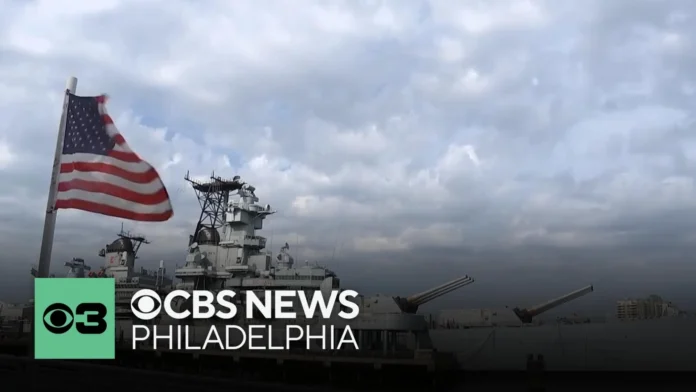

There are places in New Jersey where the weight of American history is simply unavoidable — where the ground beneath your feet, or the steel beneath your boots, carries a record of what this country has asked of the people who defended it. The USS New Jersey, moored at 62 Battleship Place in Camden along the Delaware River, is one of those places. And this summer, as the United States marks the 250th anniversary of its founding, the ship that has earned more battle stars than any other battleship in the history of the United States Navy is hosting an extraordinary sequence of events that connects the nation’s most decorated warship directly to the Semiquincentennial moment the country is living through.
The timing is not coincidental. A ship launched on December 7, 1942 — the first anniversary of the attack on Pearl Harbor — that went on to fight in World War II, the Korean War, the Vietnam War, and the Lebanese Civil War before being decommissioned for the final time in 1991 and arriving at its Camden berth in 2001 is not simply a museum artifact. It is a physical record of what American military commitment looked like across half a century, across five conflicts, across the careers of more than 55,000 sailors and Marines who served aboard its decks. Positioned on the Delaware River directly across from Philadelphia, where the Declaration of Independence was signed 250 years ago, the ship’s symbolic alignment with this summer’s national commemoration requires no editorial assistance. It is simply what it is — and what it is, is extraordinary.
Tonight: Fireworks on the Delaware (June 27, 2026)
The Battleship New Jersey’s summer events calendar opens this evening, June 27th, with a Fireworks on the Delaware event that gives attendees something no grandstand, no park, and no waterfront festival can replicate: the experience of watching Independence Day fireworks explode over the Delaware River from the deck of a historic warship, with the Philadelphia skyline stretched across the horizon as a backdrop. Gates open at 7:00 p.m., providing time to walk the ship’s decks, orient oneself to the scale of the vessel — 887 feet in length, displacing more than 45,000 tons — and find the viewing position that puts the full panorama of the river and the city in frame before the shells begin their ascent.
The fireworks over the Delaware are not merely decorative in this context. They are visible from a ship that was built to fight in the Pacific during the most devastating naval war in human history, that fired shells in combat from Korean waters to Vietnamese coastlines to the waters off Beirut. The people standing on the New Jersey’s deck tonight, watching celebrations of American independence, are standing where sailors once lived and worked and stood watch during the defining military conflicts of the twentieth century. That layering of experience — the celebratory and the historical occupying the same physical space — is what makes the Battleship New Jersey’s events different from anything else available in the region this summer.
July 4th: America’s 250th Birthday on the Nation’s Most Decorated Battleship
The centerpiece of the summer programming arrives on July 4th, when the Battleship New Jersey hosts its America’s 250th Birthday celebration — a ticketed deck-viewing event beginning at 7:30 p.m. that places guests directly on the warship’s main deck as the Semiquincentennial fireworks ignite over the Delaware River. The event includes live music, food, a full-service bar, and VIP ticket options granting access to premium viewing areas on the Admiral’s Deck and Captain’s Deck, along with an open bar.
The significance of experiencing America’s 250th birthday from the deck of this specific ship deserves direct statement. The USS New Jersey earned nineteen battle and campaign stars across its service life — nine in World War II alone, four in Korea, three in Vietnam, and three for service in Lebanon and the Persian Gulf. It earned two presidential unit citations and one Navy unit commendation. It was the first battleship reactivated for the Korean War. It was the only battleship to serve in the Vietnam War, providing fire support that Marine Corps Commandants credited with saving thousands of American lives. It was reactivated a third time during the Reagan administration’s Cold War naval buildup and deployed to Lebanon, where it provided gunfire support for embattled Marines ashore.
The ship fired nearly 12 million pounds of ordnance during the Vietnam War alone — more rounds in that single deployment than it had fired in all of World War II, two tours in Korea, and multiple midshipman cruises combined. It steamed more miles, fought in more battles, and fired more shells in combat than any other battleship in American naval history. The sailors who crewed it through six decades of active service did so under the same flag whose founding the country is celebrating on July 4th. Standing on the Big J’s deck while the Semiquincentennial fireworks break over the river is not merely a viewing experience. It is a form of historical participation that no purpose-built festival ground can provide.
Guests attending the July 4th event should purchase tickets in advance through the Battleship New Jersey’s website; the event is expected to sell out, and no comparable viewing opportunity exists anywhere in the Delaware Valley region on that night.
The Ship’s Military Record: What the Decorations Actually Mean
The phrase “most decorated battleship in American history” appears in nearly every description of the USS New Jersey, but the underlying record is worth examining with some precision because it describes an operational history that is genuinely without parallel in American naval service.
The New Jersey was commissioned in May 1943 and joined the Pacific Fleet in time for the final two years of World War II. It participated in virtually every major amphibious invasion after 1943 — the Marshall Islands, the Caroline Islands, the Marianas, New Guinea, the Palau Islands, the Philippines, Iwo Jima, Okinawa — while also serving as the flagship of the Pacific Fleet under Admirals Spruance and Halsey. It participated in the Battle of Leyte Gulf and the Battle of the Philippine Sea, two of the largest naval engagements in human history. It survived Typhoon Cobra in December 1944, which destroyed or damaged dozens of other vessels and killed nearly 800 sailors. It attacked Truk — the fortified Japanese naval base in the Caroline Islands that served as Japan’s equivalent of Pearl Harbor — twice, and with the Iowa sank fleeing Japanese warships in the only surface combat action the Iowa-class battleships engaged in during the war.
Reactivated for Korea in 1950, the New Jersey provided shore bombardment and was praised for what observers described as “some of the best shooting ever seen” in the naval gunfire support role. It served two tours totaling nine months before returning to reserve in 1957. Reactivated again in 1968 — becoming the world’s only operational battleship for much of the Vietnam War — it delivered fire support off the Vietnamese coast that protected troops in ways no aircraft could replicate: continuously, in any weather, day and night, without the aircraft loss rates that had prompted Secretary of Defense Robert McNamara to authorize its reactivation in the first place. The Marine Corps Commandant’s assessment — that “nobody ever stood up to the New Jersey” — is on record.
Its final combat service came off Lebanon in 1983 and 1984, during the Multinational Force deployment, when it provided fire support for the Marine Corps positions under attack ashore. By the time it was decommissioned for the final time in February 1991, it had accumulated 21.5 years of active service — two and a half years more than its sister ship Iowa, five years more than Missouri, eight and a half years more than Wisconsin — making it by a significant measure the most extensively used of the four Iowa-class battleships that were completed and entered service.
It arrived at its Camden berth on November 11th, 1999 — Veterans Day — and opened as a museum and memorial in October 2001. More than 55,000 sailors and Marines served aboard it during its operational career. The museum exists to honor each of them.
Recurring Summer Programs: What Else Is Available Through the Season
The Battleship New Jersey’s summer event calendar extends well beyond the two fireworks events, offering a range of experiences that serve different audiences with different levels of engagement.
Saluting Gun Saturdays take place on select Saturday afternoons throughout the summer, allowing visitors to purchase an add-on experience to personally fire the ship’s 40mm saluting gun. The program places the visitor in an operational relationship with the ship’s armament — not as a passive observer reading interpretive text but as an active participant in a version of what the ship’s gunners did across decades of service. The experience operates as an add-on to standard admission and requires advance booking through the museum’s website.
Evening Twilight Tours, available on select dates including July 24th, offer 21-and-older guided evening experiences on the ship as the sun sets over the Delaware River. The combination of sunset views, historical narration, and the particular quality of light that the river and the Philadelphia skyline produce in the evening hours makes these tours something categorically different from the standard daytime museum visit. They represent the ship at its most atmospheric — the steel decks catching the last light, the city across the water going into shadow, the history present in the structure itself becoming, in that low-light hour, more tangible rather than less.
Overnight Encampments provide families, scout troops, and youth groups with the most immersive available engagement with the ship’s history: spending the night in actual sailor bunks, experiencing the physical environment of shipboard life under the guidance of museum staff, and waking up aboard a vessel that was firing its guns in combat within living memory. The overnight program is one of the most educationally effective ways a young person can develop a relationship with military history — not through a textbook or a screen but through sleeping in the space where the people who made that history slept.
Standard daytime tours and self-guided admission continue throughout the season, with adult tickets priced at $30, senior and student rates available, and a fee structure that accommodates families. Visitors should wear closed-toe shoes, as the ship’s interior includes steep ladders and low-clearance hatchways — physical features of naval design that are part of what makes the self-guided experience genuinely educational.
The Delaware River Context: What the Ship Sees From Its Berth
The Battleship New Jersey’s position on the Delaware River at Camden places it within a few hundred yards of Philadelphia’s waterfront — directly across from the city where the Declaration of Independence was signed in 1776 and where the Constitution was drafted in 1787. The ship was built in the Philadelphia Naval Shipyard, visible from its current berth, where the steel and labor of the city’s industrial workforce were transformed into the hull that would carry American sailors through five decades of conflict.
The July 4th fireworks that will be visible from the ship’s deck on America’s 250th birthday will be launched from the same Delaware River watershed where a very different kind of crossing — Washington’s crossing at Trenton on December 25, 1776 — changed the outcome of the Revolutionary War and ensured that the nation whose founding is being celebrated would survive its first winter of existence. The geographic continuity between the founding events of 1776 and the warship that defended the republic’s interests through the twentieth century is, from the Delaware River waterfront, something that can be felt rather than merely understood intellectually.
Planning a Visit This Summer
The Battleship New Jersey Museum and Memorial is located at 62 Battleship Place in Camden, New Jersey 08103. The museum is accessible from the Benjamin Franklin Bridge by car, with parking available in the nearby waterfront lots, and by the PATCO Speedline from Philadelphia, with the Aquarium/Broadway station a short walk from the ship’s berth. The museum’s standard hours and ticketing information, along with advance booking for the Saluting Gun Saturdays, Evening Twilight Tours, and overnight encampment programs, are available through the official website at battleshipnewjersey.org. All summer events should be booked in advance; the July 4th fireworks viewing event in particular has limited capacity and is not expected to have tickets available at the door.
For New Jersey residents and visitors approaching the summer of 2026 with an awareness of what the Semiquincentennial moment actually represents — not simply as a calendar milestone but as an occasion to reckon with the specific price of the liberty the country has enjoyed and the people who paid it — the Battleship New Jersey is not simply an option among many. It is the most direct physical connection available in the region between the ideals of the founding and the military history that protected them. The ship’s nineteen battle stars did not arrive as abstractions. They arrived in the Pacific, on the Korean coast, in the waters off Vietnam, and in the Mediterranean off Lebanon, in the hands of 55,000 men and women whose service made everything this summer’s celebrations represent not merely possible but real.