
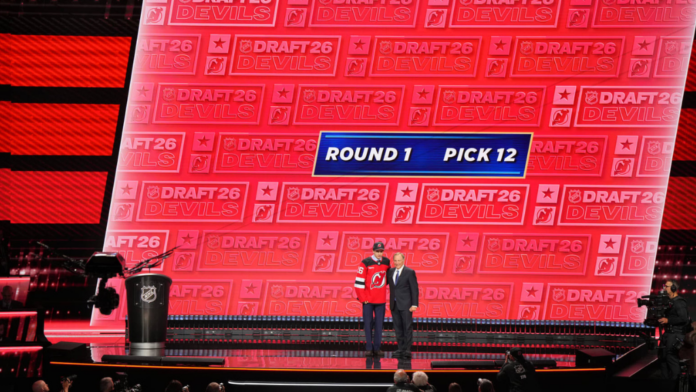

The 2026 NHL Draft in Buffalo confirmed something about the new New Jersey Devils front office that had been suggested but not yet fully demonstrated: Sunny Mehta and his scouting staff are operating from a clearly defined and actively executed philosophy rather than reacting to the board as it falls. The Devils arrived in Western New York with five selections. They left with seven prospects — the result of a second-round trade that cost them two spots but returned an extra pick and a high-value target they had coveted — and a class that is defined more by its coherence than by any single headline player.
New Jersey’s 2026 Draft Picks
| Round | Overall | Player | Position | Nationality | League | Team |
|---|---|---|---|---|---|---|
| First | 12th | Alexander Command | C | Swedish | Swe Jr | Orebro Jr |
| Second | 37th | Matias Vanhanen | LW | Finnish | WHL | Everett Silvertips |
| Second | 44th | Nikita Shcherbakov | D | Russian | VHL | Neftekamsk Toros |
| Fourth | 119th | Lavr Gashilov | C | Russian | MHL | Yekaterinburg Auto Jr. |
| Fifth | 149th | Daniil Rusakovich | G | Belarusian | MHL | Dinamo-Shinnik Bobruysk |
| Sixth | 172nd | Luke Wilfley | C | American | WHL | Portland Winterhawks |
| Seventh | 222nd | Quinn McKenzie | C | American | OHL | Soo Greyhounds |
The seven additions to the organization are Alexander Command, Matias Vanhanen, Nikita Shcherbakov, Lavr Gashilov, Daniil Rusakovich, Luke Wilfley, and Quinn McKenzie. Five of the seven are forwards. Five of the seven hail from overseas. Two are Russian. The European concentration was not a plan the front office came in with as a fixed objective — it is what happened when the staff followed its board and took the best available player at each pick. The result is a class that skews heavily international and forward-centric in a way that reflects both the demographics of this particular draft and the specific values the Devils’ evaluation process prioritizes.
Chief Amateur Scout Mark Dennehy, navigating his first draft alongside new general manager Sunny Mehta, described the experience as one where the organizational preparation paid off precisely when the draft began departing from pre-draft expectations. “As the draft is going on, we’ve identified who we’re looking for, and if that player wasn’t available due to whatever the situations were, we had a contingency plan to whether it’s trade back or there was another player that we would’ve automatically picked,” Dennehy said. “And we went through those mock drafts a number of times so that we were ready for whatever the draft held.” The contingency planning produced the second-round trade with Chicago. The pre-draft legwork produced a class whose internal logic is visible from the first pick to the seventh.
Before the draft floor opened, Mehta completed two additional roster-level moves that placed established depth players in the organization: center Amadeus Lombardi, 23, acquired from the Detroit Red Wings in exchange for the 108th pick, after he produced 42 points in 47 AHL games last season; and defenseman Declan Chisholm, acquired from the Washington Capitals for a 2027 fourth-round selection to address immediate defensive depth on the blue line. Both acquisitions reflect the same attentiveness to roster construction that the draft itself expressed — filling specific gaps with specific solutions rather than accumulating assets and hoping outcomes align.
Round 1: Alexander Command (12th Overall)
The selection of Alexander Command with the 12th overall pick in the first round generated genuine debate among analysts and Devils observers who had expected the team to move in a different direction at that position. Command is not the kind of first-round prospect who arrives with a clear offensive ceiling projection and a scoring line that translates directly into top-six NHL upside. He is something more specific and, in the Devils’ current context, arguably more useful: a complete, two-way center whose competition level, skating, defensive engagement, and playmaking ability combine into a profile that Mark Dennehy summarized as about as close to a true 200-foot player as any forward available in this class.
Command, 6-foot-1 and 185 pounds, spent the 2025-26 season at Örebro HK’s junior program in Sweden, posting 17 goals and 27 assists for 44 points in 30 games. He then elevated his game on the international stage, helping Sweden win gold at the 2026 IIHF Under-18 World Championship while recording seven points in seven games and playing a first-line role for a Swedish team that grew stronger as the tournament advanced. Command’s message to Devils fans upon learning his name had been called was direct: “You made a good choice.”
Dennehy’s description of what the staff sees in Command goes well beyond the statistical profile. “He’s got a good head, both with and without the puck. Supports his defensemen in the D zone or on the breakout, but is also gifted enough to find his wingers and put them in positions to score. Possesses a really heavy shot. Good on face-offs. He’s also a true center.” The physical qualities — the skating, the heavy shot, the face-off ability — are the foundation. The hockey intelligence is the differentiator. “Highly intense, highly competitive individual,” Dennehy said. “He is one of the best players all over the ice. At least he’s been that way at the U18 level, and we only see him, because of his drive, because of his determination, because of what he’s already shown us. We only see him getting better.”
ESP analysts described Command as a player whose profile maps most naturally to a high-end third-line center role at the NHL level, with second-line center upside if his offensive game continues to develop as he moves through the professional pipeline. The comparison that emerged most prominently in draft coverage was Nico Hischier — the Devils’ captain and the model for what a complete two-way center can look like in this organization. Whether Command reaches anything close to that ceiling remains to be seen. What is clear is that the Devils identified in him the compete level, the defensive responsibility, and the hockey sense that the franchise has been trying to multiply throughout its lineup.
The Trade and Its Yield: Vanhanen at 37th
Immediately following the first round, Sunny Mehta executed a move that acquired a second pick while costing the Devils only a minimal positional concession. New Jersey held the 35th overall selection, originally belonging to the New York Rangers before passing through the Calgary Flames as part of the Simon Nemec trade. Mehta sent 35 to the Chicago Blackhawks in exchange for 37th and 119th picks — a trade-back of two slots that netted an additional fourth-round selection while targeting a specific player the Devils had graded as worth the slightly later position.
That player was Matias Vanhanen. The Finnish left wing from Nokia had been passed over in his first year of draft eligibility in 2025 and responded by relocating to North America to play for the Everett Silvertips of the Western Hockey League — a decision that required cultural and stylistic adjustment at a level that most European players require time to navigate. Vanhanen navigated it immediately. He posted 21 goals and 66 assists for 87 points in 62 regular season games, becoming one of the WHL’s most productive first-year players and a central contributor to a Silvertips team that reached the Memorial Cup championship. He also represented Finland at the World Junior Championship, recording six assists in seven games.
The statistical case for Vanhanen is straightforward. The contextual case is what Dennehy emphasized: the speed and totality of his acclimatization. “Usually, new players, especially Europeans, there’s an acclimation period, whether it’s cultural, whether it’s style of play,” Dennehy said. “And he hit the ground running and never looked back. So, I would say his growth as a player, he’s really taken off, and we do think the sky’s the limit for him.” Vanhanen’s game is built around vision and playmaking — he recorded 66 assists in 62 games, a ratio that reflects a player who sees plays before they develop and delivers passes in the precise situations where they produce scoring opportunities rather than lost possessions.
His idol, by his own account in his post-draft media availability, is Jack Hughes — a player he has been following for close to a decade. The aspiration embedded in that statement tells you something about how Vanhanen understands his own game. He is not a Hughes — very few players are — but the orientation toward high-end offensive creativity and playmaking excellence as a professional standard says something about what he is aiming for.
Round 2: Nikita Shcherbakov (44th Overall)
Fourteen picks after selecting Vanhanen, the Devils used their natural second-round pick on Nikita Shcherbakov — a 6-foot-5, 18-year-old left-shot defenseman from Russia who had carried first-round grades from multiple evaluators entering the draft weekend. Shcherbakov played the 2025-26 season with Neftekamsk Toros of the VHL, the second tier of Russian professional hockey, recording four goals and six assists in 35 games against professional competition at an age when most draft-eligible players are still in junior leagues.
The scouting profile on Shcherbakov is built around his physical combination. He is enormous, which is the starting point, but what distinguishes him from oversized defensemen who fail to translate their physical gifts to the professional level is his skating — a quality that analytical frameworks consistently identify as the primary variable that determines whether a large defenseman becomes a reliable NHL presence or a liability on coverage. Shcherbakov moves exceptionally well for his size, covers ice at a rate that belies his dimensions, and possesses the defensive instincts and poise under pressure that suggest his defensive foundation is already ahead of where his age would predict.
The offensive contributions are modest at this stage — he has an offensive touch, particularly in transition, but it is not the defining element of his game. His professional development path will continue in the KHL or VHL next season, with Salavat Yulaev’s system in Russia providing the competitive environment for continued growth before he makes the eventual transition to North America.
The Second-Round Trade Dividend: Gashilov at 119th
The 119th pick acquired from Chicago in the Vanhanen trade was used on Lavr Gashilov, a Russian center from Yekaterinburg’s junior program. Gashilov represents the high-risk, high-upside profile that late first-round picks — the category the Devils moved to acquire — tend to produce, and his selection reflects the organization’s comfort with the geography of its draft class rather than any effort to balance it for perception purposes.
Dennehy addressed the geographic concentration of the class directly when asked about the number of European and specifically Russian selections. “In terms of geography, it’s really one of the least important factors to us in a sense. We’re looking for the best players. And it doesn’t matter where they’re coming from.” The players taken were the best available when the Devils held the pick, regardless of origin. “They just happened to be available when we got them.” That is the cleanest possible statement of a needs-agnostic board approach, and the class’s outcome is consistent with it.
Rounds 5 Through 7: Rusakovich, Wilfley, McKenzie
The Devils’ remaining picks produced three additional prospects who complete a class defined more by its early selections than by its depth. Daniil Rusakovich, selected 149th overall in the fifth round, is a Russian goaltender from Dinamo-Shinnik’s junior program — an investment in pipeline depth at a position where the organization is monitoring the ongoing development of its existing options. Goaltender prospects at the fifth-round level require long development timelines and carry significant uncertainty, but the best organizations maintain goaltending depth throughout their pipelines rather than treating the position as an afterthought in late rounds.
Luke Wilfley, taken 172nd in the sixth round, and Quinn McKenzie, selected 222nd in the seventh, are North American centers who complete a forward-heavy class and provide organizational depth at a position the Devils’ top selections had already addressed at higher value. Neither is likely to generate immediate attention, but late-round center selections with good skating and hockey sense occasionally develop into roster contributors over three-to-four-year timelines.
What This Draft Class Says About the Mehta Era
Sunny Mehta’s first NHL Draft as a general manager produced a class whose coherence is its most distinguishing characteristic. The Devils took the player they believed was the best available at 12th overall, navigated a trade that stretched their draft capital, and followed their board through seven rounds without obvious reaches or positional deviations from their evaluated grades. The European concentration was an outcome, not an objective. The forward skew was a function of who was available at each pick, not a pre-draft directive to address a specific roster category.
Dennehy captured the methodology: “We’re looking for the best players. And it doesn’t matter where they’re coming from. The players that we picked were the best players that were available.” That statement, combined with the organizational preparation that produced contingency plans and trade structures in advance of the draft floor opening, describes a front office that is operating with intellectual discipline and collaborative depth — the analytics, the scouts, the psychologist, the strength and conditioning staff all feeding into a unified evaluation framework.
Command’s compete level and defensive completeness. Vanhanen’s playmaking vision and rapid acclimatization. Shcherbakov’s size, skating, and defensive foundation. The specific attributes that defined each early-round pick map cleanly onto identifiable needs in the Devils’ prospect pipeline and onto the organizational identity that the franchise under Mehta and head coach Sheldon Keefe has been trying to establish — compete level, defensive responsibility, and the kind of hockey intelligence that makes players better teammates for Jack Hughes and Nico Hischier at the NHL level.
This was one draft weekend, and draft classes are evaluated over years rather than weeks. But the first impression of Sunny Mehta’s drafting process is of an organization that knows what it is looking for, plans for multiple outcomes, and executes without being deflected by what the room around it is doing.
















