
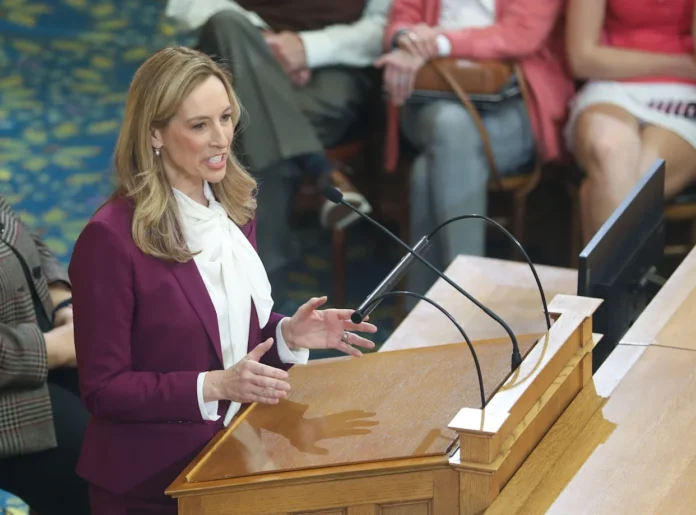

The fundamental arithmetic of New Jersey’s Medicaid program has produced a situation that Governor Mikie Sherrill has decided to treat as a policy problem rather than a fixed cost of doing business in the state. New Jersey taxpayers currently spend hundreds of millions of dollars annually to cover health insurance for workers at large, profitable corporations — companies whose payrolls are structured around wages low enough that their employees qualify for publicly funded health coverage, shifting what would otherwise be a business cost onto the public balance sheet. Sherrill’s first budget proposal, unveiled in March 2026 as part of a $60.7 billion spending plan, includes a mechanism to address that transfer directly: a fee on large employers whose workers rely on Medicaid, structured to generate approximately $145 million annually and designed to create a financial incentive for those employers to offer coverage rather than pay the assessment.
The proposal, formally designated the “Employer Healthcare Assistance Contributions,” would apply to any private employer with 50 or more employees enrolled in NJ FamilyCare — the state’s Medicaid program, which currently covers 1.8 million New Jersey residents. Qualifying employers would face per-worker annual fees ranging from $325 to $725, with the rate determined by the total number of workers enrolled on the public plan. The policy gives companies a choice: provide affordable private coverage that brings their workers off the Medicaid rolls, or pay the fee. State officials estimate the proposal would affect approximately 748 large private-sector employers in its first year.
A state Department of Human Services report tracking large employers with the highest numbers of workers and dependents enrolled in NJ FamilyCare has made visible, for the first time in a public context, precisely which companies have the most direct financial exposure under the proposed policy. The list runs from some of the largest corporations operating in the United States to regional employers, staffing agencies, logistics companies, and — in a complication that has drawn pointed attention from business groups and legislators alike — hospital systems, nonprofit organizations, and local government entities including school boards in several of New Jersey’s largest cities.
The Scale of the Problem Sherrill Is Trying to Address
The policy’s premise requires understanding the specific mechanism by which large employers shift labor costs onto public health programs. When a company employs workers at wages low enough that those workers qualify for Medicaid — and New Jersey, like most states, sets Medicaid eligibility thresholds based on income relative to the federal poverty level — the employer effectively offloads a significant portion of the compensation that includes healthcare coverage onto the state and federal governments. The worker receives health insurance, but the cost is borne by taxpayers rather than by the employer who set the wage.
This dynamic is not unique to New Jersey, and it is not a new observation. The question of whether low-wage employers should bear some direct financial responsibility for the public health costs generated by their wage structures has been raised at the state level for decades, with Massachusetts implementing a version of a similar policy. What makes Sherrill’s proposal notable in the current moment is its timing: it arrives as New Jersey faces a $3 billion structural budget gap and as federal Medicaid funding — which covers a significant portion of NJ FamilyCare costs — faces pressure from policy discussions in Washington. With potential federal Medicaid cuts that could affect up to 300,000 New Jersey residents on the table, the state’s interest in identifying alternative revenue sources to maintain the program’s coverage levels has become considerably more urgent.
Under Sherrill’s total budget framework, New Jersey would spend $28 billion on Medicaid in the coming fiscal year, with state taxpayers covering $7.2 billion of that total. The $145 million projected to be raised by the employer contribution fee represents a modest fraction of that overall expenditure but a meaningful signal about the direction of policy — and about which entities Sherrill believes should bear a more direct share of the cost.
The Ten Largest Impacted Employers in New Jersey
The state’s Department of Human Services report provides the empirical foundation for the proposed policy and identifies, with unusual specificity, the corporate footprints most directly implicated in New Jersey’s Medicaid cost structure.
Amazon leads the list by a substantial margin. The company employs some 5,600 workers in New Jersey who, along with more than 10,000 of their dependents, rely on NJ FamilyCare — a combined total of more than 15,500 individuals whose healthcare coverage is funded in whole or in part by New Jersey taxpayers. Amazon’s New Jersey presence is concentrated primarily in fulfillment and distribution operations, where the workforce is predominantly hourly and where the company’s documented compensation structures have generated sustained public attention regarding the gap between the company’s corporate revenues and the wage levels of its operational workforce.
Walmart follows with more than 10,000 workers and beneficiaries enrolled in the state program. The retail giant’s New Jersey store footprint, combined with its reliance on a large part-time workforce and a compensation structure that has historically pushed significant numbers of employees toward public assistance programs, places it firmly in the second position on the state’s list. The company’s exposure to the proposed fee is substantial enough that any meaningful per-worker assessment would represent a significant new cost if the policy becomes law.
Century II Staffing, with approximately 9,000 active Medicaid beneficiaries, holds the third position — a placement that reflects both the industrial staffing sector’s structural reliance on workers whose wages require supplementation through public programs and the particular challenge that temporary and contract employment arrangements create for benefits provision. Staffing agencies occupy an unusual position in the proposed policy’s framework: they are the employer of record for large numbers of workers, but the wages those workers receive are frequently set by the client businesses that engage the staffing agency’s services.
Wawa, the regional convenience chain with deep roots in the Philadelphia metropolitan area and extensive New Jersey operations, appears fourth on the list with approximately 7,600 individuals and their dependents enrolled in NJ FamilyCare. Wawa’s inclusion is notable because the company occupies a different public profile than Amazon or Walmart — it is a private, employee-owned business with genuine brand loyalty in New Jersey and Pennsylvania, not a publicly traded corporation with institutional shareholders whose executive compensation has become a focal point in wage debates. Its placement on the list reflects the structural challenges of the convenience retail and food service sectors broadly, where wage scales and the demographics of the workforce converge to produce significant Medicaid enrollment regardless of a company’s ownership model or its broader reputation as an employer.
Target follows with roughly 5,200 beneficiaries enrolled in the state program. The Home Depot and Wakefern Food Corp. — the Keasbey-based cooperative that operates the ShopRite supermarket chain and stands as one of New Jersey’s single largest private employers — round out the mid-tier of the list. Wakefern’s inclusion is particularly significant given its cooperative ownership model and its deep integration into New Jersey’s retail food economy; the ShopRite network employs tens of thousands of New Jersey workers across a large number of store locations, and its position on the Medicaid beneficiary list reflects the broader economics of grocery retail employment.
United Parcel Service and FedEx appear consecutively on the list, reflecting the logistics and freight delivery sector’s structural characteristics: massive hourly workforces organized around package sorting, delivery, and fulfillment operations, with significant numbers of part-time and seasonal workers whose hours and compensation place them within Medicaid eligibility thresholds. Both companies maintain substantial distribution infrastructure in New Jersey, positioned to serve the dense consumer market of the New York metropolitan area. McDonald’s rounds out the top ten, representing the concentrated impact of the fast food sector’s franchise model and its characteristic workforce demographics.
The Complications: Hospitals, Nonprofits, and School Boards
The political and policy complexity of the proposed employer contribution fee becomes significantly more difficult when the analysis extends beyond the large corporate names at the top of the Department of Human Services report. The approximately 748 employers projected to be affected in the first year of the policy include entities whose inclusion raises questions that the straightforward “make corporations pay their share” framing does not easily accommodate.
Hospital systems and healthcare networks appear on the list in significant numbers. Hospitals employ large numbers of workers across a wide range of compensation levels, including clinical support, food service, housekeeping, and administrative roles where wages frequently fall below the thresholds that would require employers to provide healthcare benefits under existing federal law. The irony of requiring healthcare institutions to pay fees for employees who rely on public health insurance is not lost on hospital administrators, who have argued that the assessment would compound existing financial pressures without addressing the underlying wage dynamics of healthcare employment.
Nonprofit organizations — group homes, social service agencies, community health providers, and similar entities — appear in the state data as employers with significant numbers of Medicaid-enrolled workers. These organizations frequently operate on constrained budgets, rely on state and federal contracts that set service rates, and have limited capacity to absorb new per-worker assessments without corresponding increases in the public funding that supports their operations. The argument that imposing Medicaid employer fees on nonprofits that deliver publicly funded services would simply transfer costs within the public sector rather than generating net savings to taxpayers has been raised by advocacy groups.
Most striking to many observers is the inclusion of local government entities — specifically, 80 school boards in cities including Newark, Paterson, and Jersey City — among the employers identified in the state data as having 50 or more employees enrolled in Medicaid. Teachers are not among the affected workers; the issue is primarily the support and operational staff employed by urban school districts at compensation levels that trigger Medicaid eligibility. The prospect of local school boards paying a new fee to the state for employees whose wages and benefits are themselves set in part by the state and by collective bargaining agreements adds a layer of governmental complexity to the policy that its initial framing did not anticipate.
The nearly 26,000 government employees and their family members enrolled in NJ FamilyCare — costing the Medicaid program close to $29 million during the three-month tracking period captured in the state report — represent a significant portion of the overall beneficiary universe that the proposed fee would need to address if the policy is to achieve its stated goal of creating incentives for employers to provide coverage rather than rely on public insurance.
The Arguments For and Against
The policy’s proponents frame it as a straightforward matter of shared responsibility and fiscal equity. Senator Troy Singleton, a Burlington County Democrat, articulated the majority position within the state’s Democratic caucus in terms that reflect the core argument: large corporations should not be permitted to structure their compensation below the level required to provide healthcare coverage while passing those costs onto every taxpayer in the state. The current system, in this view, amounts to a corporate subsidy disguised as a public health program — with New Jersey taxpayers effectively subsidizing Amazon’s operational costs by covering the healthcare of its New Jersey workforce.
Heather Howard, a Princeton University professor who served as state health commissioner under Governor Jon Corzine, described the proposed fee as a creative approach grounded in the principle of shared responsibility. Linda Schwimmer, president and CEO of the New Jersey Health Care Quality Institute, characterized it as a responsibility tax on employers that do not offer affordable health insurance to their employees, and called the concept worth exploring as a mechanism to raise money to support Medicaid or other state health care spending.
The arguments against the proposal are substantive and come from multiple directions. Business organizations led by the New Jersey Chamber of Commerce and the Chamber of Commerce Southern New Jersey have flagged the fee as a significant concern for New Jersey’s competitive position relative to neighboring states. Christina Renna, the president and CEO of the Chamber of Commerce Southern New Jersey, captured the geographic dimension of the argument precisely: in a region that borders Pennsylvania and Delaware, competitiveness is not theoretical. Companies operating across state lines have a genuine option to shift operations or investment toward states where the regulatory and cost environment is more favorable, and the risk that the proposed fee would accelerate that calculus is real even if its magnitude is disputed.
Tom Bracken, president and CEO of the New Jersey Chamber of Commerce, noted the contrast between Sherrill’s repeated pre-budget pledges of no new taxes and the business community’s experience of the actual budget proposal. Opponents in the business community have also raised a concern that cuts across the policy’s stated goals: the fee could create a perverse incentive for employers to avoid hiring lower-income workers in order to minimize their Medicaid exposure, effectively penalizing precisely the workforce the policy is intended to protect. Kevin Thompson of 9i Capital Group offered an additional analytical complication — many workers remain on Medicaid because accepting employer-sponsored insurance would reduce their take-home pay, meaning the incentive structure the fee is designed to create may not actually produce the coverage expansion its proponents anticipate.
The Legislative Path and What Comes Next
Sherrill’s budget proposal, totaling $60.7 billion, has gone to the New Jersey Legislature for review in the standard budget process. Democratic legislative leaders have signaled that the budget will be modified during negotiations, as is typical. Whether the Employer Healthcare Assistance Contributions survive the legislative process in their current form, are amended to narrow the scope of affected employers, or are removed from the final budget agreement entirely remains to be determined.
The proposal arrives in an environment where the specific question of employer responsibility for Medicaid costs has gathered renewed attention nationally as federal Medicaid funding faces legislative uncertainty. The states that have experimented with versions of employer contribution requirements — Massachusetts most prominently — provide limited but real precedent for the policy’s operational feasibility. The Massachusetts experience also suggests that the policy’s revenue projections are achievable in practice, which gives New Jersey’s budget architects a data point that goes beyond theoretical modeling.
What the state’s Department of Human Services report has accomplished — whatever the ultimate fate of the Governor’s proposed fee — is to make permanently visible the specific distribution of public health costs across New Jersey’s large employer base. The companies at the top of that list — Amazon, Walmart, Wawa, Target, the major logistics carriers, the franchise restaurant networks — now exist in a documented public record as the primary drivers of the state’s corporate Medicaid cost burden. That visibility has policy consequences that extend beyond any single budget cycle.
For New Jersey residents who have long paid taxes that subsidize the operational economics of the largest corporations in the American economy, the conversation Governor Sherrill has opened is one that the data clearly supports having.
















