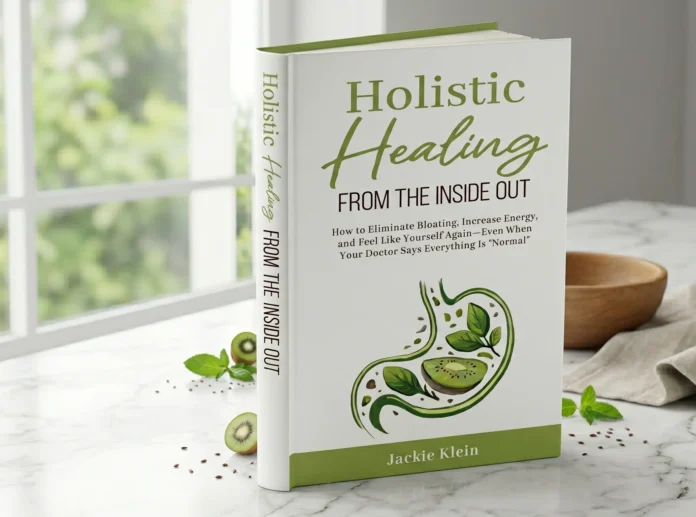

Jackie Klein spent sixteen years practicing nutrition in New Jersey before she wrote a word of her debut book. That timeline matters. The knowledge that fills Holistic Healing from the Inside Out: How to Eliminate Bloating, Increase Energy, and Feel Like Yourself Again — Even When Your Doctor Says Everything Is “Normal” did not arrive through research alone. It was accumulated across thousands of client appointments at her Fairfield, New Jersey clinic, through patterns observed in people who arrived frustrated, dismissed, and still unwell despite blood work their physicians described as unremarkable.
The book reached the number-one new release ranking on Amazon in both the Holistic Medicine and Vitamins and Supplements categories shortly after its release — a market signal that its subject matter has an audience far larger than the waiting room of any single practice. Gut dysfunction, chronic fatigue, unexplained inflammation, and the persistent dissatisfaction of patients who leave conventional medical appointments without answers are not niche problems. They are defining health concerns of a generation that has been eating processed food, living under sustained stress, sleeping inadequately, and trusting lab panels that measure the wrong variables.
Klein, a board-certified Holistic Health Practitioner and founder of Jackie Klein Nutrition, Inc., has built her practice around the population that falls between those measurements — the patient whose thyroid, cholesterol, and blood glucose come back within range but who is exhausted, bloated, inflamed, and nowhere near well. Her book is written for that patient. It is also, notably, written by a practitioner who was once that patient.
The Origin Story Behind the Practice and the Book
Klein grew up in Essex County, graduated from Clifton High School, and built her professional life within the same geographic orbit where her personal health transformation first took root. At sixteen, she was told by a physician that a breast cyst would require surgery. She sought a second opinion. She made targeted dietary changes. Within a month, the cyst had nearly resolved. The experience permanently altered her understanding of the relationship between food, lifestyle, and physiology — and it set the direction of everything that followed.
That kind of formative encounter is not unusual in the functional and integrative health space, where many practitioners arrived through personal illness rather than academic theory. What Klein did with that experience, however, was build a fifteen-year clinical practice grounded in evidence-informed nutrition, targeted supplementation, and the kind of systematic patient inquiry that asks not just what symptoms are present but what underlying conditions are generating them.
Her practice, Jackie Klein Nutrition, Inc., operates out of 186 Fairfield Road in Fairfield, New Jersey — a brick-and-mortar functional wellness and digestive health clinic that serves patients both in person and virtually, Monday through Friday. The work there is specific: she focuses on digestive issues, inflammation, metabolic imbalance, and the interconnected systems — gut microbiome, blood sugar regulation, hormonal balance, stress response — that conventional medicine tends to address in isolation rather than as a coordinated whole.
The book is, in Klein’s own framing, an extension of that clinical mission. The goal, as she has described it, is to simplify health information for a population that is simultaneously overwhelmed by it and underserved by the systems supposed to deliver it. People are not failing to get well because they lack willpower. They are failing to get well because they have never been given the foundational information about how their bodies actually function and what those bodies need to do so properly.
What the Book Actually Contains
Holistic Healing from the Inside Out is not a detox program, a supplement marketing vehicle, or a prescriptive protocol that requires the reader to overhaul their life in a single weekend. Klein wrote it as a practical guide — the kind of resource she would hand to a new client before their first appointment to ensure they arrived with a working vocabulary for the conversations ahead.
The book addresses the inflammatory triggers most commonly associated with bloating, digestive discomfort, and low energy. It covers gut health, digestion, blood sugar balance, and the daily habits that support or undermine each. It gives readers a framework for evaluating supplement quality — a category where consumer confusion is massive and the gap between marketing claims and physiological utility is often substantial. It addresses stress management not as a soft lifestyle topic but as a hard physiological factor, examining sleep, meditation, and breathing practices through the lens of their measurable effects on the body’s inflammatory and digestive systems.
The book concludes with a two-week meal plan with accompanying recipes — a concrete starting point designed to support digestion and provide a structured transition away from the dietary patterns most likely to be driving the symptoms Klein’s target reader is experiencing.
The subtitle of the book — Even When Your Doctor Says Everything Is “Normal” — is the detail that positions it precisely. It speaks directly to the patient who has been told, repeatedly, that their test results show nothing of concern, and who has returned home with that verdict and a body that continues to tell a different story. Klein is not arguing against conventional medicine. She is filling the space it leaves behind — the space where patients with real, measurable physiological dysfunction fall outside the diagnostic thresholds that trigger treatment.
That space is large. The population of people experiencing chronic gut symptoms, persistent fatigue, hormonal irregularity, and low-grade inflammation while carrying “normal” lab panels runs into the tens of millions in the United States. The Amazon ranking Klein’s book achieved within its first days of availability is, in part, a reflection of how many people recognized themselves in that description and reached for the first credible resource that addressed it directly.
The Landscape of Functional Nutrition and Where Klein’s Work Sits
The fields of functional medicine, integrative nutrition, and holistic health have expanded substantially over the past two decades, driven by a combination of consumer demand, accumulating research into the gut microbiome, and growing recognition within mainstream medicine that chronic disease management — as opposed to acute illness treatment — requires a different set of tools. Conditions once treated as distinct diagnoses — irritable bowel syndrome, chronic fatigue syndrome, fibromyalgia, subclinical hypothyroidism — are increasingly understood as overlapping expressions of systemic dysregulation with common upstream causes.
Klein’s approach bridges the methodological gap between conventional diagnostics and the functional interventions that the research literature increasingly supports. She describes her practice as focused on identifying and addressing underlying imbalances, not solely managing symptoms — a distinction that sounds philosophical but has concrete clinical implications. A patient presenting with chronic bloating who receives dietary modification guidance for FODMAP sensitivity is receiving symptom management. A patient who receives an investigation of their gut microbiome composition, their mucosal barrier integrity, their stress-cortisol dynamics, and their eating patterns across a week is receiving something closer to the upstream inquiry Klein practices.
The book translates that clinical approach into accessible language. It is written for the patient, not the practitioner, and the distinction matters in a genre where functional health texts sometimes slide into technical density that serves more as credential display than practical guidance. Klein’s fifteen years of explaining these concepts in clinical settings — to people who are unwell, confused, and often skeptical of anything outside what their primary care physician has already told them — have produced a writing style calibrated to the person who needs the information, not the person who already has it.
The June 30 Book Launch at Loopwell in Montclair
On Tuesday, June 30, from 7 to 9 p.m., Klein will celebrate the release of Holistic Healing from the Inside Out at Loopwell, the wellness and community space located at 80 Maple Avenue in Montclair, New Jersey. The evening is structured around a fireside chat format, a question-and-answer session, and a book signing — a programming structure suited to the subject matter, which benefits from the kind of dialogue that a lecture format does not allow.
Loopwell, which describes itself as a well-being social club with a mission oriented toward women’s wellness, corporate health programming, and grassroots community building, is a purposeful venue selection. Its audience overlaps substantially with the readership Klein’s book is designed to reach: women in the tri-state area navigating health concerns that conventional medicine has not fully resolved, professionals managing chronic stress, and people who understand that wellness is a domain requiring active engagement rather than passive reliance on a healthcare system not designed to address their specific needs.
The event will include mocktails and is structured to allow attendees to engage with Klein directly — a format she is clearly accustomed to from clinical practice, where the ability to translate complex physiological concepts into language that prompts genuine understanding and behavioral change is the fundamental professional skill. Proceeds from the evening benefit The GiveWell Project, directing the event’s charitable component toward women’s wellness initiatives consistent with the audience and the author’s values.
For New Jersey residents interested in attending, the event takes place at Loopwell, 80 Maple Avenue, Montclair, NJ 07042. Information and registration are available through the Loopwell website.
Why New Jersey Has a Stake in This Book
The vast majority of books published by practitioners in the functional health space are produced by clinicians based in major media markets or operating national platforms — Los Angeles, New York City, Austin, or the broader wellness-industry ecosystem that has developed around celebrity health culture. Klein’s book comes from Fairfield, New Jersey, was shaped by patients from Essex, Bergen, Morris, and Passaic Counties, and is being launched at a community space in Montclair. That geographic specificity is not incidental.
The health concerns the book addresses — digestive dysfunction, chronic fatigue, metabolic irregularity, inflammatory response — are not problems with regional boundaries. But the practitioner whose clinical experience produced this guide learned what she knows in New Jersey, from New Jersey patients, at a clinic serving New Jersey families. The research and recommendations in the book are grounded in fifteen years of appointments at 186 Fairfield Road, not in an academic literature review conducted at a distance from actual patient care.
Klein has operated in a healthcare environment where New Jersey residents face the same structural gaps in conventional care delivery as patients everywhere else — the limited appointment time, the reliance on panels that measure biomarkers within ranges designed for population averages rather than individual optimization, the institutional pressure toward pharmaceutical intervention as a first response to chronic conditions that would respond to dietary and lifestyle modification. She built a practice to address those gaps. She wrote a book to extend the reach of that practice beyond the patient population she can see in a week.
That is a contribution to the state’s health landscape that deserves recognition as such — not as a lifestyle media moment, but as a substantive addition to the resources available to the millions of New Jersey residents managing chronic health conditions that have not been resolved by the conventional care they have access to.
What Readers Will Take Away
The book’s practical architecture — from foundational principles through daily habit frameworks to the two-week meal plan — is designed to produce an outcome that Klein describes as sustainable, long-term improvement rather than temporary correction. The distinction reflects both the clinical evidence base and the failure mode of most intervention-oriented health books, which produce short-term results that reverse when the structured period ends because the reader has not been given the conceptual foundation to maintain the changes independently.
Klein’s objective is reader competence, not reader dependence. The goal of the book, as she has framed it, is to help people feel more empowered and less overwhelmed — to provide the tools that support real, lasting change rather than a protocol that requires external management to function. That objective shapes every structural choice in the text, from the way complex topics are introduced to the way the meal plan is built around accessible ingredients and repeatable habits rather than specialty products and elaborate preparation.
For the New Jersey patient who has spent years managing bloating, fatigue, or digestive irregularity with inadequate results from conventional care, Holistic Healing from the Inside Out represents something specific and useful: a clinically grounded, practically structured guide from a practitioner who has spent fifteen years working with people in exactly that situation, in this state, and who built a career on the premise that feeling well is not an aspirational outcome but an achievable one when the right information is applied to the right underlying variables.
The book is available now on Amazon. Klein’s practice, Jackie Klein Nutrition, Inc., can be reached at 186 Fairfield Road, Fairfield, New Jersey 07004, with virtual and in-person appointments available Monday through Friday.