

Community theatre in New Jersey has always occupied a specific and underappreciated place in the state’s cultural life — a form of local artistic production that operates without the budgets, the press coverage, or the institutional infrastructure of professional theatre, but that draws on genuine talent, serious commitment, and a relationship with its immediate community that regional professional companies rarely achieve. The Road Company Theatre in Williamstown is that kind of organization, and its upcoming production of Shrek the Musical represents both an ambitious artistic undertaking and a significant open invitation to actors across South Jersey who have been waiting for a project of this scale and quality.
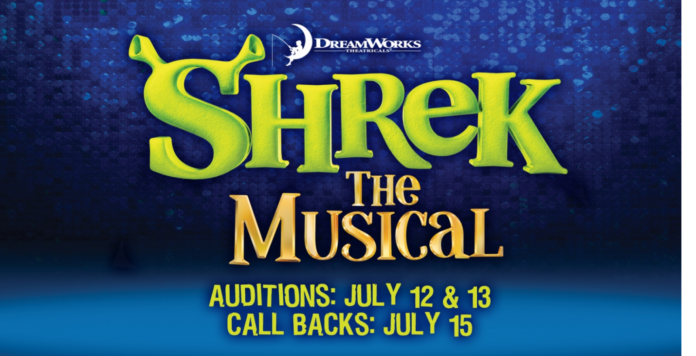
The Road Company will hold open auditions for non-equity actors on Sunday, July 12th and Monday, July 13th, both evenings running from 7:00 p.m. to 10:00 p.m., at 405 South Main Street in Williamstown, New Jersey. Callbacks, extended by invitation only, will take place on Wednesday, July 15th beginning at 7:00 p.m. The production team behind this effort is not a collection of casual hobbyists. Director and producer Danielle Harley-Scott leads the creative team, joined by co-director Scott Angehr, Music Director Ruslan Odintsov, Choreographer Natalie Donisi, and Stage Manager Natasha Kargbo. The convergence of defined creative leadership with a show of this complexity is a signal worth reading: this production is being built with professional methodology, regardless of its community theatre context.
What the Show Is and Why It Matters
Shrek the Musical arrived on Broadway in 2008, based on the Oscar-winning DreamWorks Animation film that introduced a generation of audiences to the unlikely premise that a giant green ogre could carry a love story, a satire of fairy tale convention, and one of animated cinema’s most durable emotional arguments — that what you are on the outside has nothing to do with what you are worth. The musical adaptation, with a book by David Lindsay-Abaire and music by Jeanine Tesori, preserves those themes and expands them with a score that ranges from comedy to genuine emotional depth, a cast of characters that gives actors across a wide range of ages and abilities something to do, and production design requirements that make it one of the more technically demanding shows a community theatre can attempt.
The production’s central narrative follows Shrek, a solitary ogre whose swamp is invaded by a collection of displaced fairy tale creatures banished there by Lord Farquaad, the comically diminutive and despotic ruler of Duloc. Tasked with retrieving the exiled Princess Fiona from a dragon-guarded castle in exchange for reclaiming his swamp, Shrek is joined by Donkey — an irrepressible talking animal who appoints himself as a permanent companion against all of Shrek’s protestations. The journey that follows produces not only the rescue Farquaad demanded but a love story, a meditation on belonging and self-acceptance, and a climax that subverts the conventions of the fairy tale form in ways that the show communicates with both wit and genuine feeling. The material rewards strong performances across multiple roles rather than concentrating everything in the lead, which makes it an unusually rich vehicle for an ensemble-based community production.
The Production Team: Creative Credentials Behind the Work
The creative team assembled for this production reflects the seriousness of the undertaking. Danielle Harley-Scott, serving as both producer and director, carries the primary artistic and organizational responsibility for a show whose production demands — including significant prosthetic makeup requirements for the lead roles, complex ensemble choreography, and a score requiring substantial vocal range across multiple principal parts — are not trivial. The co-direction of Scott Angehr extends that leadership, providing the kind of divided creative responsibility that large-cast productions genuinely require to execute at a high level.
Music Director Ruslan Odintsov oversees what is arguably the most technically demanding dimension of the production. The Jeanine Tesori score for Shrek the Musical is not a collection of accessible pop songs. It requires the principals to deliver material ranging from broad comedy to legitimate emotional ballads, and the ensemble vocal demands — particularly in the larger production numbers — require musical direction that balances theatrical effectiveness with vocal sustainability across a rehearsal process that runs from July through October. A music director who understands both the score’s theatrical function and the practical requirements of a non-equity cast is essential, and Odintsov occupies that role.
Choreographer Natalie Donisi faces the specific challenge of a show whose dance vocabulary is genuinely mixed — the production includes tap sequences, character movement, and ensemble staging that serve very different theatrical purposes and require different levels of technique from different members of the cast. The character breakdown explicitly encourages tap-experienced dancers to audition, which indicates that tap will be a substantive element of the choreographic design rather than incidental texture. Stage Manager Natasha Kargbo provides the organizational infrastructure that allows a production of this complexity to function, managing the flow of rehearsals, tracking blocking and choreographic changes, and ensuring that the production’s many moving parts remain coordinated across a rehearsal schedule that will extend over three months.
The Rehearsal Structure and Performance Dates
First rehearsal is scheduled for Monday, July 20th at 7:00 p.m. Regular rehearsal calls will run on Sundays at 6:00 p.m. and Mondays and Wednesdays at 7:00 p.m., with the addition of occasional Thursday calls as the production moves into its final weeks. That schedule represents a serious time commitment — three nights per week, sustained across roughly eleven weeks between the first rehearsal and opening night — and prospective auditioners should evaluate it honestly before submitting their audition registration. Community theatre productions of this scale succeed or fail in part on the consistency of company attendance through the full rehearsal process, and a cast that understands and commits to that expectation from the outset is a cast that gives the director and choreographer the time they need to build something worth showing.
Performance dates run across three weekends in October: October 8th, 9th, 10th, and 11th; October 15th, 16th, 17th, and 18th; and October 22nd, 23rd, and 24th — eleven performances in total across three consecutive weekends. That schedule gives the production adequate time to develop in performance, for the company to find the rhythms and the ensemble energy that live theatre requires, and for audiences across South Jersey to discover and attend what promises to be a substantial theatrical event for the region.
Audition Requirements: What Actors Need to Know
Auditions on July 12th and 13th will consist of vocal material only. The production is asking auditioners to prepare a song from the show itself — a choice that serves multiple curatorial purposes. It allows the music director to evaluate not only basic vocal quality but a candidate’s familiarity with the show’s style, their preparation process, and their capacity to make specific dramatic and comedic choices within the score’s particular demands. Candidates who have done their homework will arrive with a song they understand, a character they have thought about, and a prepared vocal performance rather than a generic audition cut.
All dance evaluation will be reserved for callbacks, which take place by invitation on July 15th. Dancers with tap experience are explicitly encouraged to apply — a strong signal that tap proficiency will be a meaningful asset in the company selection process, particularly for ensemble roles that include dedicated tap sequences. Actors who move well but lack tap training are not excluded from consideration, as the character breakdowns include roles requiring only basic movement skills alongside those requiring intermediate to strong dance ability.
Actors interested in auditioning are required to complete and submit the audition registration form prior to attendance at either July session. Registration must be completed in advance; walk-ins who have not pre-registered may not be accommodated. A small stipend will be provided to cast members, calculated on the basis of opening night sales — an acknowledgment of the cast’s investment and contribution that distinguishes this production from purely volunteer-based community theatre.
The Character Breakdown: Who the Production Is Looking For
The production requires a company spanning a wide age and experience range, from children as young as seven to adults with no upper age limit, across a broad spectrum of vocal ranges and dance abilities. The specific requirements for each principal role reflect the theatrical demands of the material with considerable precision.
Shrek himself calls for a male-presenting actor between the ages of 25 and 50, with a baritone-to-tenor range spanning A2 to G#4. The role requires physical presence, comedic instinct, and the emotional depth to take an audience from amusement to genuine investment across the arc of the character’s transformation. A Scottish accent is identified as an asset. Critically, the actor in this role will be required to wear substantial latex makeup appliances — a physical commitment that extends preparation and performance time considerably and that requires a specific tolerance for the prosthetics process.
Donkey demands a male-presenting actor, age 20 or older, with a tenor range extending to B4 and the classification of “strong mover” in terms of dance ability. The role is vocally demanding, dramatically specific, and physically energetic in a way that sustains across the full evening. Donkey is the show’s most consistent source of comedy and, in the hands of a skilled actor, its most unexpected source of emotional resonance. The casting requirement of a “strong mover” reflects the role’s choreographic demands — Donkey is rarely still.
Fiona requires a female-presenting actor between 25 and 45 with a soprano range from F3 to G5, strong movement skills, and tap experience as a preferred qualification. The role presents distinct dramatic layers — the idealized princess exterior, the self-sufficient woman underneath, and the ogress identity that complicates both — requiring an actor with genuine range across comedy, romance, and physical characterization. The role also involves a latex nose prosthetic that must be worn throughout performance.
Lord Farquaad presents one of the production’s most technically specific casting challenges. The character’s notorious height — or lack of it — is established in the stage version through a theatrical convention that requires the actor to perform all blocking and choreography on his knees throughout the production. This is not a cosmetic choice. It requires an actor with specific physical capacity and training who can sustain that constraint across the blocking demands of the full production. The role requires a male-presenting actor between 25 and 40 with a tenor range to D5 and intermediate-to-strong dance skills.
Dragon, calling for a female-presenting actor 18 or older with a soprano range to Eb5, presents the challenge of creating a physically imposing and emotionally complex character — equal parts menace and vulnerability — within the constraints of a stage representation that demands strong presence and intermediate movement skills. The Sugar Plum Fairy is a double role of unusual complexity: the actor voices the Gingy puppet while also playing the Fairy, requiring two distinct character voices and the kind of comic dexterity that makes this one of the production’s most demanding and rewarding supporting parts.
The young Fiona and young Shrek roles are designated for children between the ages of 7 and 10, with teen Fiona requiring an actor between 13 and 15. These roles provide an entry point for younger performers into a full-scale musical production under experienced adult creative direction — an experience with considerable developmental value for young actors at precisely the age when sustained creative involvement tends to have the most lasting effect.
The ensemble of eight to ten performers, age 16 and older, will be featured across an extensive range of characters: King Harold, Queen Lillian, the Angry Mob, the Three Blind Mice, Tapping Rats, Knights, Dragonettes, Thelonious, and a broad range of Duloc citizens, fairytale creatures, and other ensemble roles. Trained dancers are specifically sought for ensemble positions, particularly given the variety of dance styles — including tap — that the ensemble will execute across the production’s musical numbers.
The Road Company’s Commitment to Inclusive Casting
The Road Company Theatre practices non-traditional casting as an organizational commitment, extending equal opportunity to performers of all backgrounds, races, ages, genders, gender identities, disability statuses, and belief systems. This policy is not a formality. It reflects an understanding that community theatre’s particular strength — its embeddedness in the actual community it serves — is best expressed through a company that looks and sounds like that community rather than a company that reproduces the casting conventions of commercial theatre.
Non-traditional casting also, practically speaking, increases the pool of available talent in a regional market where restricting casting by demographics other than the specific vocal and physical requirements of individual roles would unnecessarily limit the company’s ability to find the strongest possible performers for each part. The Road Company’s approach treats those specific requirements — voice range, dance ability, age range, the physical demands of particular roles — as the legitimate constraints that they are, while refusing to add demographic restrictions that serve no artistic purpose.
How to Submit and What to Bring
Actors interested in auditioning for Shrek the Musical at The Road Company Theatre must complete the audition registration form prior to attending either July 12th or July 13th session. The form is available through the theatre’s standard registration process. Auditions take place at 405 South Main Street, Williamstown, NJ 08094, beginning at 7:00 p.m. on both evenings. Prepared vocal material from the show is required. Additional dance evaluation for candidates invited to callbacks occurs on July 15th at 7:00 p.m. at the same location.
The Road Company Theatre’s production of Shrek the Musical will open on October 8th, 2026. South Jersey’s community theatre audience has not seen a production with this scale of creative ambition at this address in some time. Auditions are the first step in building the company that will realize it.
















