
Some concerts entertain. Some concerts celebrate a moment. And then there are those rare evenings that feel larger than the performers on stage, larger than the venue itself, and larger than the audience fortunate enough to witness them. The second night of “Music America: The Songs That Shaped Us” at Monmouth University was one of those events. It was not simply a concert. It was a declaration about the importance of American music, the cultural history that connects generations, and the role New Jersey continues to play in preserving that legacy.
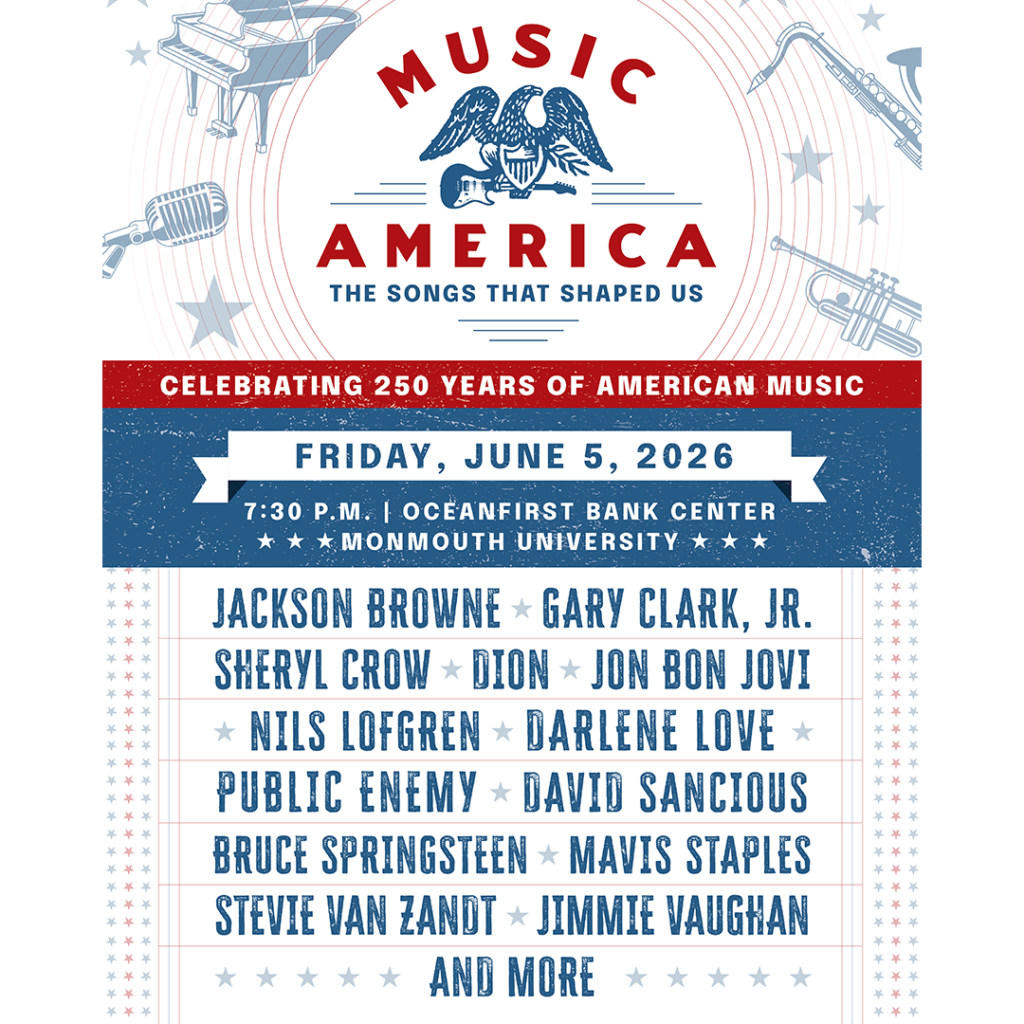
Presented in advance of the June opening of The Bruce Springsteen Center for American Music at Monmouth University, the event brought together an extraordinary collection of artists representing multiple generations, genres, and musical traditions. The result was a sweeping journey through the evolution of American music that moved from the birth of rock and roll to modern hip-hop while celebrating the artists, songwriters, and performers who helped shape the soundtrack of the nation.
For New Jersey music fans, however, the evening carried an even deeper significance. The concert served as a reminder that the Garden State remains one of the most important musical regions in America. From the clubs of Asbury Park and the stages of Newark to the universities and theaters spread throughout the state, New Jersey has consistently produced artists whose influence extends far beyond state lines. The gathering at Monmouth University felt like a culmination of that history while simultaneously pointing toward its future.
Bruce Springsteen understood the significance of the moment.
During the evening, he reflected on performing at Monmouth decades ago when it was still known as Monmouth College. Looking out at a sold-out arena and the massive institution now preparing to open in his name, he acknowledged how unimaginable such a moment would have seemed during his earliest days as a struggling musician.
Yet the center itself represents something much larger than one artist. While Springsteen’s career serves as a cornerstone of the project, the mission extends to documenting and celebrating the broader story of American music in all of its forms. That philosophy was reflected throughout the concert’s programming.
This set included rock classics and blues, featuring performances by Bruce Springsteen (“Jailhouse Rock,” “Burning Love”), Jon Bon Jovi (“Johnny B. Goode”), Sheryl Crow (“I Fall to Pieces,” “A Hard Rain’s a-Gonna Fall”), Dion (“The Wanderer”), and more, including a duet on “I Shall Be Released”.
SET I
“Jailhouse Rock,” Bruce Springsteen
“Burning Love,” Bruce Springsteen
“Johnny B. Goode,” Jon Bon Jovi
“Bye Bye Johnny,” Stevie Van Zandt
“I Fall to Pieces,” Sheryl Crow
“Catfish Blues,” Gary Clark Jr.
“The Wanderer,” Dion
“A Hard Rain’s a-Gonna Fall,” Sheryl Crow (solo)
“I Shall Be Released,” Bruce Springsteen and Sheryl Crow, with Larry Campbell and Teresa Williams
“River Deep — Mountain High,” Darlene Love
The second set highlighted blues and rock, with notable performances from Mavis Staples (“The Weight”), Public Enemy (“Fight the Power”), and a finale featuring Bruce Springsteen and a full ensemble (“Raise Your Hand,” “I Don’t Want to Go Home”).
SET II
“Sleight of Hand,” David Sancious & Will Calhoun (duo)
“Texas Flood,” Jimmie Vaughan
“The Weight,” Mavis Staples
“Power to Love (Power of Soul),” Gary Clark Jr.
“Abraham, Martin and John,” Dion
“For America,” Jackson Browne
“I Am a Patriot,” Stevie Van Zandt & Jackson Browne
“Rockin’ in the Free World,” Nils Lofgren & Jon Bon Jovi
“Fight the Power,” Public Enemy
“Further on up the Road,” Bruce Springsteen, Gary Clark Jr., Nils Lofgren and Jimmie Vaughan
“Raise Your Hand,” Bruce Springsteen & Ensemble plus Grace Bowers
“I Don’t Want to Go Home,” Bruce Springsteen, Stevie Van Zandt, Jon Bon Jovi & Ensemble plus Grace Bowers
“Land of Hope and Dreams,” Bruce Springsteen (solo)
The evening began with a burst of energy as Springsteen stepped to the microphone and delivered powerful renditions of Elvis Presley classics “Jailhouse Rock” and “Burning Love.” Backed by Steven Van Zandt’s Disciples of Soul under the direction of guitarist Marc Ribler, Springsteen immediately established the chronological framework of the show. Rather than focusing exclusively on one era or style, the concert would travel through decades of American musical innovation.
From there, the night unfolded like a living documentary.
Jon Bon Jovi paid tribute to early rock and roll with “Johnny B. Goode,” while Steven Van Zandt revisited the roots of American rock storytelling. Sheryl Crow delivered emotionally resonant performances that bridged folk, country, and rock traditions. Dion reminded audiences why he remains one of the most enduring figures in American popular music, while Gary Clark Jr. showcased the continuing evolution of blues-based guitar music with performances that were both technically brilliant and emotionally charged.
One of the evening’s most memorable moments arrived when Springsteen and Crow joined forces for Bob Dylan’s “I Shall Be Released.” The performance demonstrated the timeless power of great songwriting and reinforced the concert’s central theme: American music is not a collection of isolated genres but a continuously evolving conversation between artists, influences, and generations.
The second half of the evening expanded the musical scope even further.
Original E Street Band keyboardist David Sancious and acclaimed drummer Will Calhoun opened the set with an adventurous jazz-fusion performance that reminded audiences how experimental American music can be at its best. Jimmie Vaughan paid tribute to Texas blues traditions, while Mavis Staples delivered a stirring rendition of “The Weight,” bringing gospel, soul, and Americana together in a performance that felt both intimate and monumental.
Gary Clark Jr.’s interpretation of Jimi Hendrix’s “Power to Love” stood among the evening’s most compelling surprises. Rather than relying on familiar Hendrix standards, Clark reached deeper into the catalog, highlighting the innovative spirit that continues to influence contemporary musicians.
The educational mission of the concert remained evident throughout the evening. Through commentary and introductions, the audience was guided through different chapters of American musical history, exploring how various styles emerged, evolved, and influenced one another. While it would have been impossible to cover every artist or genre within the confines of a single evening, the program successfully demonstrated the extraordinary diversity that defines American music.
That diversity reached its most explosive expression when Public Enemy took the stage.
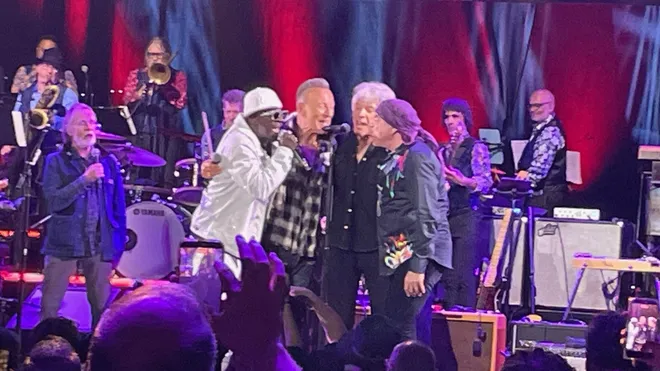
Chuck D, Flavor Flav, and DJ Johnny Juice transformed the arena with a ferocious performance of “Fight the Power,” reminding everyone that hip-hop occupies a vital and permanent place within the American musical landscape. The performance felt every bit as urgent and relevant as it did when the song first emerged decades ago.
The appearance also generated one of the evening’s most memorable moments of humor.
Repeated references to the house band as the E Street Band prompted Springsteen to jokingly announce that his legendary group had effectively been replaced. The playful exchange highlighted the relaxed atmosphere that permeated the evening despite the immense talent assembled on stage.
As impressive as the individual performances were, the true magic of the concert emerged during its closing stretch.
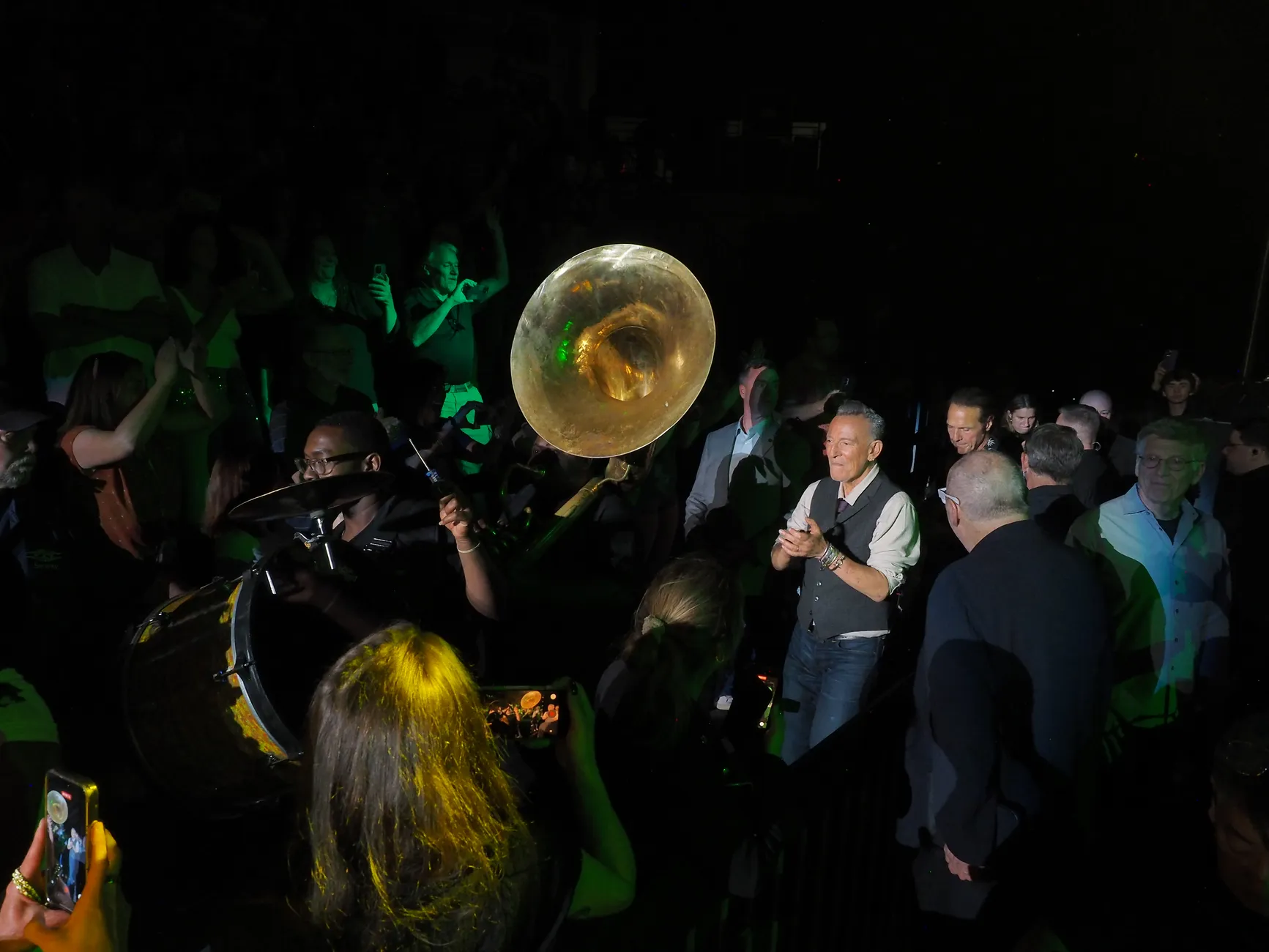
What began as a celebration of musical history transformed into something resembling a family reunion for American music itself. Artists from different genres, backgrounds, and generations gathered together, sharing songs that transcended stylistic boundaries.
Springsteen, Gary Clark Jr., Nils Lofgren, and Jimmie Vaughan united for a blistering performance of Bobby “Blue” Bland’s “Further On Up the Road,” creating a masterclass in guitar-driven American music. The energy continued to build with Eddie Floyd’s “Raise Your Hand,” bringing many of the night’s performers together in a communal celebration of rhythm and soul.
Then came the moment that many in attendance will remember for years.
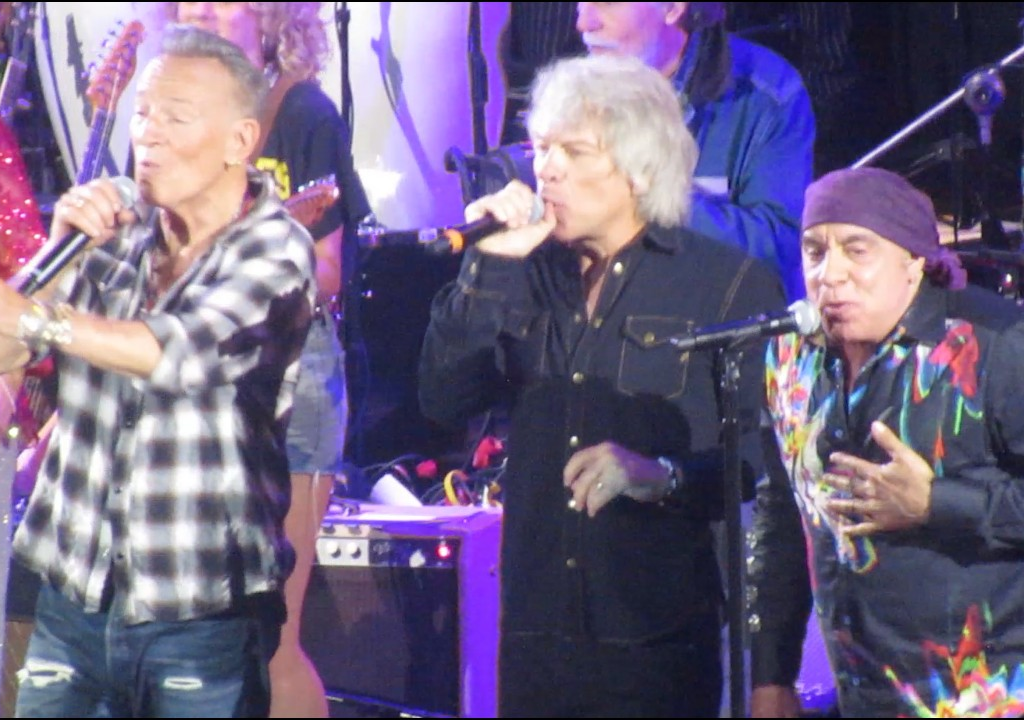
Springsteen, Van Zandt, Jon Bon Jovi, and fellow New Jersey music legends joined forces for a powerful rendition of “I Don’t Want to Go Home.” More than a song, it felt like a statement about New Jersey’s enduring place within American music history. With Southside Johnny’s classic anthem serving as the foundation, the performance united multiple generations of Jersey musicians around a song deeply connected to the state’s musical identity.
The inclusion of Flavor Flav during the finale only reinforced the evening’s spirit of collaboration, proving that the boundaries between genres become meaningless when artists share a genuine respect for music itself.
The concert concluded with Springsteen alone on stage performing “Land of Hope and Dreams.”
The simplicity of the moment contrasted beautifully with the spectacle that preceded it. After hours of collaborative performances, legendary artists, and genre-spanning celebrations, the evening ended with a song that perfectly captured the event’s larger message. American music has always been about bringing people together. It has always been about telling stories, expressing hopes, confronting challenges, and finding common ground through shared experiences.
As Monmouth University prepares to officially open The Bruce Springsteen Center for American Music, these two extraordinary “Music America” concerts have already demonstrated why the institution matters. The center is not merely a museum dedicated to one artist. It is a place dedicated to preserving the story of American music itself, a story that continues to evolve every day.
For New Jersey, the significance is impossible to overstate. The state has produced Hall of Fame performers, groundbreaking songwriters, influential bands, and cultural movements that have shaped music around the world. The opening of the center places New Jersey firmly at the heart of preserving that legacy for future generations.
On a stage in West Long Branch, surrounded by icons from rock, soul, blues, folk, hip-hop, jazz, and Americana, that legacy was on full display. The music told the story. The audience witnessed it. And for one unforgettable evening, Monmouth University became the center of the American musical universe.