
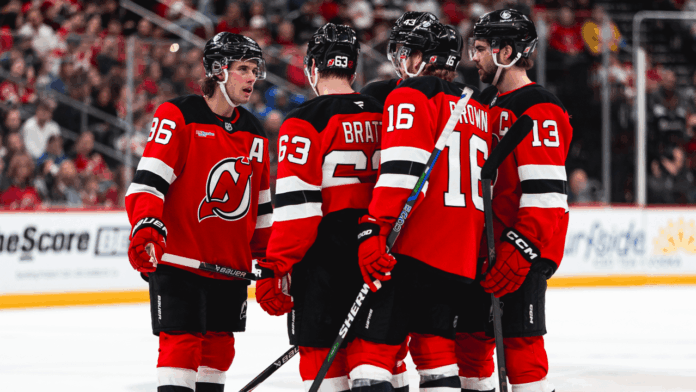

The New Jersey Devils enter the final stretch of the 2025–26 season with clarity, urgency, and a rapidly shifting organizational landscape. With just two games remaining on the schedule, the focus has already moved beyond standings and into something far more consequential: evaluation, accountability, and the blueprint for what comes next.
The reality is now official. Following their April 7 loss to Philadelphia, the Devils have been eliminated from Stanley Cup Playoff contention. It is a stark outcome for a team that entered the season with expectations of progression and consistency. Instead, the year has unfolded into a case study in missed opportunities, inconsistency, and structural questions that now demand answers at every level of the organization.
The immediate task is to close out the season with purpose. The Devils return home on April 12 to face the Ottawa Senators in what will serve as both their final game at Prudential Center and a symbolic moment for the fanbase. Marketed as “Jersey Appreciation Night,” the event carries added weight this year, as it represents a direct connection between a frustrated but loyal audience and a team that must now recalibrate. Two days later, the Devils will travel to Boston for their final game of the season against the Bruins, bringing an end to a campaign that never fully found its rhythm.
In the standings, the Devils sit in seventh place in the Metropolitan Division, a position that reflects not just where they are, but how far they are from where they intended to be. The numbers reinforce the narrative. This is a team that will fall short of the benchmarks typically required for postseason contention, with a likely negative goal differential underscoring the imbalance between offensive potential and defensive execution.
Yet, within this disappointing conclusion lies an opportunity—one that may ultimately define the organization’s trajectory more than the season itself.
The most immediate and visible shift has already taken place at the executive level. The departure of General Manager Tom Fitzgerald marks a turning point that extends beyond a single decision. It signals a willingness to reassess direction, leadership, and long-term strategy. With no interim GM formally installed, the current structure places increased responsibility on the remaining leadership group, including assistant general managers and key figures within the organization. This transitional period is not without risk, but it also creates space for decisive action.
On the ice, that action has already begun to take shape. The call-ups of goaltender Nico Daws and defenseman Topias Vilen represent more than routine roster adjustments—they are indicators of a philosophical shift toward evaluation and development. With the postseason no longer a factor, the remaining games become a controlled environment for testing players who may play significant roles in the near future.
Daws, in particular, represents a compelling case. While his numbers at the AHL level this season reflect the challenges faced by the Utica Comets as a whole, his previous NHL appearances have demonstrated a level of composure and effectiveness that warrants further examination. In limited action over the past two seasons, he has delivered strong performances, suggesting that his development curve may not be fully captured by traditional statistics. Giving him meaningful minutes in the final games is not simply a reward—it is a necessary step in determining his place within the organization’s goaltending hierarchy.
The broader goaltending situation remains one of the most pressing issues facing the Devils. The current tandem has shown flashes of reliability but has ultimately failed to provide the consistency required for sustained success. Performance trends throughout the season reveal a pattern of early promise followed by gradual decline, a trajectory that has contributed directly to the team’s inability to maintain momentum. As the offseason approaches, the organization must evaluate not only individual performance but the overall structure of its goaltending strategy.
On the defensive side, the introduction of Vilen offers a glimpse into the next layer of depth within the system. His steady presence in Utica, combined with positive underlying metrics, positions him as a player worth extended evaluation. The same logic applies to other young defensemen who have yet to receive NHL opportunities. With veteran players occupying significant minutes, the final games present a rare window to assess how these prospects perform against top-level competition.
The argument for expanding this evaluation extends beyond the blue line. Up front, the Devils have a collection of developing forwards whose potential remains largely untested at the NHL level. Players who have shown flashes of energy, physicality, and offensive instinct in limited roles should be given the opportunity to contribute in more meaningful situations. The current lineup, while familiar, has not produced the results required, making experimentation not only logical but necessary.
This approach is not about short-term gains. It is about information. Every shift, every matchup, and every in-game decision becomes part of a larger dataset that will inform offseason planning. Which players can handle increased responsibility? Which combinations generate chemistry? Which areas require external reinforcement? These are the questions that must be answered before the next season begins.
Injuries have also played a role in shaping the team’s late-season strategy. The decision to shut down Luke Hughes for a medical procedure reflects a broader emphasis on long-term health over short-term participation. With no playoff implications remaining, there is little value in risking further injury. This philosophy should extend across the roster, ensuring that players enter the offseason in the best possible condition to prepare for the demands ahead.
Amid these challenges, there are still moments of individual achievement that deserve recognition. Jack Hughes’ nomination for the King Clancy Memorial Trophy highlights his leadership and contributions beyond the ice, reinforcing the idea that the organization’s core still possesses both talent and character. Performances like Jesper Bratt’s recent multi-goal effort against Detroit serve as reminders of the offensive capability that remains within the roster, even in a difficult season.
What emerges from this moment is a clear narrative: the Devils are at a crossroads. The foundation is not broken, but it is incomplete. The talent is present, but the structure requires refinement. The final games of the season are not about salvaging standings—they are about setting the tone for what comes next.
For fans and observers, the focus now shifts toward the offseason, where decisions made in the coming months will shape the trajectory of the franchise. The search for a new general manager, the evaluation of roster composition, and the integration of young talent will all play critical roles in determining whether this season becomes a temporary setback or a turning point.
As the Devils take the ice for their final home game and prepare for the closing chapter in Boston, the message is clear. The season may be ending, but the real work is just beginning.
For continued coverage, analysis, and updates on the team’s direction, developments, and future outlook, follow the latest through Explore New Jersey New Jersey Devils, where the conversation around this pivotal moment continues to unfold.
















