
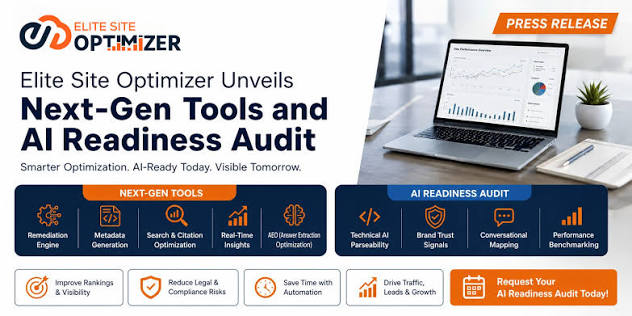

Elite Site Optimizer has officially launched its new AI Tools Suite and AI Readiness Audit, marking a genuinely significant shift in how the company approaches digital marketing, moving beyond standard search engine optimization and directly into the emerging world of AI search discovery. The launch reflects a broader industry recognition that the way people find information online is changing fundamentally, and the company, headquartered in East Brunswick, is positioning itself squarely at the front of that transition.
The core purpose behind the new suite involves helping corporate websites get properly recognized, synthesized, and directly cited by conversational AI engines like ChatGPT, Gemini, Claude, and Perplexity. That focus addresses a genuine structural shift in how users actually search for information today. Rather than clicking through a traditional list of blue links returned by a Google search, an increasing share of users now rely on AI engines that scan the web directly and formulate a single, synthesized answer rather than pointing users toward a list of external websites to click through themselves. For businesses that built their entire digital marketing strategy around ranking highly in traditional search results, that shift represents a genuinely significant challenge, since ranking well in classic search no longer guarantees that an AI engine will actually reference or cite that business when answering a related question.
To address that gap, Elite Site Optimizer’s new tools focus heavily on two related but distinct disciplines shaping this emerging search landscape. Answer Engine Optimization involves structuring a website’s content specifically so that AI systems can easily parse it and use it to directly answer a user’s question, rather than requiring the AI to guess at meaning from poorly organized or ambiguous text. Generative Engine Optimization takes that concept a step further, focusing specifically on optimizing a brand’s overall visibility so that an AI system actually selects and explicitly cites that company as a genuine authority source rather than pulling information from a competitor instead.
The AI Tools Suite itself includes several distinct capabilities built to help businesses actually measure and improve their standing within this new search paradigm. The platform can simulate AI crawlers, scanning a company’s domain to mimic exactly how large language models actually read and process a website’s text, moving considerably beyond the basic page speed and keyword density metrics that defined an earlier generation of SEO tools. It also calculates what the company calls AI Share of Voice, measuring how frequently a given brand or its specific products get naturally referenced across major AI platforms compared directly to its closest competitors, giving businesses a genuinely quantifiable benchmark for how visible they actually are within AI generated answers.
Beyond those measurement tools, the suite also identifies specific formatting blockers that might be preventing a company’s content from getting properly recognized by AI systems in the first place, flagging technical issues like broken schema validation, unstructured formatting, or missing entity associations, any of which can cause an AI model to simply skip over a company’s content entirely rather than surfacing it as a source. Once those issues are identified, the platform generates a full readiness roadmap, delivering a customized readiness score alongside a downloadable PDF action plan that lays out exactly which content and technical fixes a business should prioritize to improve its standing within AI driven search results.
Taken together, Elite Site Optimizer’s new AI Tools Suite reflects a genuinely forward looking response to one of the more significant shifts reshaping digital marketing right now, the move away from a search landscape built entirely around ranking pages and toward one increasingly built around whether an AI system chooses to cite a business directly when answering a user’s question. For companies that have spent years optimizing purely for traditional search engine rankings, tools like this offer a genuinely practical starting point for understanding exactly where they stand within this new AI driven search environment, and precisely what steps they might need to take to remain visible as more of their potential customers begin relying on conversational AI systems rather than a traditional search results page.
















