
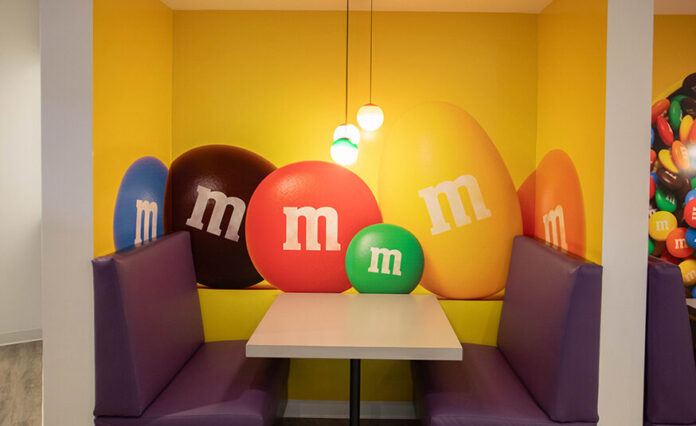

Mars Wrigley is winding down its U.S. headquarters presence in Newark as part of a broader corporate strategy to consolidate key functions in Chicago, marking the latest in a genuinely significant string of major companies scaling back their New Jersey footprint. In a July 2026 filing with the New Jersey Department of Labor and Workforce Development, the candy and snack giant confirmed it will eliminate 307 positions at its Newark base by mid-October, closing what the company refers to as its Newark Market Hub entirely by December 2027.
The timing of the announcement carries a genuine sense of irony given Mars’s recent public investment elsewhere in the state. The downsizing comes just a few months after Mars announced a $100 million expansion of its global snacking headquarters in Chicago, a move the company says is expected to add more than 600 jobs to that region. In a statement to NJBIZ, a Mars spokesperson explained that following a comprehensive review of the company’s Mars Snacking North American office footprint, the decision was made to sunset the Newark Market Hub consistent with the previously announced move to Chicago, framing the change as part of a broader strategy to position Mars Snacking for long term growth while strengthening operations across key locations in North America. The spokesperson acknowledged the impact on Newark associates directly, stating the company remains committed to supporting affected employees through the transition, including offering relocation opportunities and support where appropriate.
Mars’s relationship with Newark actually runs considerably deeper than this latest chapter suggests. The company got its start in Newark during World War II before relocating operations to Hackettstown in 1958. It returned to its Newark roots six years ago, drawn back in part by a ten year, $31.5 million tax credit awarded through the New Jersey Economic Development Authority, taking office space at Ironside Newark, a mixed use complex at 110 Edison Place owned by locally based Edison Properties. The company separately received a $1.15 million tax credit to renovate and expand its Hackettstown offices and factory. Between the two locations, Mars currently employs roughly 500 associates in Newark alongside approximately 1,000 workers in Hackettstown.
That Hackettstown operation appears set to remain firmly part of Mars’s long term New Jersey presence even as Newark winds down. Back on March 20, 2024, Mars hosted a ribbon cutting ceremony celebrating more than $70 million in investment at its Hackettstown site, including the opening of a Research and Development Innovation Studio alongside manufacturing efficiency upgrades and food safety advancements at the factory itself. A company spokesperson reiterated that commitment directly, noting Mars’s rich history in the state and affirming the company remains committed to New Jersey, continuing to invest in its ongoing innovation and manufacturing work in Hackettstown even as its Newark corporate presence winds down. The company also emphasized it remains focused on serving customers and consumers without disruption throughout the broader transition. Representatives for the New Jersey Economic Development Authority and Newark Mayor Ras Baraka did not immediately respond to requests for comment on the Newark closure.
Mars itself operates as a genuinely massive global enterprise, generating approximately $55 billion in annual sales across a portfolio spanning snacking, food, and pet care products, including household brands like M&M’s, Snickers, Twix, Milky Way, Skittles, Ben’s Original, Dove, Extra, Pedigree, Royal Canin, Whiskas, and Cesar. The family owned corporation also operates a substantial pet health division encompassing veterinary hospitals and specialty care providers, including Banfield Pet Hospital, BluePearl, VCA, and AniCura. Last year, Mars completed its roughly $36 billion acquisition of snack maker Kellanova, a mega deal that added brands including Pringles, Cheez-It, and Pop-Tarts to its already substantial lineup.
Mars’s Newark drawdown arrives amid a genuinely broader pattern of major corporations reducing or fully relocating their New Jersey operations. According to a June 2026 report from Focus NJ, a series of recent corporate relocations and structural downsizings has shifted more than 7,200 jobs out of the state altogether. Among the most prominent complete headquarters and legal relocations, Samsung Electronics America is moving its U.S. headquarters from Englewood Cliffs to Plano, Texas, affecting roughly 1,000 workers, while ExxonMobil severed its 140 year legal tie to New Jersey after shareholders voted to move the company’s state of incorporation to Texas entirely.
Beyond those full exits, a separate Focus NJ analysis, titled Missed Opportunities, documents a wider group of corporations that have downsized their New Jersey presence specifically to expand operations in states they consider more business friendly or better suited to specialized growth. Bristol Myers Squibb transferred roughly 1,700 jobs from New Jersey to Massachusetts, while Verizon relocated 1,319 positions to expansion hubs in Texas and New York City. Eos Energy Enterprise shifted 1,000 clean energy manufacturing and corporate jobs to Pennsylvania, and Hertz Global Holdings moved 700 operational and corporate positions to Florida. Johnson & Johnson relocated 620 roles away from its New Jersey footprint toward North Carolina and Pennsylvania, Walmart shifted 481 corporate management and digital jobs to its primary headquarters in Arkansas, and Honeywell International moved 200 jobs to its main corporate campus in North Carolina.
Beyond these large scale relocations, state WARN notices filed with the New Jersey Department of Labor point to a broader wave of local downsizing and layoffs as well, with companies including Spirit Airlines, Danone North America, and Prudential Insurance all substantially scaling back their workforce presence or closing regional hubs within the state. Taken together, Mars’s Newark exit fits into a genuinely significant statewide pattern of corporate contraction, one New Jersey officials and business advocacy groups are likely to continue scrutinizing closely as they weigh what policy responses, if any, might help slow the pace of departures affecting the state’s job base.
















